
During my research into the history of my missionary relatives, I have found a few telegrams. Whenever there was a need for speedy information and one didn’t trust the postal service to deliver in time, the solution was to send a telegram. Letters could take a month to arrive from Europe to China – sometimes more. My great grandfather Robert was one of the missionaries trusted with operating the telegraph and receiving telegrams for fellow missionaries in the region.
Until recently I had not thought about how this service was carried through. I recently got in touch with a cousin of my late father, Kurt. He was born in China because his father (my grandfather’s brother) also became a missionary as an adult. Kurt is a delight to talk with. During one conversation he told me he had this book.
“It’s a code book,” he said, and I was immediately intrigued. He left the phone for a bit to go get it and came back a bit out of breath.
“They used it to send telegrams. As if they were spies,” he almost whispered. I felt immediately drawn into the past and the life of these pioneers, giving their all for their calling.
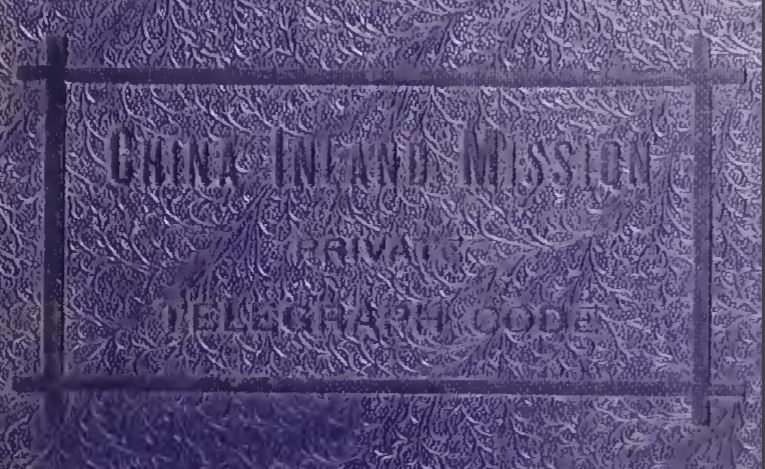
Kurt had kept the book from his father. It’s called “China Inland Mission private telegraph code” and was used not only by C.I.M. missionaries, but also by those sent out by other missionary societies like the one Kurts’ father and my other relatives were with.
Ever since 1899 C.I.M. had been using some sort of code to send messages – but it had been a pretty limited one. The need for a more comprehensive code became apparent as the number of missionaries grew and communication became even more important. The work of compiling such a code, based on telegrams sent back and forth since 1899, was undertaken in 1904 by Mr. F. H. Neale.
Kurt read some of the contents to me over the phone. His voice corresponded so well with the material I felt a chill running down my spine. It is a very interesting compilation of phrases that say a lot about what the main concerns for the missionaries were back then.
What about code 31: “Must finish before winter sets in, or it will have to stand over until spring.”
Or code 90 “Have advised the withdrawal of missionaries from interior stations.”
I started searching for the book online and found that it had been scanned and was possible to read.
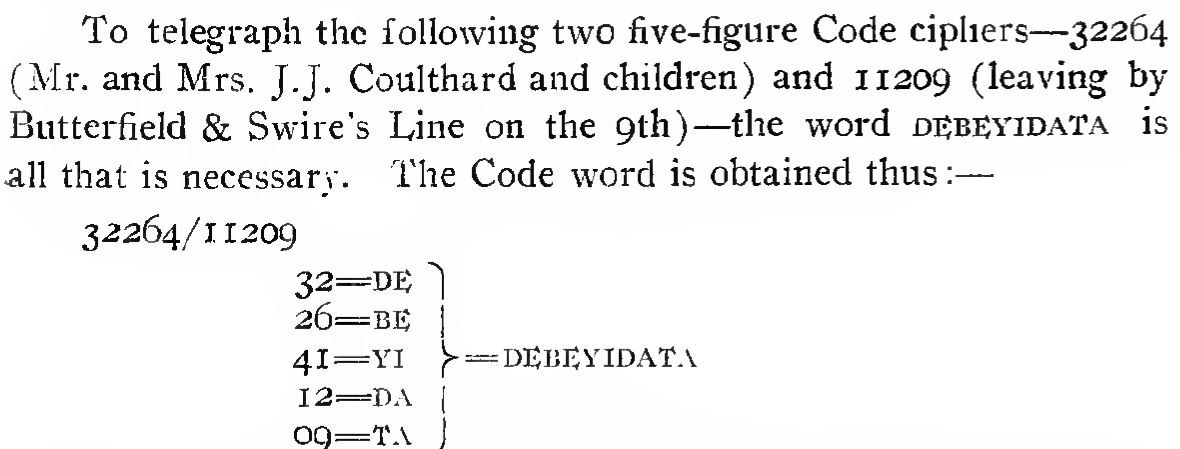
The code book starts out with a few pages of instructions on how to use it and how the number combinations work. The book in itself must have been very important to have in order to dechiper the messages – noone could ever guess the sentences behind those numbers, I’m sure.
I don’t know how many missionaries were in possession of the code book or how many telegraph stations there were in China at the time – if anyone knows more about this, please share.
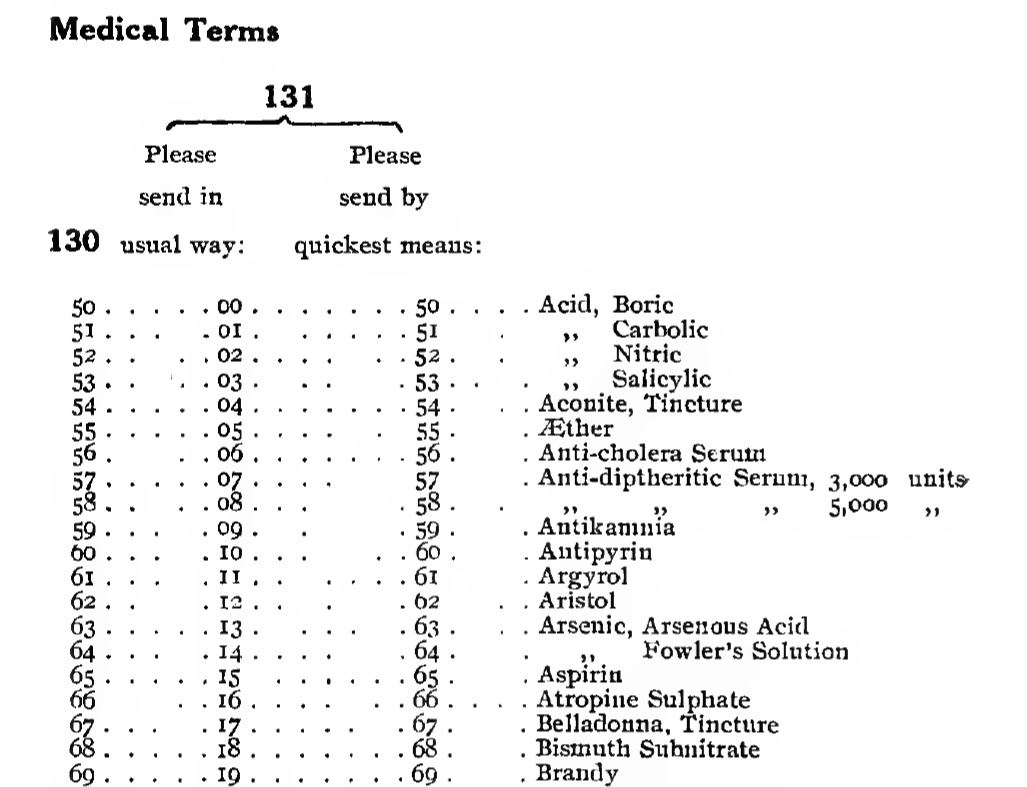
As many missionaries were involved with medical issues and were sometimes the last resort for both other missionaries and the local population in matters of medicine, I wanted to see what medical terms they found useful.
And well, requesting to send anything form arsenic and aspirin to brandy or opium tincture was apparently common.
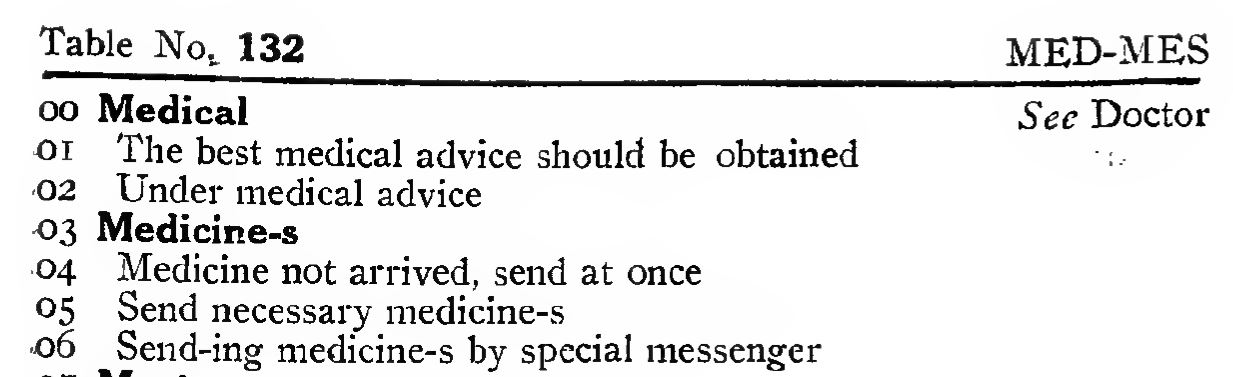
Sometimes, one had to send telegrams if the medicine did not arrive or if one intended to send medicines by special messenger.
And of course, misunderstandings happened. For instance, I find this phrase very telling: “Mistake has been made but through no fault of ours; make the best arrangements you can.”
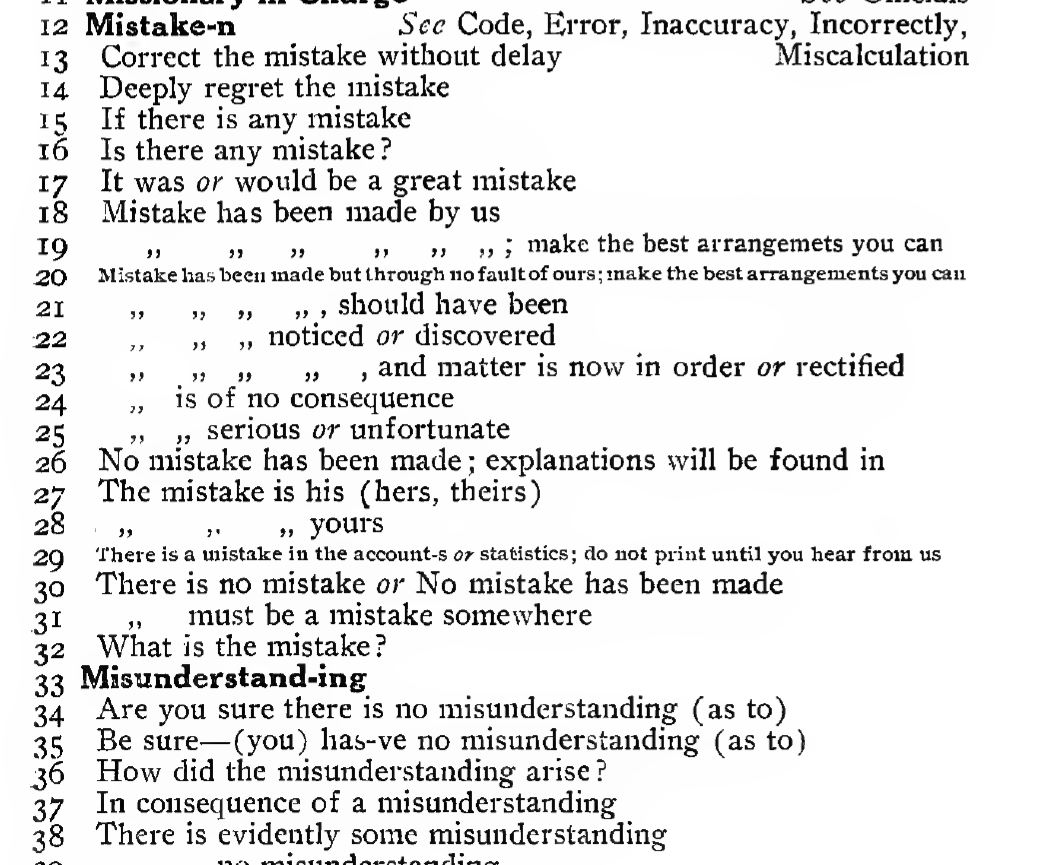
I can imagine this section with different phrases about mistakes and misunderstandings was frequently used… or what do you think?
 Thérèse Amnéus
How fascinating! Was the primary purpose of the codes to allow for messages longer than the telegram format allowed for?
LikeLiked by 1 person
😊 That might have been the case, Liz. Perhaps it was quicker to write in code as well. And maybe there were also security issues, as the missionaries were not well seen at all times in China. The code book does not reveal the reasons as to why they needed it, only that there was a demand. I’ll try to find out more 😊
LikeLiked by 1 person
I would be interested in learning more, Therese. What you’ve presented so far is fascinating!
LikeLiked by 1 person
So happy you find it interesting, Liz! It seems the code was mainly put together in order to “effect greater efficiency and economy” in telegraphing. Looking through it I also find codes for personal names frequently used – most of them connected to different missionary societies present in China at the time. The well renowned Hudson Taylor and his successor D.E. Hoste – both directors of the C.I.M are represented of course – as is my great grandfather Robert and of course Olga. It seems married missionary women were usually sorted under the names of their husbands, but with an additition of a “Mrs.” in code. Olga was not married when the first edition of the book was printed, and the code was not corrected in the updated version of 1913, when her husband Nils had been in China for 4 years – which is probably why she is in it but not Nils. The more one reads the more interesting it gets!!
LikeLiked by 2 people
Thank you for seeking out and sharing the additional information, Therese. I thought that “efficiency and economy” must have played a large part in it. Interesting how Olga came to be listed but not Nils.
LikeLiked by 2 people
😊👍
LikeLiked by 2 people
I love this story! The code book is such a treat, especially the misunderstandings section – I mean how many types of misunderstanding can there be??
LikeLiked by 1 person
😄 Yes – fascinating that they were so detailed concerning mistakes and misunderstandings – and who to blame for it 😉 Perhaps they felt there was little room for making mistakes and feared being transferred or asked to go back home if their work was not up to standard…
LikeLiked by 1 person
That makes sense. It’s humbling how tenacious and organised the missionaries were all those years ago.
LikeLiked by 2 people
That is a very Good description, Louise – tenacious and organised! I suppose those who weren’t, couldn’t have lasted out there for long… 😬
LikeLiked by 1 person
Wow! This is amazing! This is from before I started following your blog, or I definitely would have responded to it. Knowing that even now, missionaries are not well received in China, I immediately thought that was the reason for the code book. They may have had to keep some of their activities a secret. 🤔
LikeLiked by 1 person
Thanks for checking out even some older posts and commenting! As all that I’m writing about is history anyway, the posts are quite timeless 😄. I sometimes look through the blog to remember what I have already written about or refresh on some research already done. I find it interesting to see how what I have learned during writing the blog also makes me understand previous themes an queries differently. The other week I went back and edited a post where I found out I had been sadly mistaken about the persons in a blurry photo. I am happy to have become better at recognizing the missionaries in China, but sad that the photo was not of my great great grandparents, that I first suspected. 👉https://thereseamneus.wordpress.com/2019/09/30/photos-revealing-photos-lost/ Quite funny though, how one reads into a picture what one would like to see, don’t you think!? 😄
LikeLike