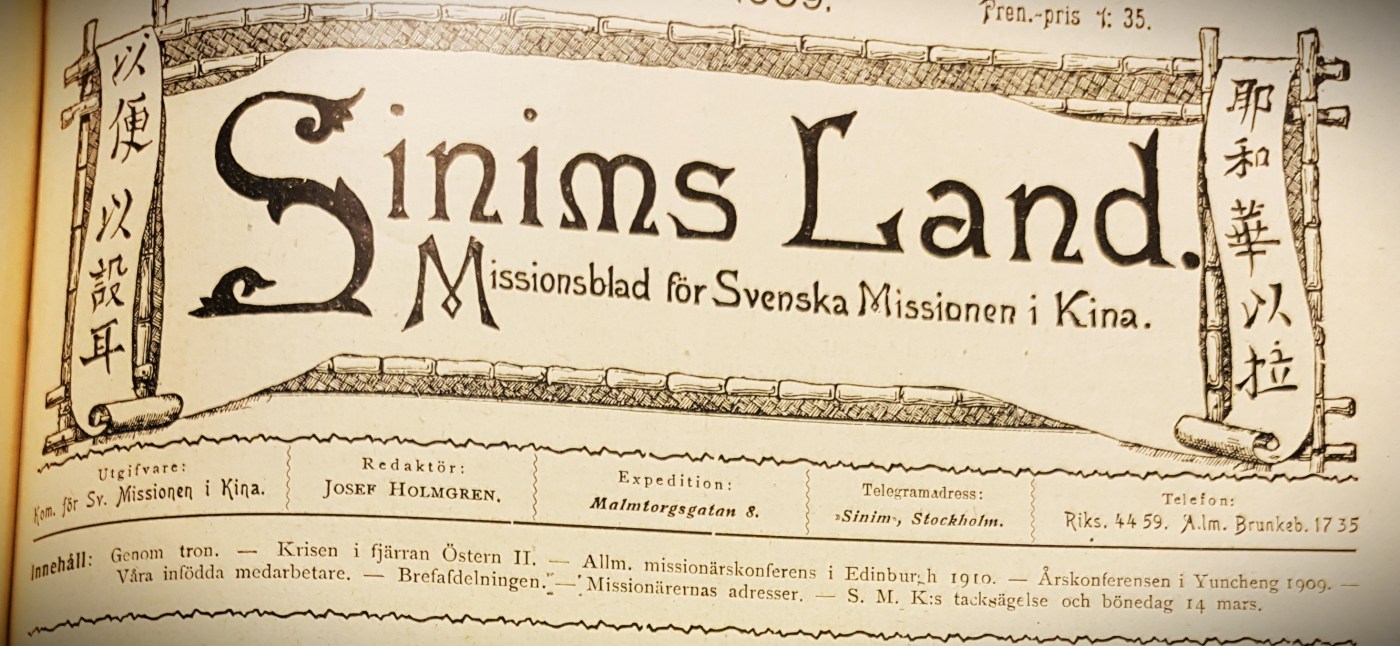
Throughout my research, one particularly important source has helped me make sense of the adventures my great-grandparents experienced during their time as missionaries in China.
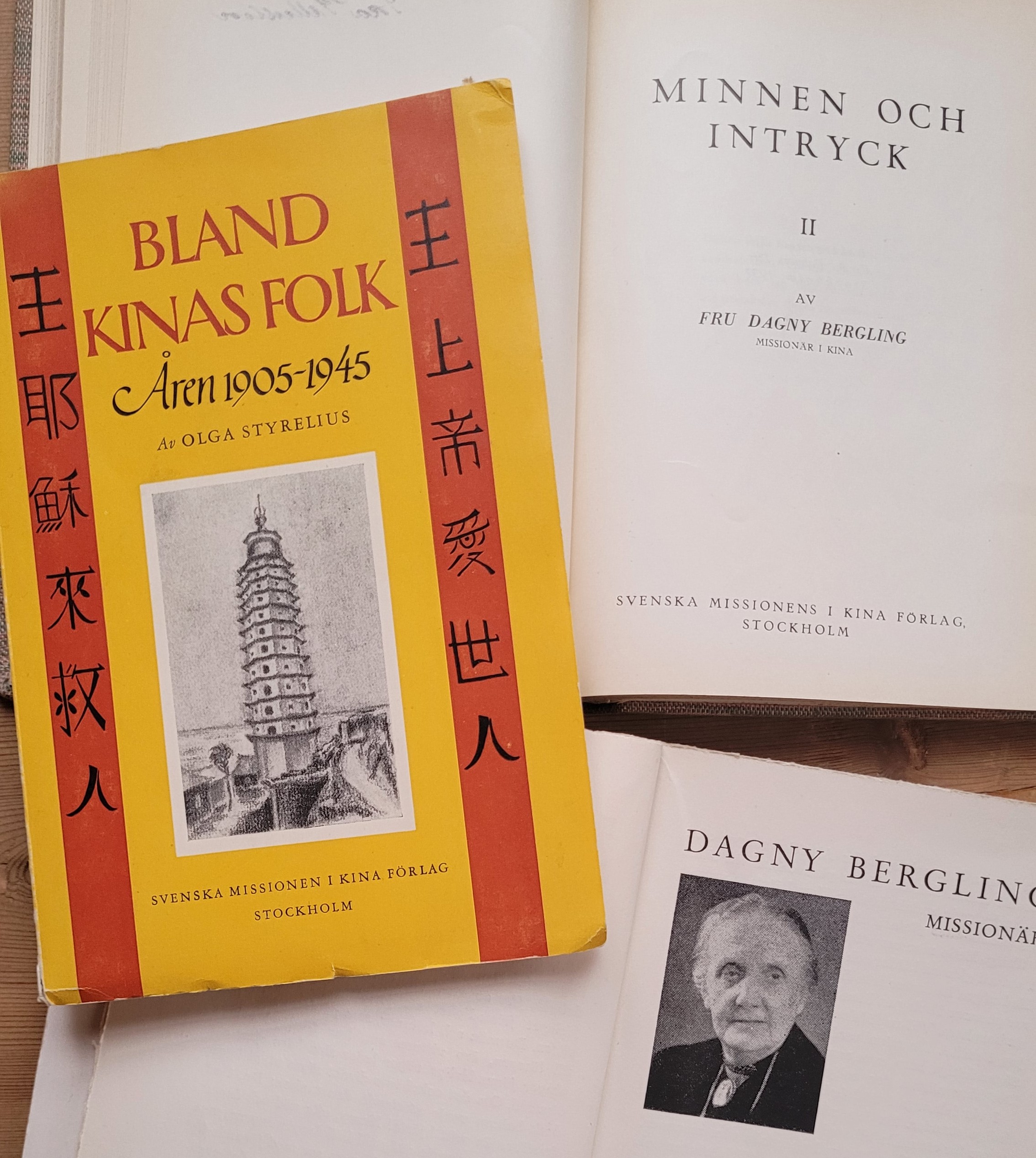
The Swedish missionary magazine in China – Sinims Land – first published in 1896, is filled with articles from Robert, Dagny, Nils and Olga. Aside from their contributions, I can also read articles and messages from their colleagues and friends, not seldom mentioning them and their work from another angle. Both Dagny and Olga also wrote their own books about their experiences in China – possibly drawing from the many articles they had already written in the mission paper. Sinims Land is a great source for me to go back to, in order to understand at what time things happened, what the context was, and how other missionaries reported about the same, or similar events.
In 1896, Robert and Dagny had been missionaries in China for three years already. I have found their stories up until then in different accounts, such as application letters to the mission and chapters in books telling about their youth and path to the mission. I have found a very early letter from Robert to the mission in 1892, when he is in London, preparing to go out as a missionary. There are also letters from 1894-1896, where he also describes his engagment to Dagny. But, thanks to Sinims Land, there is a continuity and an ease to the research that would not have been there otherwise.
A subscription to the monthly mission paper Sinims Land in 1896 cost 1 SEK and the editorial staff explained that the purpose of the paper was ”to awaken the interest for the mission, especially that by the Swedish Mission in China”, where the sole purpose shall be to elevate God’s work; connect the missionaries on the field to the friends of the mission in Sweden; discuss matters of interest also from other missionary fields; if space permits – convey such thruths from God that can foster a true interest for the mission and a deepening of the spiritual life.”
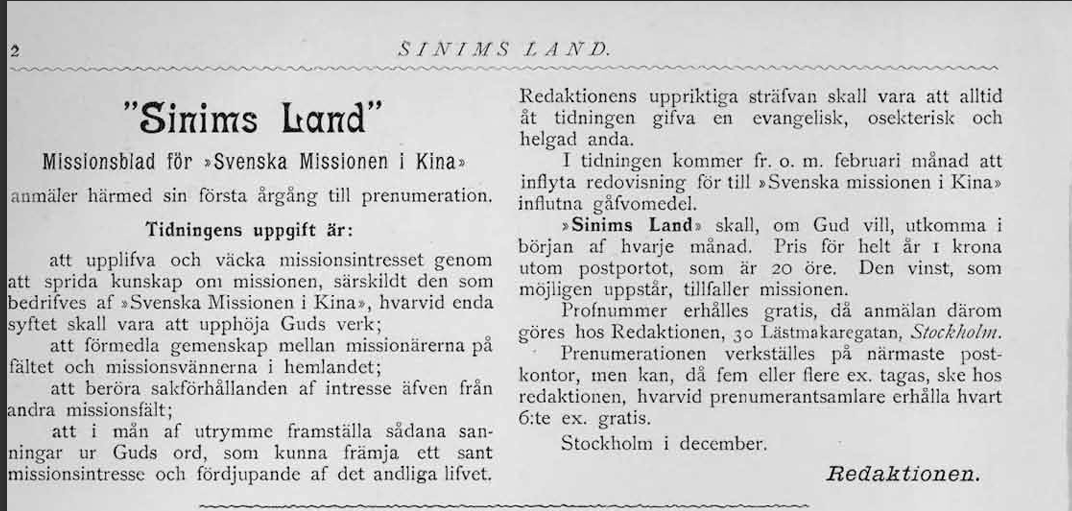
In the first edition, I found an entry about my great grandfather Robert. It was a note from the previous year, that the founder of the mission Mr Erik Folke shared from Yuncheng on August 9th, 1895.
“Bergling will accompany me next week to Hancheng. They hope to stay with Mr. Connell in Ho-tsin, a town very close to Han-ch’eng. We hope we will succeed in renting a house for them. The inhabitants of Hancheng are very hostile, and our brothers and sisters are in great need of many prayers.”
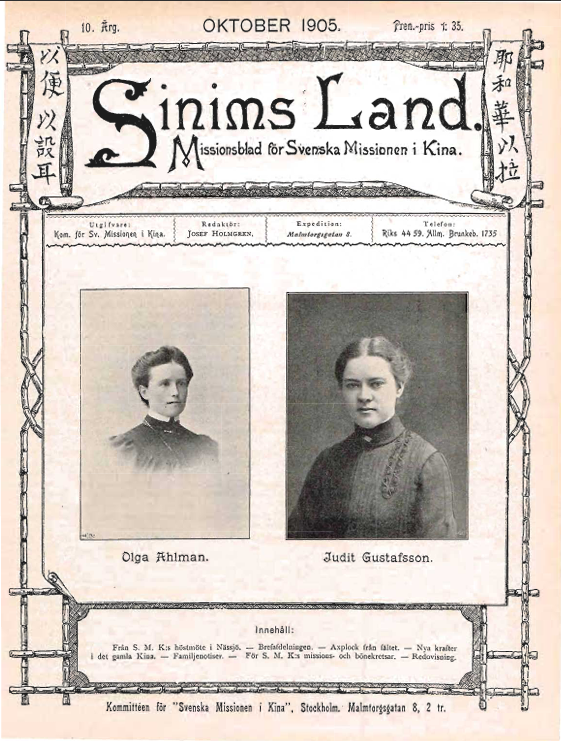
Olga arrived in China as a missionary in 1905. She and another female missionary were honored with the front page of Sinims Land.
Nils, who first emigrated from Sweden to America – only to find his calling for China there – arrived as a missionary in 1910. The first entry about him, that I have found, is from February 1911. A colleague, Mr August Berg, mentions the following from Tungchow, where Nils was stationed:
”We now have quite a large congregation and Hugo and Maria Linder have more work than they can handle. They will soon need back-up. Our newly arrived brother Nils Svensson* is battling with the language and had his first exam during my visit in Tungchow.”
* before Nils and Olga changed their surname to Styrelius, they bore the name Svensson.
A family paper
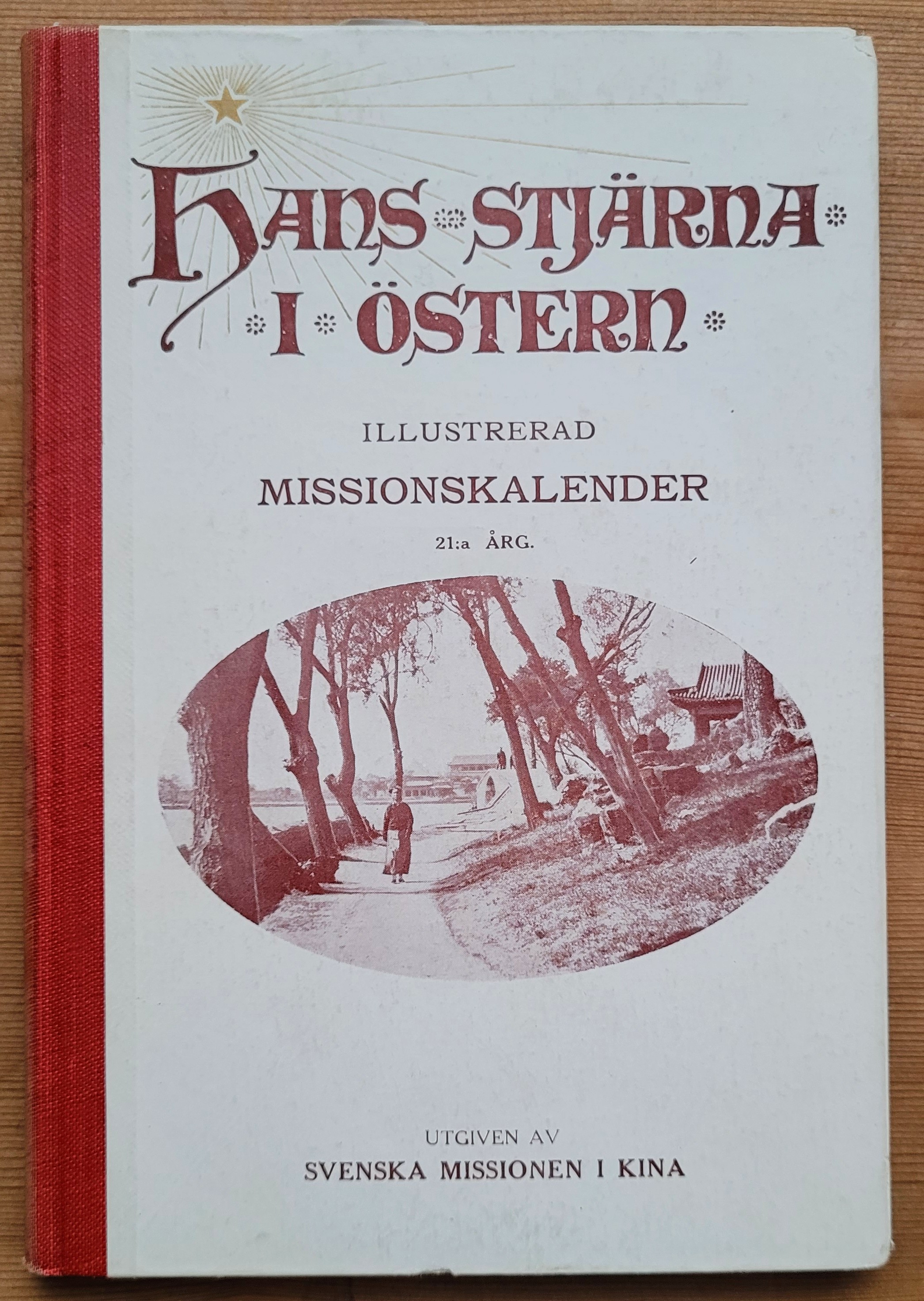
Olga and Dagny not only wrote articles about the missionary work but also contributed to a column titled “To Our Little Friends of China.” In this column, they shared child-friendly stories with moral lessons, aiming to entertain the children of fellow missionaries and their supporters back home. These stories also served to educate and inspire, nurturing a sense of connection and commitment to the mission’s cause in the next generation. It seems to have been something that mainly Dagny took upon herself, but several columns under this headline are also written by Olga. Dagny also wrote these kinds of stories for children in the yearly calendar “His Star in the East”, that could be ordered from the mission in time for Christmas every year. The calendar contained essays by the missionaries in the field and Dagny often concentrated on the younger generation and wrote stories that could be read aloud in Sunday school.
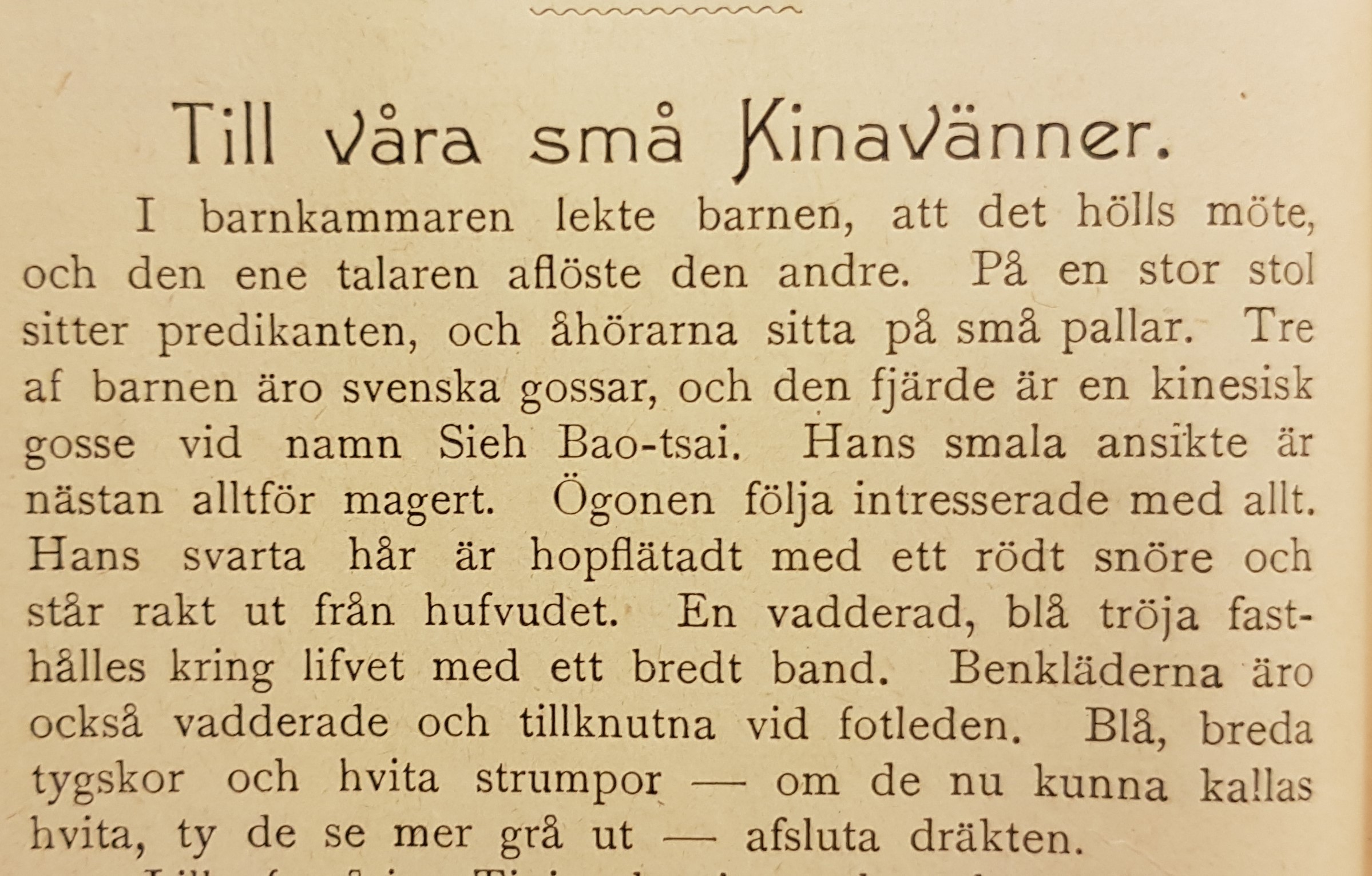
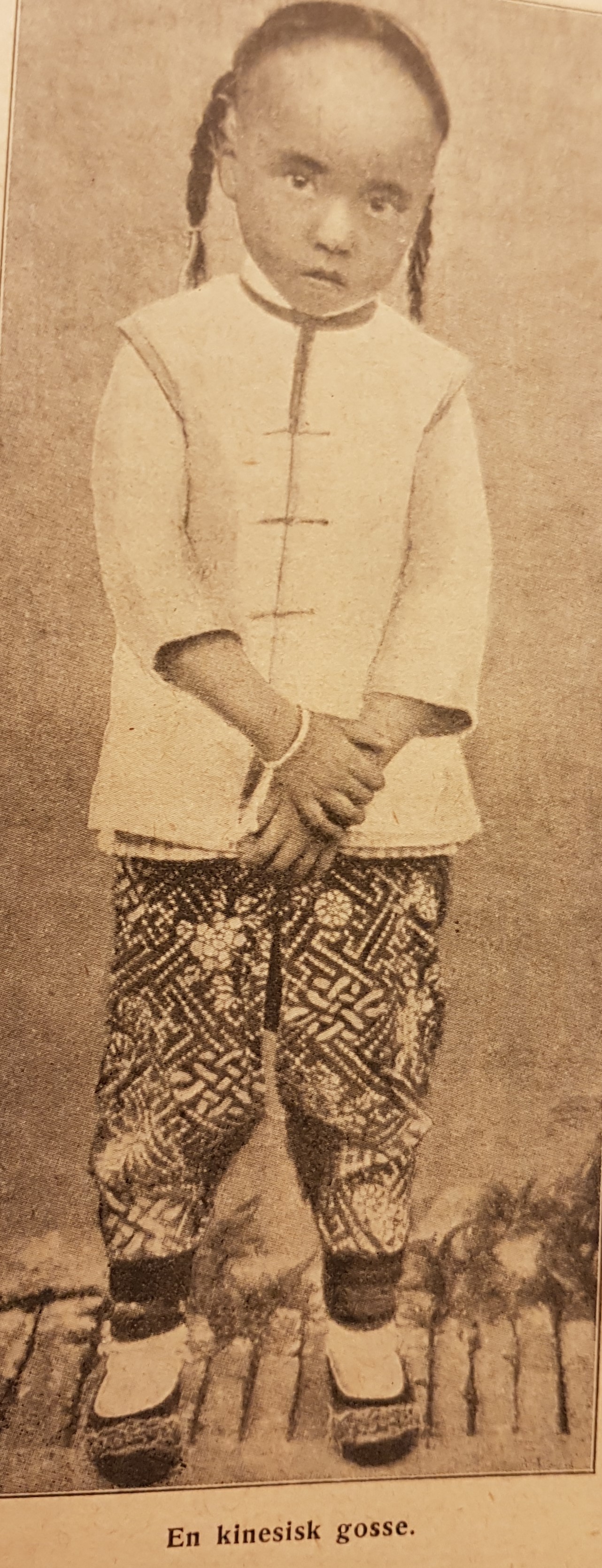
In Sinims Land from April 15, 1908, Dagny shares a story about a little Chinese boy named Bao-tsai, who was playing with the other children in the nursery. Dagny’s son, Rolland, was only five months old at the time, so the story takes place in January 1908. She writes that the children were pretending to hold a meeting, complete with speeches. Three of the children were Swedish, and the fourth was Sieh Bao-tsai.
“His thin face looks almost too delicate. His eyes watch everything happening around him with great interest. His black hair is braided with a red string, sticking straight out from his head. He wears a padded blue sweater, tied at the waist with a blue ribbon. His padded trousers are tied at the ankles, and his wide, blue canvas shoes are paired with white stockings to complete his outfit.
Little four-year-old Tinius climbs onto the speaker’s chair and suggests they sing a song in Chinese:
‘Jesus loves me, I know,
Because my Bible tells me so.’
Everyone joined in the song, except for little Rolland, who, being only five months old, could not sing but still watched everything with wide, curious eyes. After the song, Tinius proposed they pray. The little group prayed so earnestly that Dagny was sure their prayers reached our heavenly Father. Then, they sang another song, this time in Swedish:
‘I’m a little pilgrim moving on,
I’m a little pilgrim traveling home.
Walking on the narrow way,
That to heaven guides my stay,
I’m a little pilgrim traveling home.’
Our little Chinese friend, Bao-tsai, had heard this song so often that he had learned it by heart and was very proud of this achievement. Next, two-year-old Elias climbed onto the speaker’s chair. His speech was a mix of Swedish and Chinese, and he used the word “Li pai tang”, which means chapel or church. However, as his speech didn’t hold the audience’s attention, someone suggested Bao-tsai take a turn. Bao-tsai quickly picked up a book with Bible pictures, held it up, and said, ‘This is Abraham, who is going with his son Isaac to offer a sacrifice to God.’ He then told the story of Abraham, who was willing to sacrifice his son Isaac to God. While Bao-tsai spoke, little Elias grew restless and ran off to cause mischief with a pair of pliers. Thankfully, the pliers were taken away, and the meeting continued.
Dagny concluded the story with a heartfelt request:
“My purpose in sharing this is so that you, my friends, can get to know and pray for Bao-tsai. I saw his father only once, on his deathbed. His name was Sieh, and he had heard about the Savior from a Christian woman. When we came to pray for him, I’ll never forget the holy expression on his face as he lifted his hand to heaven and said, ‘Whether I live or die, I want to belong to God.’ I am sure the King of Kings heard him. Bao-tsai’s father went home to God. Since then, Bao-tsai’s mother has also given her heart to Jesus and is now part of the congregation in Hancheng. Two of his married sisters attend meetings as often as they can. The older sister, in particular, listens so intently that it seems as though she drinks in every word about Jesus.
After New Year, Bao-tsai will start school and continue his reading. His impoverished mother doesn’t have much to give him, but the Lord has provided so far. Sieh, his father, always hoped that his only son would grow up to be a preacher. Before, Bao-tsai used to steal small things whenever he could, but he has changed, and we haven’t caught him doing that anymore.
Dear young friends of China, won’t you pray for Bao-tsai? Pray that he will grow up to bring honor to God.
Yours, for China
Aunt Dagny“
I think that this recount of the children playing in the nursery says a lot about what life was like for the children at the mission station. Dagny was in the nursery, watching the children, tending to her smallest child. The games were related to the missionary work and the children played in both Chinese and Swedish. The missionaries helped many of the Chinese children in the villages with schooling. They had both boy- and girl-schools and mixed teaching the children to read and write with lessons about Christian faith.
Dagny saw the value in every person at the mission station and thus she wrote about the childrens’ interaction. This way she could connect with children at other mission stations as well as the children back in Sweden.
Creating a community
Sinims Land was a very important paper that served both as a channel for missionaries to report on their work, challenges, and achievements, keeping supporters in Sweden and other countries informed and as an encouragement for financial and material support so that the mission could keep going. By sharing stories about their everyday life and struggles, supporters at home understood they needed to help the missionaries in any way they could.
Apart from that, it was both entertaining and important for the missionaries to read about what was happening at the other stations around China. It fostered a sense of community that was crucial in these often difficult conditions.
The paper also helped bridge cultural gaps, making people at home understand the Chinese culture. In many ways, I would say that Sinims Land was kind of a lifeline for many missionaries. It really connected the missionaries to each other as well as to the broader mission community.
Sinims Land’s last issue was published in 1981, when the Swedish Mission to China and Japan and the Swedish Mongolian Mission merged and created the Evangelical East Asia Mission (Evangeliska Östasienmissionen, EÖM) in 1982. On EÖM’s website, most issues of Sinims Land can be found and browsed through. After 1982, EÖM published an updated mission paper and starting in 2013, they changed into a newsletter about the work the mission is doing today. The continued aim for the mission is to support social development projects and help with disaster relief, focusing on vulnerable groups such as children with disabilities, people affected by HIV/AIDS, the elderly in need of care, and those impacted by natural disasters.
With this post, I wanted to express my gratitude to the never tiring missionaries, who kept writing about their experiences during all those years and I am equally thankful to the Swedish Mission in China (now EÖM), that has kept up the good work, publishing accounts from the mission field. This has become such an invaluable source for us, who are interested in finding out more about the work our relatives carried out, or just know more about the life the missionaries led in China over a hundred years ago.


What an incredible source Sinims Land, a family historian’s dream!! I found the excerpts you shared today fascinating.
LikeLiked by 1 person
You said it, Liz! A family historian’s dream. That should have been the heading of this post 😀!
Thanks for commenting ❤️
LikeLiked by 1 person
You’re welcome, Therese!
LikeLiked by 1 person
As always, I love the photos you included in your post! I wonder if Sinims Land was distributed to churches in the US during that time? If so, maybe my great grandparents would have seen them. I know they were very active in their Swedish Lutheran church. 🤔
LikeLiked by 1 person
Thank you! I think the missionaries were pretty good at taking photos. Not only did they photograph special events, but they also caught every day life and regular people going about their business. The Chinese landscape is also something one sees a lot – though I feel that is where I would have liked the photos to be in colour 😀 It just looks like different shades of brown in those old papers.
About distribution to churches in America – I don’t know for sure, but I know Sinims Land was sent to the mission stations in China and it would not be a far fetch to assume it could also have found its way to America and at least the Swedish missionary congregations there. Also, Swedish missionaries in China came over to the US to talk about the mission in churches there – that’s how my great grandfather Nils came to be interested. And these missionaries could have brought Sinims Land with them to show what the mission in China entailed. But it would require some more research to be sure about this. I will see what I can find out! Wouldn’t it be great if your great grandparents would have read Sinims Land as well – and perhaps a story by one of my relatives 😁!
LikeLiked by 1 person
Yes that would be so cool if they did! I’m going to have to search the Ludington Daily News🤔I have found articles about Swedish missionaries coming to visit the Lutheran churches there, so maybe I’ll find something! 😀
LikeLiked by 1 person
That would be very cool! If they mention any names of Swedish missionaries, I might know who they are 🙂
LikeLiked by 1 person
What a fascinating and illustrative find! It’s wonderful when research pans out with something so full of insights not only into history but what it was like to live through. Dagny’s story about Bao-tsai totally captured my attention. 🙂
LikeLiked by 1 person
I am so happy you enjoyed it! Dagny was a good storyteller!
LikeLiked by 1 person
Yes! The photos were a great addition too.
LikeLiked by 1 person
Thank you! I am so pleased whenever I find photos – so much has changed since my great grandparents time, that photos add a lot of understanding to the information.
LikeLiked by 1 person