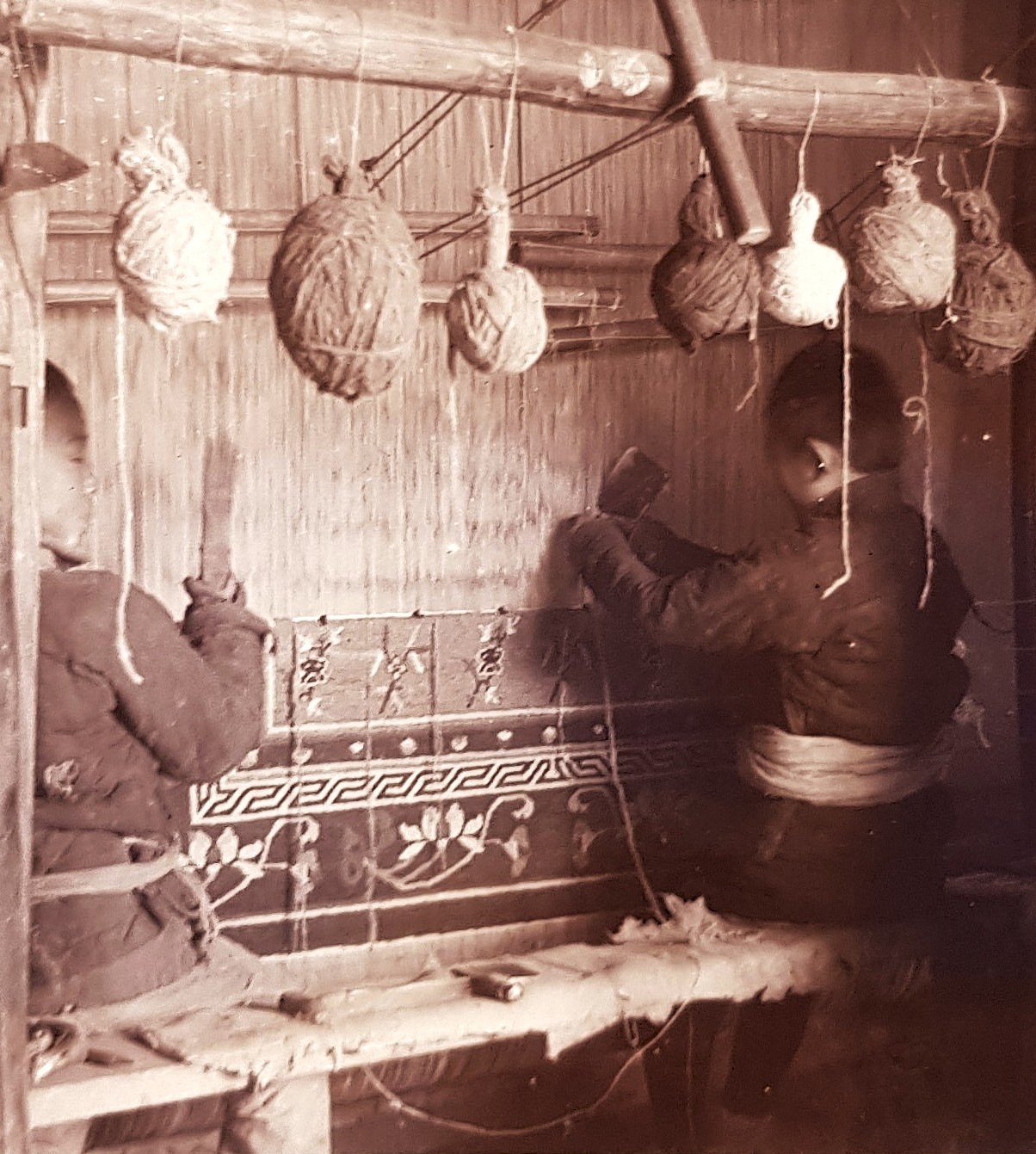
As many of my blog posts testify, the missionaries in China did not only preach and teach Christianity, but also worked with various forms of education and healthcare. Above all, they started many boys’ and girls’ schools for the children in their areas of outreach, and opium asylums were common in regions where many were addicted to the drug. The withdrawal from opium often went hand in hand with an introduction to Christianity. As patients were weaned off the drug, they could begin attending church services – and in this way, many Chinese people became Christians as they also became drug-free.
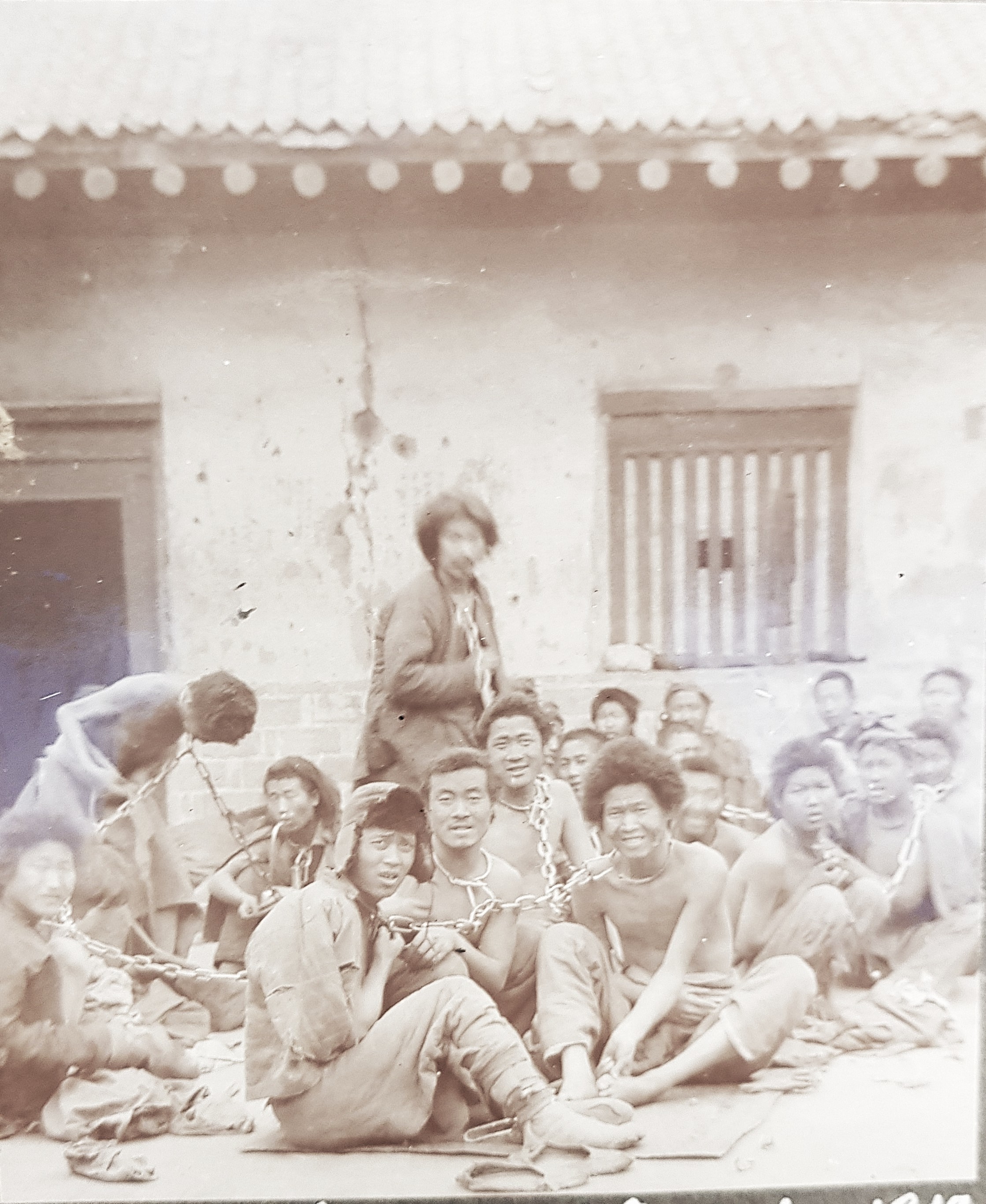
My great-grandfather Robert Bergling also initiated various projects such as the building of bridges, prison ministry, and he even started an industrial school where carpets were woven and later sold – including in Sweden
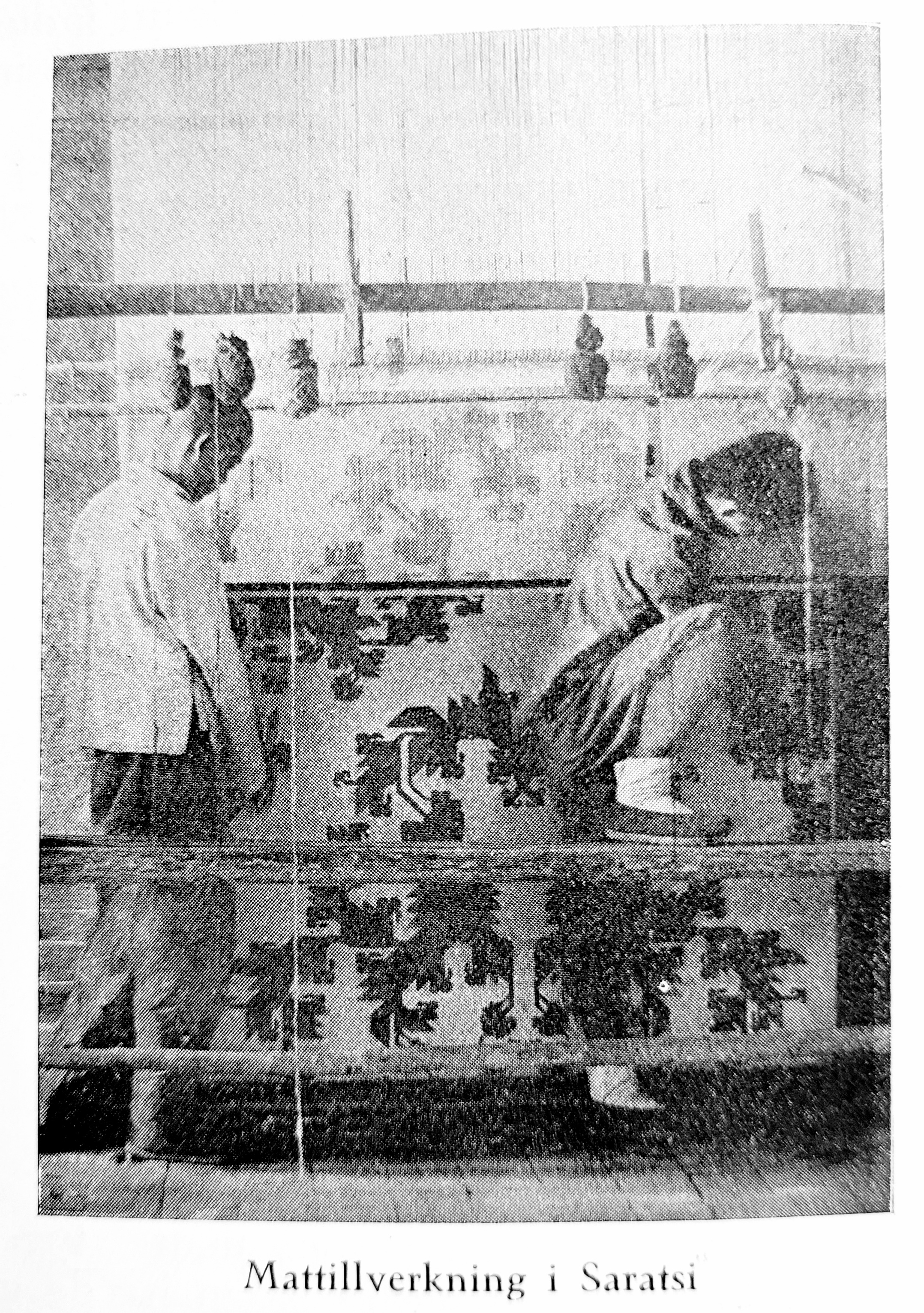
In the book Outside the Wall, published by the Swedish Alliance Mission in 1937, an industrial school established in Saratsi (located on the Suiyuan plain, north of the Yellow River) is described. It was children from the mission’s orphanage and boys’ school who, by moving on to the industrial school, could be kept within the Christian faith while also learning a trade.
The Alliance Mission had observed that a large amount of wool was being exported from the Saratsi area abroad, and it was thought that by producing carpets, ribbons, and woven fabrics, the material could be refined and sold. According to the mission, the greatest “profit” was spiritual, but some income was also generated through sales.
When the young people had finished weaving for the day, they would listen to sermons in the evening, and the mission was able to baptize many of them – something that was regarded as a success. The mission also noted that all the carpets they had produced had been sold, and that the Swedish minister Wallenberg* had ordered a carpet measuring 15 by 12 meters. The responsible missionary for this industrial endeavour by the Swedish Alliance Mission was a missionary named Otto Öberg. He started the industrial school already in 1908.
When I checked the mission paper Sinim’s Land to find out if the Swedish Mission in China had started similar schools by the time of 1913, I found information that they were in the process of starting industrial schools in various locations. In a report from Midsummer’s Day 1913, it says that missionary Wester (I have referred to him in this article) traveled to Shanghai to search for craft masters for the industrial school.
“It is no easy task. He also intends to travel to Chi-kung to see if a suitable plot of land can be acquired, and to rest a little at the same time,” the article says.
Chi-kung must refer to Jigongshan or Rooster Mountain – where the Swedish school would later be located from 1918 onward. At the annual conference in Yuncheng in 1913, it was decided to begin industrial mission work specifically in Yuncheng.
Three years later, in 1916, Robert started the first industrial school by the Swedish Mission in China. But not in Yuncheng. Instead it was founded in Hoyang. The Hoyang region had suffered greatly from bandits who had looted and ravaged the area, so founding a school there was considered a major victory. But it was also easier for Robert, as he was stationed there at the time.
In my photo archive, I found the following photograph:
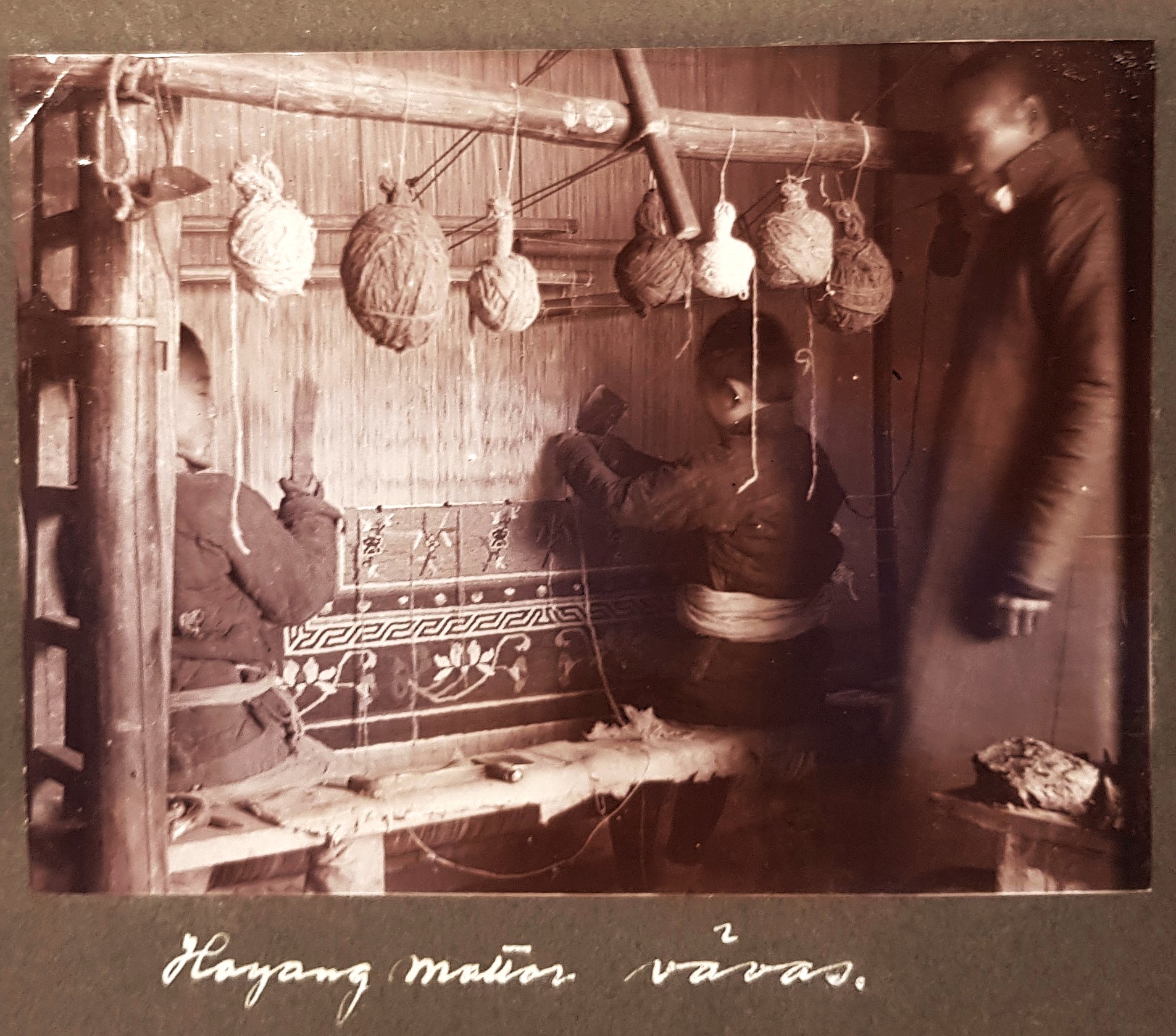
Here, a carpet is being woven in Hoyang, and the pattern strongly reminds me of one that my grandparents had in their large living room in Stockholm for many years. It was in various shades of blue, with some red in it, and it had fringes that my grandmother would carefully comb out at regular intervals At Christmastime she would give the fringe an especially thorough grooming. Perhaps it is the very same rug that is in this photo – wouldn’t that be great!?
In July 1916, the mission paper Sinim’s Land thus reports that a new branch of activity has been initiated:
“It is one of the long-cherished wishes of the Christians that has thus been fulfilled. The difficulty for them to place their children as apprentices with pagan craftsmen is exceedingly great. Yet no other option seemed open to them if the children were to have a future. With funds donated for this purpose, a weaving course has now been started, and three young men have been sent to a mission industrial school in another part of the country to learn the art of weaving. How this venture will turn out remains uncertain, mostly depending on whether there is a market for the products. The aim is to make the enterprise independent of foreign materials. The number of students has been eight.”
On the 1st of January 1917, a short account of the responsible missionaries is given in Sinims Land:
“Hoyang, 1916:
A large opium asylum had been founded, along with schools for girls and boys. An industrial school with a rug-weaving workshop was also in operation. Robert and Dagny Bergling, Ester Berg, and Emy Öhrlander were stationed there.”
The full story
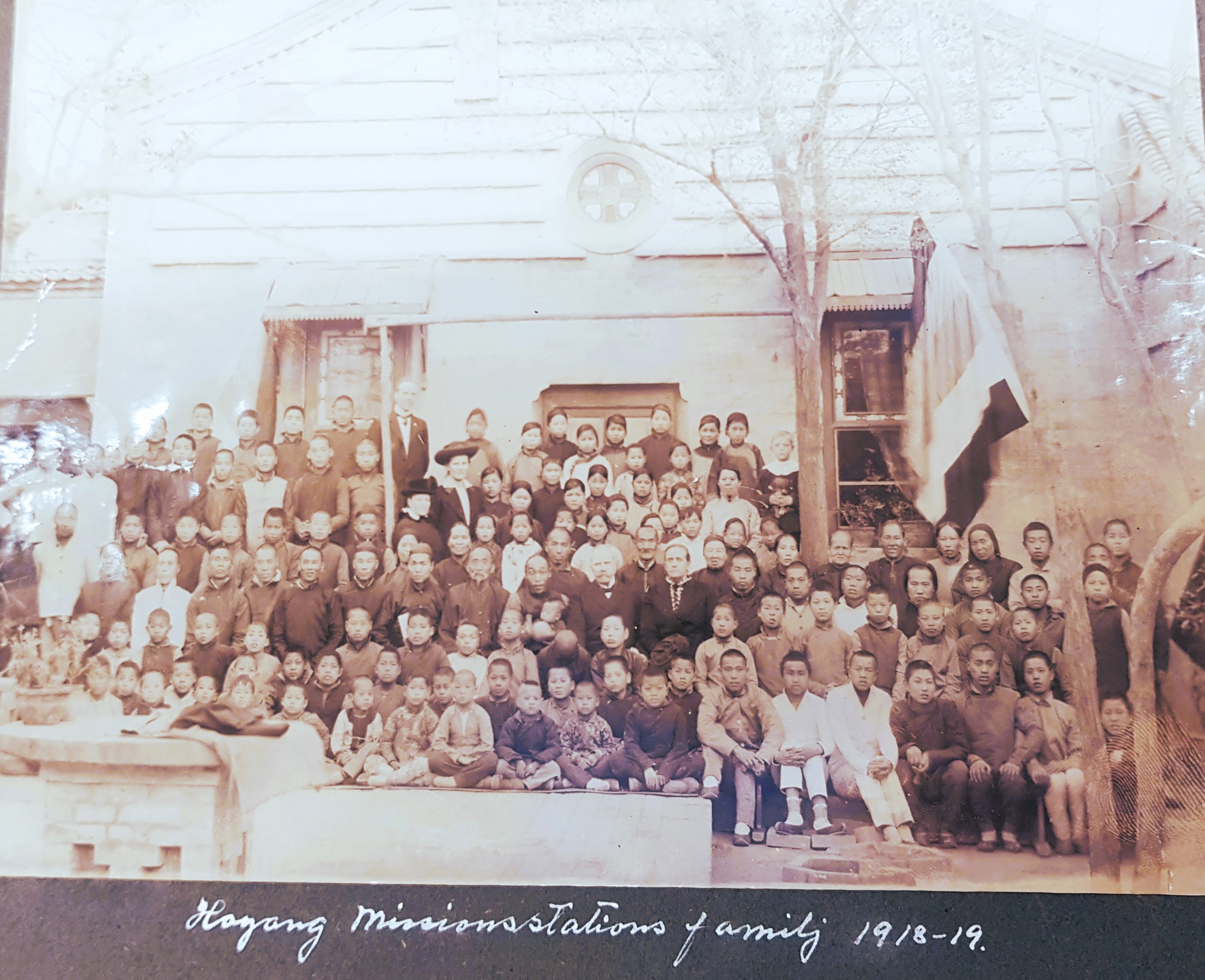
In 1920, Robert writes a long article in the paper Sinims Land about the start of the industrial school. The cover photo of that issue depicts he school. This is the same photo I uploaded in 2023, when I wrote about the Hoyang mission station. At that time, I thought it was simply a photograph of all the people engaged in the mission station, but it seems to be more than that – the building in the background might well be the acutal industrial school, as the text under the cover photo says.
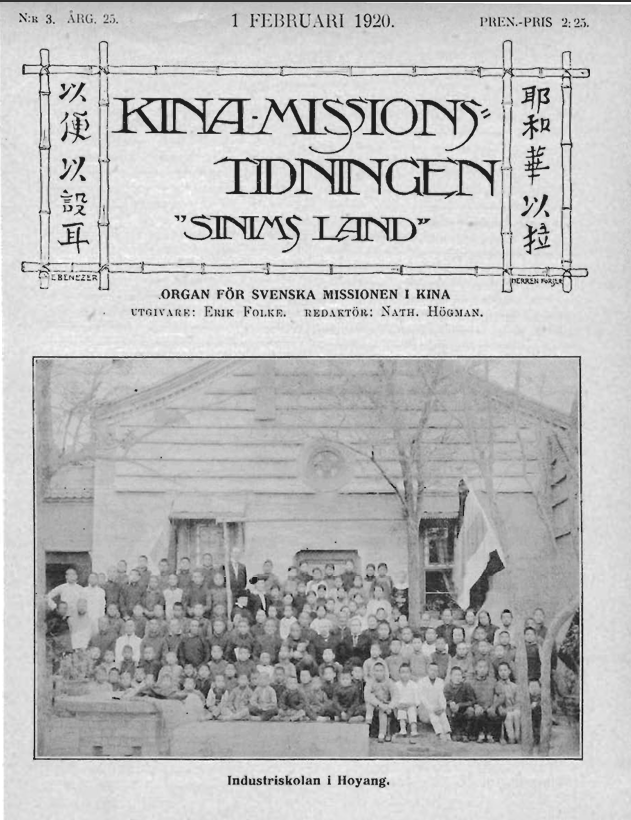
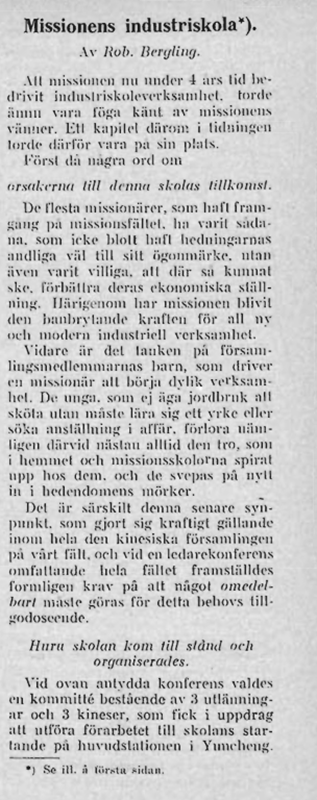
Robert writes:
“That the mission has now, for four years, conducted industrial school activities is likely still little known among the mission’s friends. A chapter about it in the mission paper is therefore fitting.
First, a few words on the reasons behind the founding of this school: Most missionaries who have had success in the mission field have been those who not only had the spiritual well-being of the heathens as their goal, but who were also willing, where possible, to improve their economic conditions. In this way, the mission has become the pioneering force behind all new and modern industrial activity.
Furthermore, it is the thought of the children of church members that drives a missionary to begin such work. The young people who do not have land to farm, and who must instead learn a trade or seek employment in a shop, almost always lose the faith that had begun to grow in them at home and in the mission schools. They are once again swept into the darkness of heathenism.
It is especially this latter concern that has made itself strongly felt throughout the entire Chinese congregation in our field. At a leadership conference covering the whole mission field, a formal demand was made that something must be done immediately to meet this pressing need.
At the aforementioned conference, a committee was elected, consisting of three foreigners and three Chinese, who were tasked with carrying out the preparatory work for the establishment of the school at the main station in Yuncheng.
The committee soon reached an agreement that, since the mission lacked sufficient operating capital for the enterprise, it would have to be organized as a joint-stock company. The shares were to be priced so low that even the less well-off members of the congregation could be encouraged to invest.
While this process was underway, I (the author of this article) was on a journey to northern Shansi, as far as La-tsi – the station of the now-deceased and practical missionary Öberg. There, I had the opportunity to engage a foreman for our weaving industry. This decision was gratefully approved by the rest of the committee, and it was resolved that I should begin operations in Hoyang, as no premises had yet been secured in Yuncheng.
The mission’s industrial school fund was then placed at my disposal. However, the subscription of shares proceeded so slowly that the committee members from the provinces of Honan and Shansi considered the enterprise hopeless and expressed their desire to withdraw from the committee.
Due to the many heavy expenses at the start of the enterprise, the school was nearly driven to a state of famine, even as it became overcrowded with students. During the first two years, the entire operation ran at a significant loss. Since only the congregations in Hancheng and Hoyang supported me with the school’s expenses, I was eventually forced to send home about half of the students.
Since then, the school has operated without loss – indeed, in the last year, it even yielded a small profit. It must be admitted, however, that financing the enterprise has often caused me considerable difficulty, and due to the lack of working capital, any gain has been consumed in the spinning.
I have therefore often cried out to God, that He might help us obtain the necessary working capital, whereby the school’s financial future could be secured. For if the capital could be increased by 3,000 to 5,000 taels, to purchase a few smaller, more accessible machines, we could not only admit a greater number of students – and there is no shortage of applicants – but, humanly speaking, the mission might also gain a source of income.
What kind of work is done in the school? someone may ask. In addition to Mongolian and Turkestani carpets, our work also includes the weaving branch – producing various kinds of fabrics, Turkish towels, napkins, and more.
We have also long considered acquiring sock-knitting machines and hand-operated machines for knitting undershirts and similar garments. These items are now in high demand in the country’s interior. So far, however, we have not had the funds to open this interesting and undoubtedly profitable branch. Thanks to a donation from friends in Norrköping to this school, we have now been given the opportunity to begin – and the first machines are already on their way from Shanghai to the field.
The sale of goods is handled entirely by the Chinese, either in our local sales outlet on site, or in the case of rugs, through agents on the foreign market.
The profits of this enterprise?
Economically, they consist in the fact that we have been able to provide favorable means of livelihood for a total of about ten of the congregation’s poorer members, while at the same time helping to develop certain branches of the local industry. Spiritually, however, the gains are infinitely greater. For as many students as we are able to receive, nearly as many are saved from once again being drawn down into the darkness of heathenism.
Daily morning and evening prayers are held with the students at the industrial school, and during these times, seeds are sown in their hearts which, in many cases, bear fruit in the form of genuine conversion and rebirth. Indeed, more students from the industrial school have been able to be baptized since the school’s founding than from our three boys’ schools in the district during the same period.
Another often-overlooked, yet highly significant, spiritual benefit lies in the impression this enterprise makes on the heathen surroundings. We and our Christian believers are often equated with Buddhist monks and lamas, who do nothing but sacrifice and worship their gods. Thus, when asked whether they would like to study the doctrine and get to know the true God, they typically reply: We have no time. We have our farming to tend, our families to support, and so on. Now, when they see us engaged in industrial work, they begin to realize that it is possible to fear God and still carry out earthly duties — and they begin to see us as human beings like themselves, which they previously did not.
With this, I have wished to give the mission’s friends an insight into our industrial school enterprise, and I hope and pray that it may lead to its many and varied needs becoming a matter of interest and prayer for the mission’s supporters.
Robert Bergling”
Thus, the work of missionary Otto Öberg continued with the Swedish Mission to China. Öberg himself passed away in a brain hemorrhage during the winter of 1918.
The carpets are still with us
Another carpet that was woven in Robert’s industrial school is this one, which today belongs to my father’s cousin Kurt. It is a bit worn after all these years, but still – it’s almost as if you can hear the beautiful bird calling out from the weave.
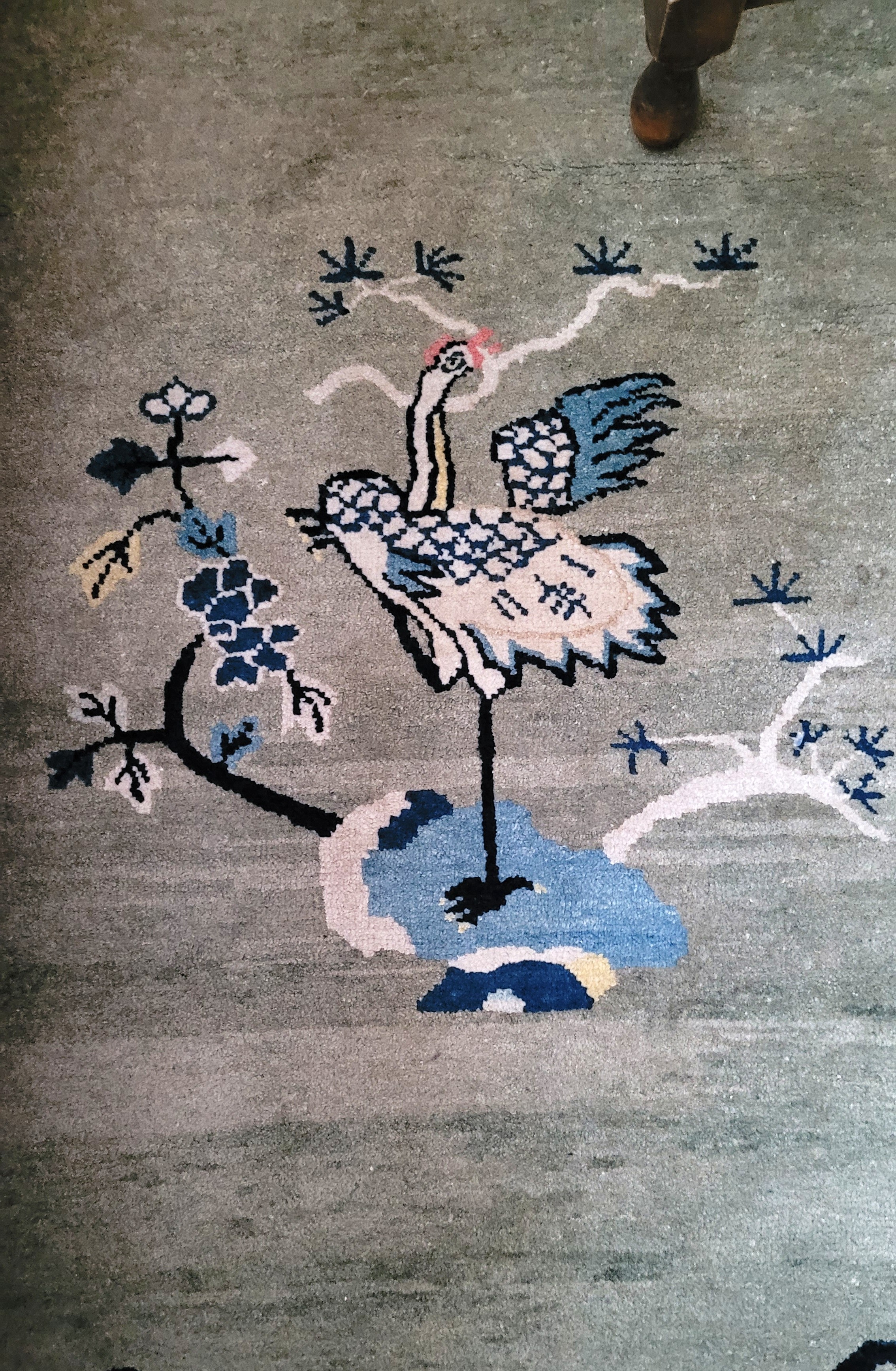
I have also read letters, that Robert has written about the carpets as he was trying to sell them to different people in Sweden. He talks about delivery times and prices. As the production increases, so does his worries and work with the whole endeavour. There are always personnell issues, with people leaving and no one to teach the art of weaving. Somehow he sorts out all the problems.
To this day, several carpets from my great‑grandfather’s industrial school have made their way to Sweden. Two are mentioned here: the large blue carpet (now at my sisters’ home) and the bird‑patterned one that Kurt owns. I also recall that there is another carpet with a second cousin of mine, that I saw a few summers ago. It is nice to know that some of these carpets are still in the family and above all – are being used! And since there were several such schools in China, it’s quite possible that other period pieces still survive in Sweden.
And what of the carpet that was custom‑made in Saratsi for Mr. Wallenberg? Well, it may yet lie somewhere in the family’s collection -unless it’s been sold at an auction…
*Fun facts about Wallenberg and the carpets
The Alliance Mission’s report above dates from 1913. In searching for Swedish ministers named Wallenberg active around that time, I came across a couple of candidates. The Wallenberg family was – and still is – one of Sweden’s most prominent and influential families. Among the Wallenbergs of the time, one figure stands out for both his political role and his connection to China: Gustaf Oscar Wallenberg.
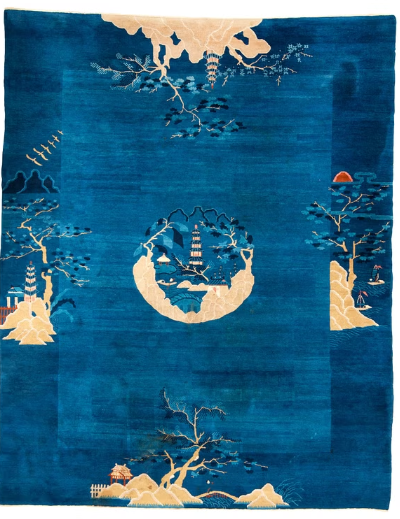
Gustaf Oscar was a diplomat who was appointed to a post in China sometime after 1906. Interestingly, he also had a personal interest in Chinese art and craftsmanship. For example, I found a Chinese carpet from this very period listed at an auction house, where his name appears in the provenance. I suppose it must be this G.O. Wallenberg who commissioned the carpet from Saratsi.
Another noteworthy detail is that Gustaf Oscar was the grandfather of Raoul Wallenberg, the renowned diplomat who rescued thousands of Jews from Nazi concentration camps during World War II.


Hi
LikeLiked by 1 person
Hi!
LikeLike
A very interesting read again Thérèse. And how nice some of the caperts still excist. From a distance in time and place it seems kind of ‘logical’ to me that in order to make and keep people interested in a new faith it would help that there would be an added benefit for daily, practical life, like earning an income, food on the table, etc. Why else swap one believe for another if there wouldn’t be such a reward? A school I think is a perfect tool for that. The name Wallenberg of course is known in the Netherlands too. Raoul, indeeed!
LikeLiked by 1 person
Very true – there had to be something in it – work, health, food. And it was of course connected to becoming a Christian. Thanks for reading (all the way to Wallenberg 😀) and for commenting!!
LikeLiked by 1 person
A fascinating article! The missionaries’ developing a path to economic security for those they ministered to looks like it ended up being successful. Are the industrial schools still in existence?
LikeLiked by 1 person
Thank you, Liz! The missionaries’ goal was for the Chinese to run the industrial plants themselves. And I think it worked out for some time, but then I have understood that all mission schools were closed when the communists took over by 1949. And I presume that would also apply to the industrial schools. But at least there were a lot of Chinese who by then had learned a trade and had some income during times of hardship.
LikeLiked by 1 person
You’re welcome, Therese! I shouldn’t be surprised that the communists shut down the mission schools and the industrial schools. A shame, though.
LikeLiked by 1 person
Yes, they were not very approving of anything connected to religion, that’s for sure…
LikeLiked by 1 person