My great grandfather Nils Styrelius passed away on this day, the 16th of October, 82 years ago. By then he was a well-travelled man, who had lived an adventurous life. I have written about his passing before, and a bit about his time as an emigrant to America. He emigrated from Sweden to Chicago in 1905 and it was in Chicago he found his calling.
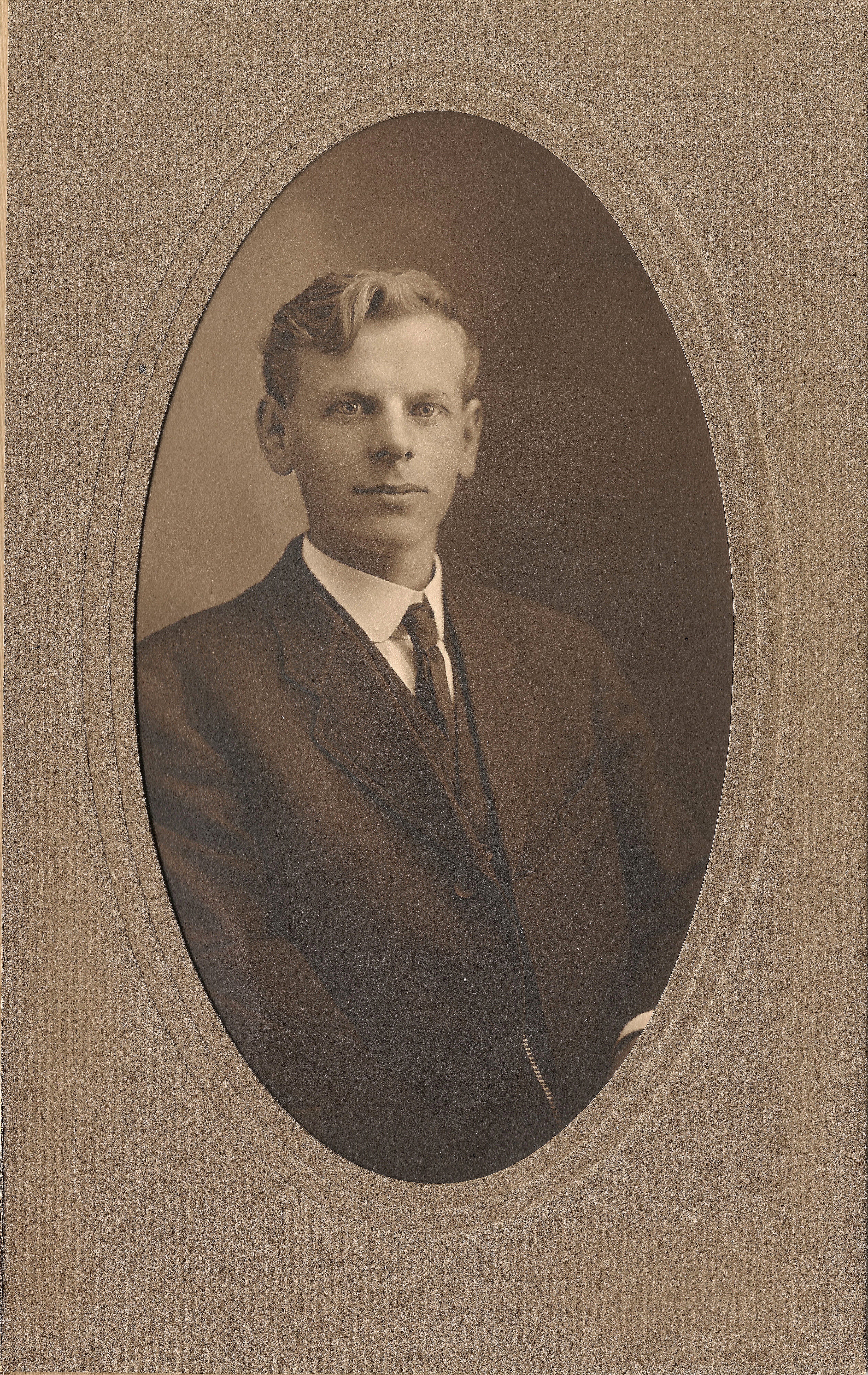
As every aspiring missionary, he wrote about his life up until his calling in a letter to the missionary society he wanted to join. When I found his application letter, I was very happy, as there is not much information about him available from before he became a missionary.
This is what he wrote:
“I was born on the 5th of November 1881 in Göteryd, Småland. My parents are farmers. By the age of 13, I had finished school. At 17, I apprenticed with a carpenter and worked in that profession for the following 9 years.
On the 15th of July 1905, I arrived to America. I started to believe in God in Chicago in 1906, and became a member of the Swedish Mission Society in Grand Crossing. I moved to Los Angeles during the fall of 1907 and joined the Swedish Mission Society there.
Ever since I came to believe in God, I have wanted to be a blessing for someone, why I have tried to bear witness about the Lord whenever I have had a possibility to. I have also participated a little in Sunday School activities.
The thought of becoming a missionary came to me when I heard missionary Linder during his visit to Los Angeles. He described how there was a great need of workers in China and that China is now open to the Gospel. Having heard that, I could not get any peace of mind until I could completely surrender to the Lord so that I may be used by him in this work, the way He sees fit.
The Lord has since led me step by step and I wish for nothing else than to continue to follow his lead.
I believe:
– That the Bible is inspired by God and thus of divine origin according to 1 Peter 1:21: in a Triune God, and that the Father is eternal, that the Son is eternally begotten of the Father, and that the Holy Spirit eternally proceeds from the Father and the Son.
– In the fall of man and the need for rebirth according to Romans 5:12.
– In the atonement according to Galatians 3:13.
– In justification by faith according to Romans 3:30.
– In the resurrection of the body according to 1 Corinthians 15:42-44.
– In eternal life for the righteous and eternal punishment for the ungodly according to John 3:16 and Revelation 20:15.
I hereby declare myself willing to follow the principles, practices, and other statutes adopted by the Swedish Mission in China, and upon my arrival in China, to place myself under the leadership of the Swedish Mission in China in the field and to work according to the mission’s rules. Kingsburg, 17th of February 1909.“
Reading his very short application letter and his assurances about his faith, I can’t help but compare to the very long and exhaustive accounts my other great grandparents provided to the mission. They wrote about their whole lives, recounted their feelings and thougths upon receiving their calling and enclosed essays about their faith, that must have taken a lot of time to complete. Nils seems to be a man of few words, not very eager to please. At the same time, he seems straightforward, a no fuss kind of man. He simply states what he think is necessary and leaves it at that. We don’t get to know him through his application letter in the same way that the others’ letters reveal personal details about life, love and God. It seems he saves that part of himself for his close ones.
Training
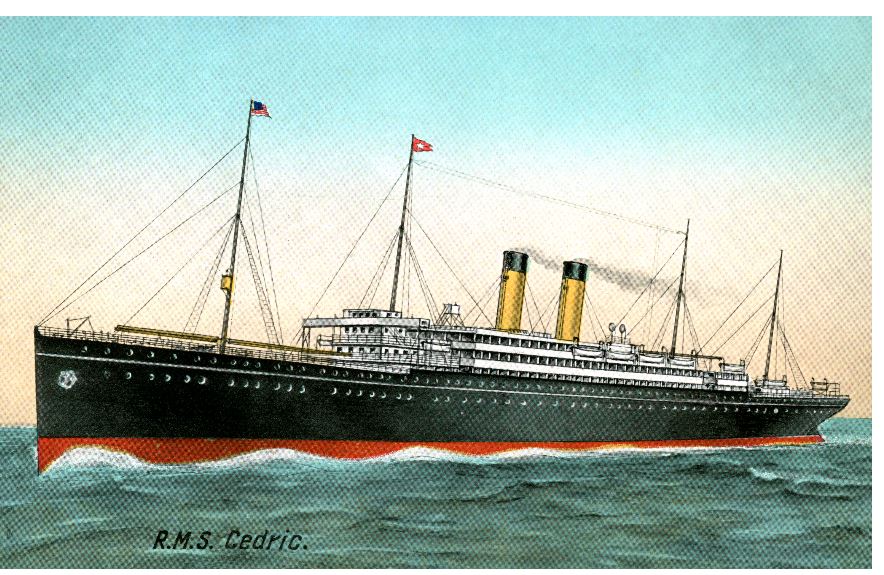
Nils was accepted as a missionary by the California Committee of the Swedish Mission in China and, after a six-month study course there, he traveled from San Francisco to Anking (modern-day Anqing), in China. The China Inland Mission (CIM), founded by Hudson Taylor in 1865, had established a training home for missionaries there. The training home prepared the new missionaries, particularly for language and cultural immersion. In Anking they also provided support for evangelistic work, medical missions, and education.
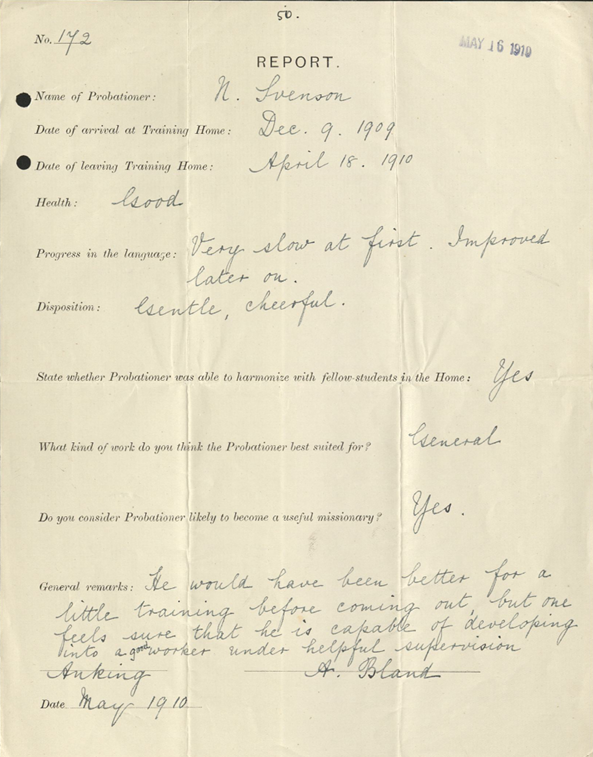
Nils arrived there in December of 1909 and left four months later in April of 1910.
I found a report that summarizes his efforts at the training home. It says he was quite slow in learning the language at first, but that he improved. His disposition is described as gentle and cheerful, and he got on well with the other probationers. The report also says that he would have been better off having had more training before coming out, but that he can develop into “a good worker under helpful supervision”.
It seems the mission was not all that impressed by Nils. He must have struggled a lot with the language and everything he should know as a future missionary. He had only had some basic schooling in Sweden, and was a worker, with a newly found passion for God. Apart from being a good man, he did not have much else than his faith speaking in his favour and the fact that the mission was in need of new missionaries on the ground in China. Letters from my other great grandfather Robert, confirm that. In his letters, he was regularly praying for more missionaries to understand the great need in China and to join them in their work there.
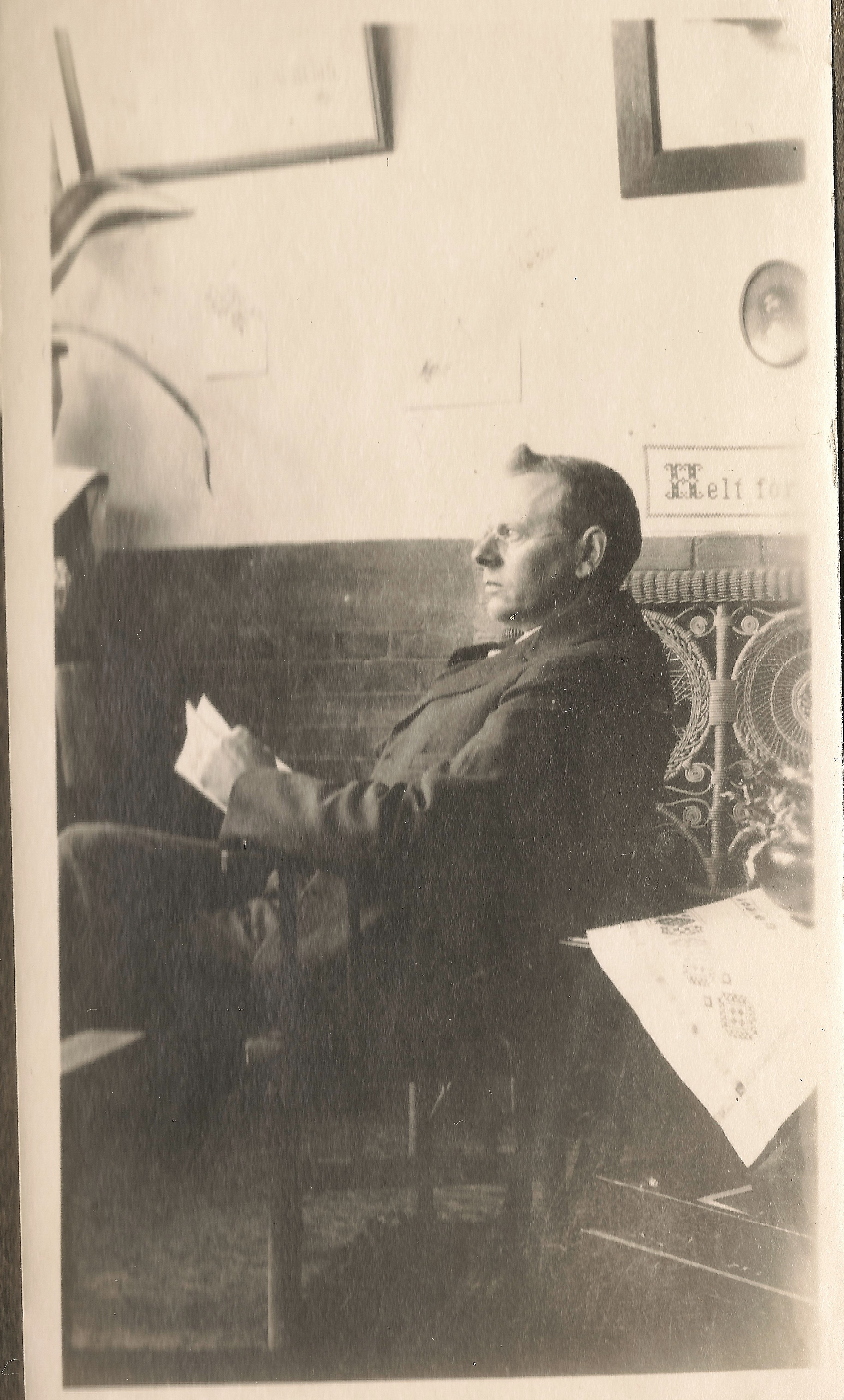
I wonder what Nils felt as he read the assessment about himself. At least, he was not discouraged. And at Christmas, only a month after having arrived in China, Nils was invited to a missionary family in Dali, in Shanxi. If calculated or not, we will never know, but Olga was invited as well, and this was the first time Nils and Olga met. A year and a half later, the couple was engaged. The 17th of Juni 1911, Nils writes to Erik Folke, the founder of the missionary society, to thank him for his well-wishes:
“Dear brother Folke!
Heartfelt thanks for the kind letter I received, as well as for the warm congratulations and well-wishes extended to me. It feels good to read the positive opinion brother Folke gave about the one the Lord has given me as a companion through life.”
He goes on to say that it is fine if they want to put an engagement ad in the paper, he has already notified the California committee.
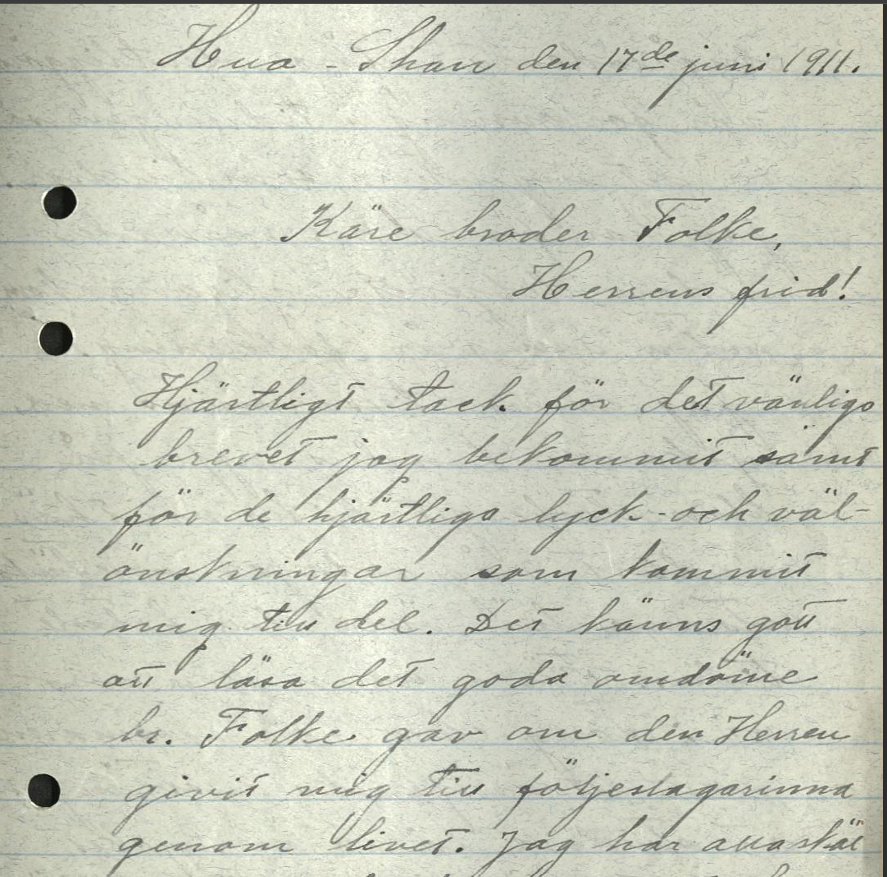
It seems, he was not one to give away too much about his feelings. Looking at the bulk of letters written by my all of my great grandparents to the mission, he is the one with the fewest letters.
Last words
I found his last letter, written only two months before his passing to Martin Bergling – Robert’s son, who was working for the mission back in Sweden. It was sent from Pucheng in China on the 24th of August 1942 and arrived on the 9th of January 1943, three months after his death.
A lot of the letter is about the heat in China at the time and how slow the postal service is. Letters written from Sweden in February, arrive in August and letters written from China return without having even crossed a border to another country.
Nils is working very hard at the time. He writes that he has not been at home more than one Sunday a month.
“On my bike, I travel to the outstations for the monthly meetings. Yesterday, I thought I would suffocate from the heat in the blazing sun on the way home. As you know, it is not like at home with a slow darkening in China, but the darkness falls quickly as soon as the sun has set. So, one cannot wait for the evening coolness if one wants to travel home. It is distressing to see the dry fields – the autumn harvest is completely failing in these areas.”
He goes on to talk about the very high price for wheat compared to before the war, and worries about the situation and what is coming.
“The conceivable possible has already been surpassed. Now, it is only the impossible, the unthinkable, such that not even the most dizzying imagination could have produced; this is what is happening now, this is the kind of circumstances in which we live and work.
The Yellow River has flooded again so violently that the new judicial district established on the floodplains between Ingeborg’s and Åke’s town has been almost entirely washed away; more than 5,000 people are reported to have been swept away.
It will be interesting to know sooner or later if the annual report, budget proposals, and other letters have reached you. Will the rider on the white horse of Rev. 6:2 perhaps bring peace to the world – the same lord as in 13:1. – He needs to come soon, but then Jesus must first gather His own. II Thess. 2:3-9. May we all be ready! – Everyone is doing well! The Lord is good! Greetings to all. Don’t forget the children.
Always warmly united in the Lord, Nils Styrelius”

Nils did not live to see the end of World War II or the Second Sino-Japanese War (1937-1945). He passed away from ileus, leaving behind Olga, his daughters, and his Chinese congregation in deep sorrow. My grandmother Edna was convinced that if her father hadn’t returned to China for the last time in 1939, despite already having health issues, he would have likely lived longer and might have had the chance to meet his grandchildren. Even so, he was a deeply committed missionary, and he lived his life in accordance with his beliefs — which is an accomplishment in itself.
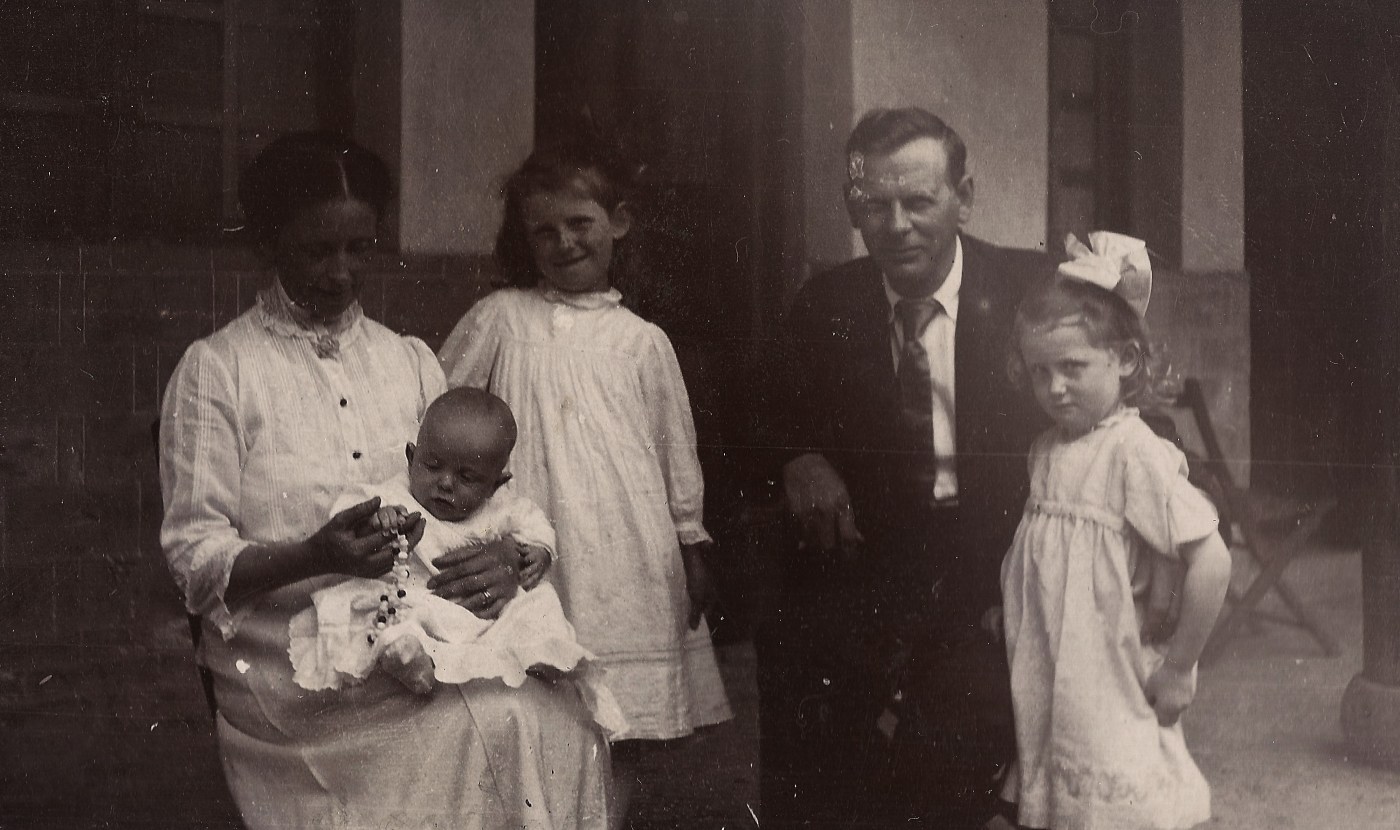
Photo at the top: Nils, surrounded by his family. To the left Olga with Erik on her lap (he died when he was 4 years old), beside her is my grandmother Edna, then Nils and Linnéa.


This is the takeaway from your post about your great grandfather Nils: “Even so, he was a deeply committed missionary, and he lived his life in accordance with his beliefs — which is an accomplishment in itself.” People’s commitment to the Lord can take different forms.
LikeLiked by 1 person
Hi Liz! Yes, it can. I think Nils was someone who did not speak so much about it, he just acted in accordance with what he thought was right.
LikeLiked by 1 person
In spite of a rather short schooling time your great grandfathers English was more then sufficient. I know the Swedes are very good in English nowadays, but were they then as well? And what a beautiful hand of writing he had! A lot of attention was paid to that, I remember from my fathers hand too. And even in my own primary school time we had to learn penmanship, with dip pen and inkwell, and if we did well we were granted to write a whole day with green ink! 🙂 Your family consisted and no doubt still consists out of courages folks, travelling to unkown places, bearing hard times and tough circumstances. I find it wonderful you are taking the time and effort to reconstruct their ways,Thérèse. Are you putting this together in a book?
LikeLiked by 1 person
Hi Peter! Yes, I think he did well to both learn English and then Chinese as well (!). And, from what I gather, the language studies were very hard work. Swedes in general were not good at English back then, as it was mainly an option to learn English in college. My great grandfather probably picked it up as an emigrant to America – and perhaps he had some kind of knack for lanugages. Lovely that you noticed his handwriting – I too, think it’s quite beautiful. We have lost a lot of that today, which is a bit of a shame – there is a certain kind of joy in reading a beautifully penned letter :).
What a great memory – having had the luxury of writing in green ink!! I remember that using different colors of ink was exciting back then – the joys we had were not as bombastic as they are today, that’s for sure 😀
Thank you for your lovely words about my family – I do hope their stories can be as interesting to others as they are to me. Theirs are the lives that were quite different and adventurous, but that are long forgotten by now – and I feel that they merit a bit of a revival. And yes, I am writing a book about them, starting with my great grandmother Olga. But it’s an alterfiction, so it won’t be a regular family history book and I don’t keep to the exact turn of events, though everything is based on the real stories of their lives. It is quite a project though, seeing how much material I have and how much time it takes to just decipher their letters 🙂 But as my great uncle told me – the process is the main objective, not the finished books – and I live by that!
LikeLiked by 1 person
This is so cool! I love that you have the letters, and his “evaluation” from his missionary training. In looking at the excerpts from Nils’s letters in Swedish, I recognized some 3 or 4 words, that I learned from studying my great grandfather’s letters. 😂 (brevet, tack, broder, hälsningar till alla) so I felt pretty happy about that LOL. It made we want to go on Newspapers.com to see if I can find any articles about the Swedish missionary who came to Los Angeles. If I find anything I’ll let you know!
LikeLiked by 1 person
How great that you understand the Swedish words!! It is amazing what one can find in the archives – I am not sure I would have kept this “evaluation” myself, had it been my decision… Which just goes to show that one never knows what future generations will find of value or interesting 😊.
Yes, let me know if you find something searching the newspapers – it’s truly intriguing with all these stories! 🤗
LikeLiked by 1 person
They must have saved everything back in the day. I have my grandpa Emil Johnson’s report cards from Augustana Lutheran college in Rock Island, Illinois, and he got a C in Swedish! 😮 But he did learn French at the University of Leon. He and another guy from his unit were able to stay in France after WW1 got over and go to college for another year or so. I have that report card too😀
LikeLiked by 1 person
Oh, wonderful!! It’s such a treasure! Your grandfather got around as well! Imagine just the travels back then (!)…
LikeLiked by 1 person