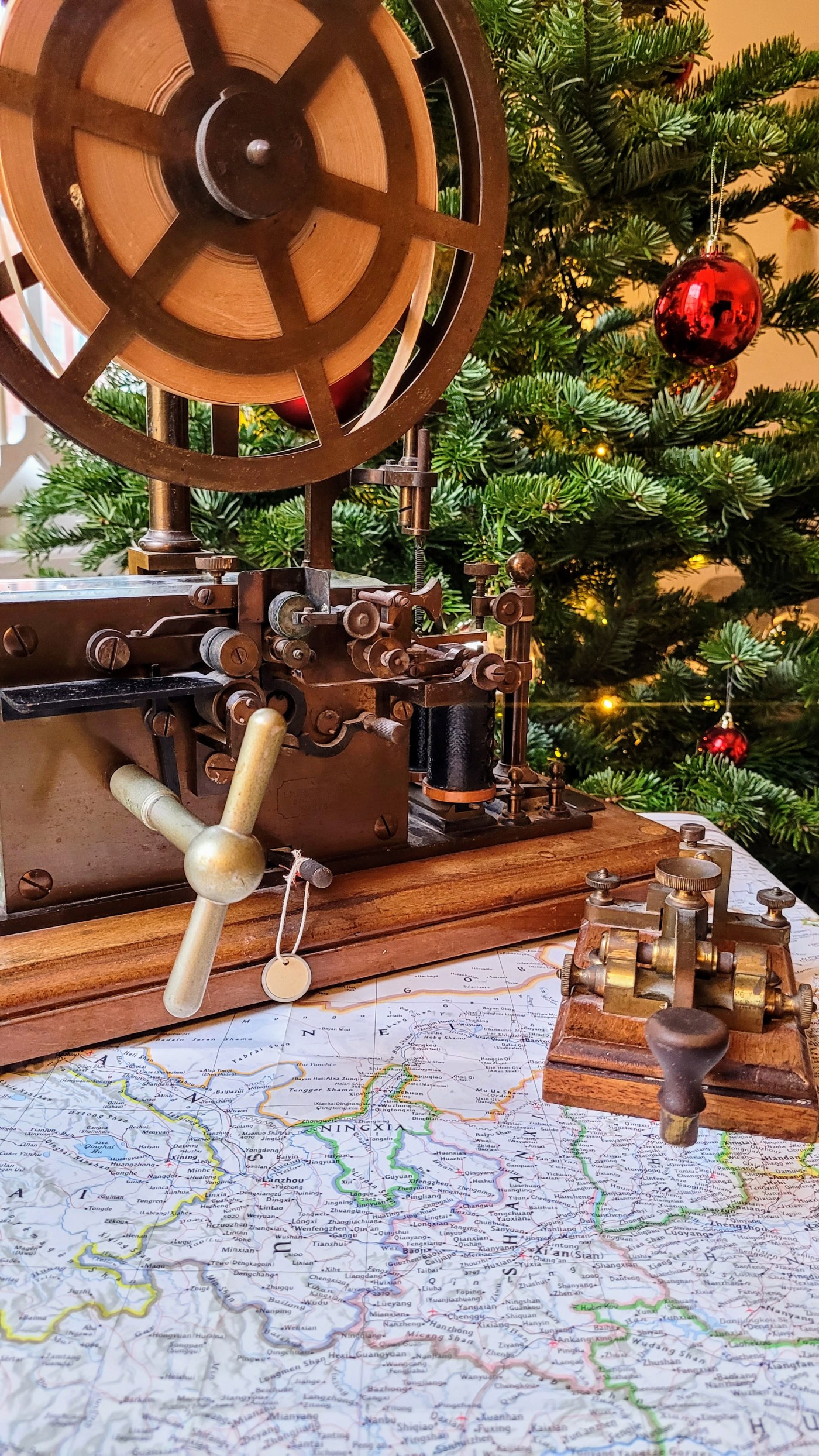
This Christmas, I received two handwritten Christmas cards in the mail. The number of Christmas cards has steadily decreased in recent years. I used to write a lot of cards myself, but like so many others, I don’t write them anymore. I was very, very happy to receive the two cards, though. There is something special about getting a handwritten greeting. I’ve noticed that I hardly see handwriting anymore; everything is always typed.
The Swedish missionaries in China mostly penned their letters to friends, family and missionary colleagues. Yes, some letters are typed, but not that many. The missionaries often faced significant challenges in communicating with friends and relatives back home or even in other parts of China. The postal service was a difficult and unreliable enterprise at the time, with letters often taking months to arrive. To ensure a Christmas card reached a loved one in time for the holiday season, it had to be sent as early as August or, at the latest, three months in advance. The missionaries were used to news travelling slow. But when there were especially important news, they could make use of one of the telegraphs available in China. Of course, most missionaries had to travel some distance to reach one, but it was still quicker than even the fastest postal service
My great grandfather Robert operated one of the available telegraphs in China. I suspect a wish for a Merry Christmas did not really qualifiy for sending a telegram, and I am not sure he was in service during Christmas. Looking through the missionary telegraph code book, to see if I can find codes for Merry Christmas, I come up short. The word Christmas is in there – with the code 28, but there is no code for “happy” or “merry”. I know the missionaries received Christmas boxes from Sweden to the mission stations in China. They were filled with food items, magazines, newspapers, mittens, socks and other warm clothes as well as objects their congregations had collected to give away. It was a nice way to thank the missionaries for the past year and show them some warmth in the midst of winter. In the code book, there is a code for boxes, so the missionaries could send a telegram saying the Christmas box did not arrive, for instance – something that did happen now and then.


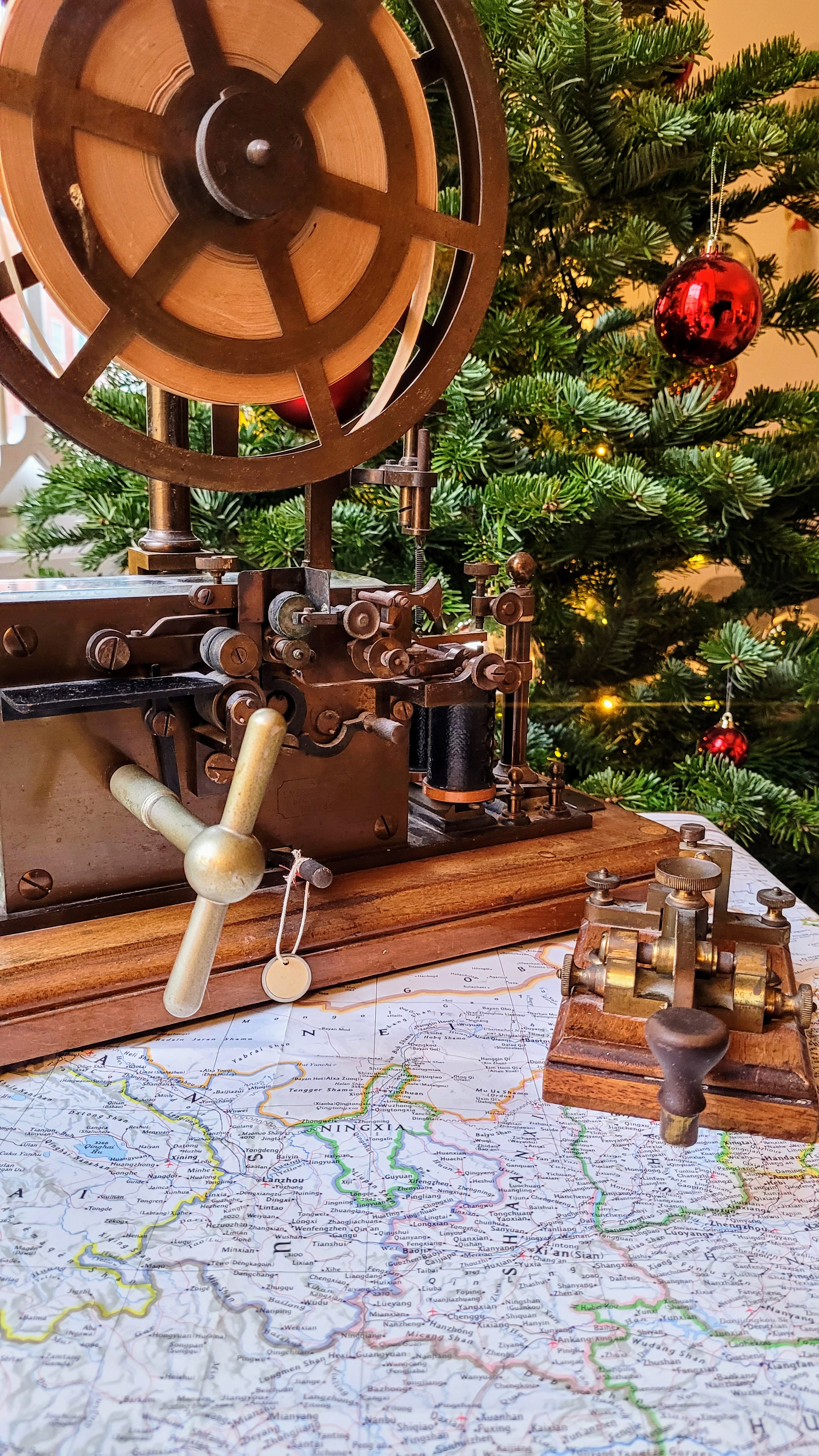
Telegraphs all around
There were many telegraph offices in China from the late 1800s and onwards. The code book lists all the offices by noting a “T” in front of the village/city. Over 1 700 villages are listed in the code book and looking for the “T:s”, I stopped counting when I realized there were over 200 telegraph offices in the provinces listed.
The telegraph was a convenient way to share information by the end of the 1800s, and a great part of the world was connected for communication via electrical telegraphs by then.
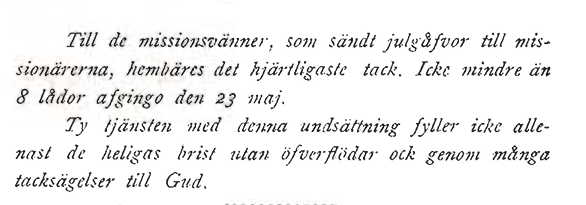
A common telegraph was the one made by the Swedish firm LM Ericsson. It could have been such a telegraph that Robert used in China.
Of course, friends and family back home, were often worried about their missionary relatives in China. They could read in the paper about wars and difficulties, but would have to wait for a long time to be certain their relatives were not injured or dead. In 1942 the world was literally on fire, and a Swedish newspaper called Aftonbladet reported on missionaries in China, noting that they were continuing their work despite the chaos. My great-grandfather, Nils, was mentioned among them. One of his letters is cited in the article titled “723 Missionaries Working Even Though the World Is on Fire”:
“The Swedish Mission in China recently received a letter from Shensi, dated on January 7th. Work was carried on as usual and everything was well amongst the five missionaries at the station, where the sender of the letter – missionary Nils Styrelius – lived. A telegram from Tientsin in northern China the 9th of March was received in Jönköping on the same day. The telegram stated that all was well.”
This short passage gives us a good comparison of the different methods of communication and how fast they were. A letter compriced more information, but was much slower – Nils letter took almost three months to arrive, whilst the telegram was received on the same day it was sent. But the telegram was much shorter of course – only a sentence that all was well. But sometimes, that is really all you need, isn’t it?
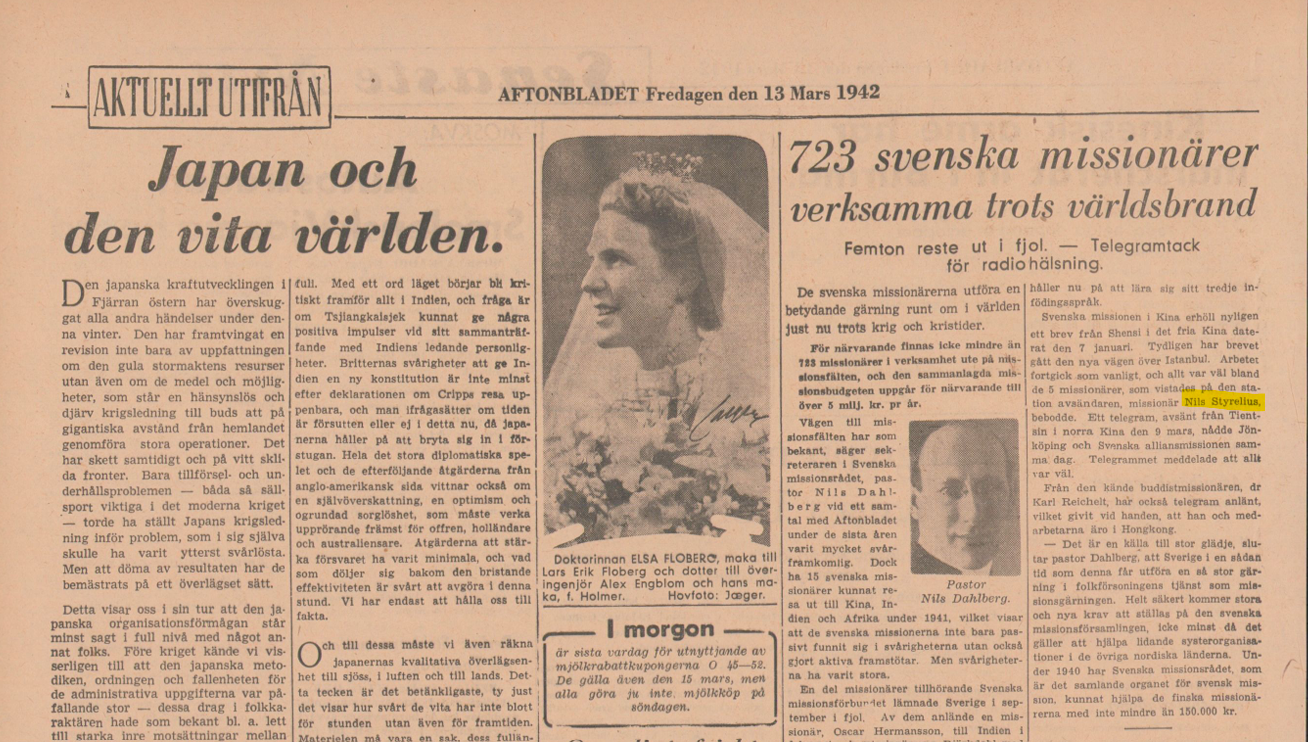
13th of March 1942, Nils Styrelius letter is mentioned in “Aftonbladet”.
In the mission paper published in November 1903 there was a timely Christmas greeting from missionaries in Hancheng – written on the 16th of September (!) by missionary Sigrid Bengtson, who served together with my great grandparents in Hancheng.
She writes “As this letter will likely reach you in time for Christmas, I would like to take this opportunity to wish you all a Merry Christmas and a New Year ‘richly blessed by the Lord.’ May He bless all your work for His kingdom within this land! Sisters Bergling, Eriksson, and Bordson join me in sending heartfelt greetings”.
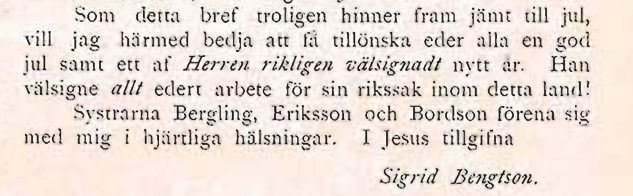
Example of an old telegram
By contrast, in 1897, Hudson Taylor, the British missionary to China, founder of the China Inland Mission and the man who also wed Robert and Dagny back in 1895, sent a telegram that looked like this to Josef Holmgren, the secretary at the Swedish Mission in China.
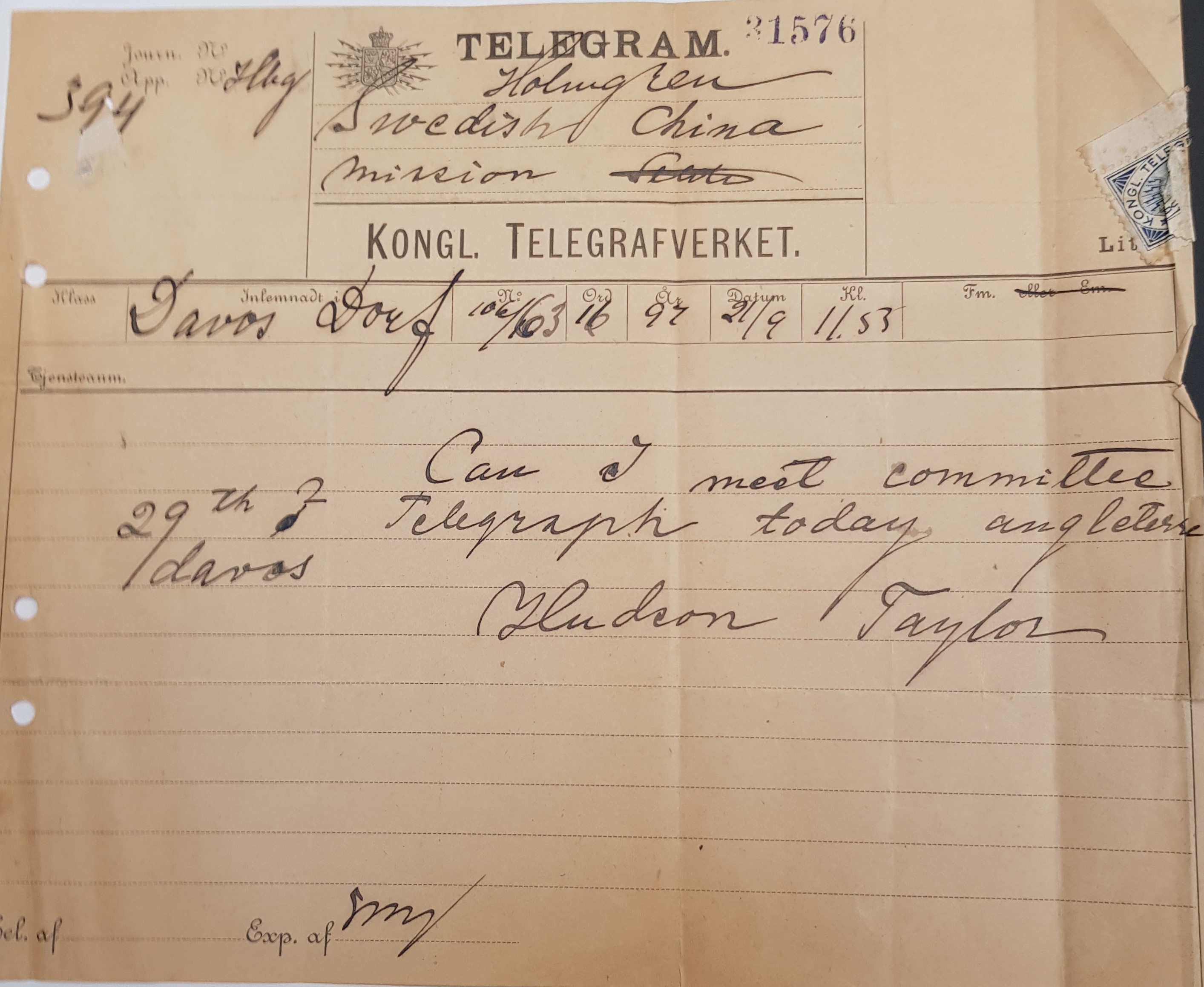
It is very short, but to the point and it reached its destination on the same day. I hope he was able to meet with the committee – it seems to have been important.
The two handwritten Christmas cards I received this year brought back memories of the past. Growing up, handwritten cards and letters were just a part of how we kept in touch, along with phone calls where we actually spoke to each other :). Nowadays, even phone calls seem rare, replaced by quick text messages.
Maybe that’s why the two cards I got this year felt so special. They carried written care and thoughtfulness that’s hard to find today. They reminded me of the letters and telegrams my ancestors once sent during both World Wars and while being away for such a long time from friends and family in Sweden. Despite the great distance between the countries, the messages eventually reached their destinations, carrying the longed-for news that, at least at the time of writing, all was well on their end.
That is also my hope for all of you reading this text ❤ . I wish for a 2025 where human rights and compassion take center stage and where we see a more peaceful development in the world.
 Thérèse Amnéus
What a fascinating read, such thorough and well presented research! I was already really enjoying reading it when I came to the part about James Hudson Taylor! Earlier today I walked past the blue plaques which are on a wall on the site of his birthplace in Barnsley, South Yorkshire, England. I alway stop and look at them when I’m in town. There are two plaques. Other people get one but he was given two because one is in Mandarin.
There is also a James Hudson Taylor trail around the town, marked by red plaques, which covers about ten or twelve buildings and streets associated with him. This link, if it works, tells the story of the plaques.
https://www.bbc.co.uk/news/uk-england-south-yorkshire-18139123.amp
Meryl
LikeLiked by 1 person
Dear Meryl, what a coincidence that you walked past Hudson Taylor’s birthplace earlier today!! Amazing! And, that you were familiar with him. I don’t think his name is common knowledge anymore – at least not here in Sweden. Thank you so much for telling me about this and posting the link as well – it also led me to info about the trail itself:http://www.jameshudsontaylor.org.uk/trail.html
Such a great idea to create that trail and provide info about Taylor in that way. He was truly a very interesting and driven man. Robert and Dagny even named a son after him – Hudson Wilhelm Bergling – but he unfortunately died only 2 years old, in 1904.
I am so happy you shared this with me 🙏🙏
LikeLiked by 1 person
I just had to send you a message when I got back from town (Barnsley) and read your post. I always enjoy your posts. I’m a history nerd, but this was just such an amazing coincidence. I had to share it with you. Happy New Year. Meryl
LikeLiked by 1 person
I am so happy you did! A lovely coincidence indeed! Happy New Year to you too 🌟🥳
LikeLiked by 1 person
What a cool post! And I love the photo of the actual telegraph apparatus, and that it’s in your family to this day. My grandpa Emil Johnson seemed to have typed almost everything he wrote, but that could have been because since high school he had worked for the Ludington paper, in a position he referred to as “cub reporter”. But the letters he got in Swedish from his father during WW1 were mostly handwritten. On the typed ones you can see where Nels had gone through with a pen or pencil and put all the little marks over the Swedish vowels, I’m guessing his typewriter didn’t have those. The amazing thing about all those handwritten letters is that people kept them for entire lifetimes! Even when I was in my teens we wrote letters to our cousins, friends, and pen pals from around the world. Now, we can be on our phones commenting on people’s blogs and they can read it even sometimes in “real time” from across the world!😀
LikeLiked by 1 person
Thank you!! I am very happy to be the family guardian of the telegraph, it is a strong reminder of how far we have come regarding communication to this day 😀.
I think it’s great your grandfather typed his letters as a true newspaper man – so much easier for you to read today! I quite struggle with the penned letters I have in my collection – it’s not always evident with the handwriting, though beautiful. They also used a lot of different word endings and expressions than we do today, so sometimes it’s no use even trying to guess…
I think you must be right that Nels could not have had a Swedish typewriter – but a good idea to put the dots in by pen! Otherwise one had to write ae for ä and aa for å, for exemple, and that is a bit harder to read.
I loved writing letters when I was young – it was a way to express oneself a bit better than one could when speaking, I found – really giving some thought as to how best express a sentiment or train of thought. Not bad for teens that are normally not very verbal 😁.
LikeLiked by 1 person
That’s true, and if you read over the writing we did as teenagers and then compare it with the way a lot of kids write today (no offense to them, but I know this from having been a middle school and high school teacher) you will see that our writing was much better. Plus we knew cursive!😂
LikeLiked by 1 person
😄 Oh, yes! Writing has certainly become a sought-after skill these days!
LikeLiked by 1 person