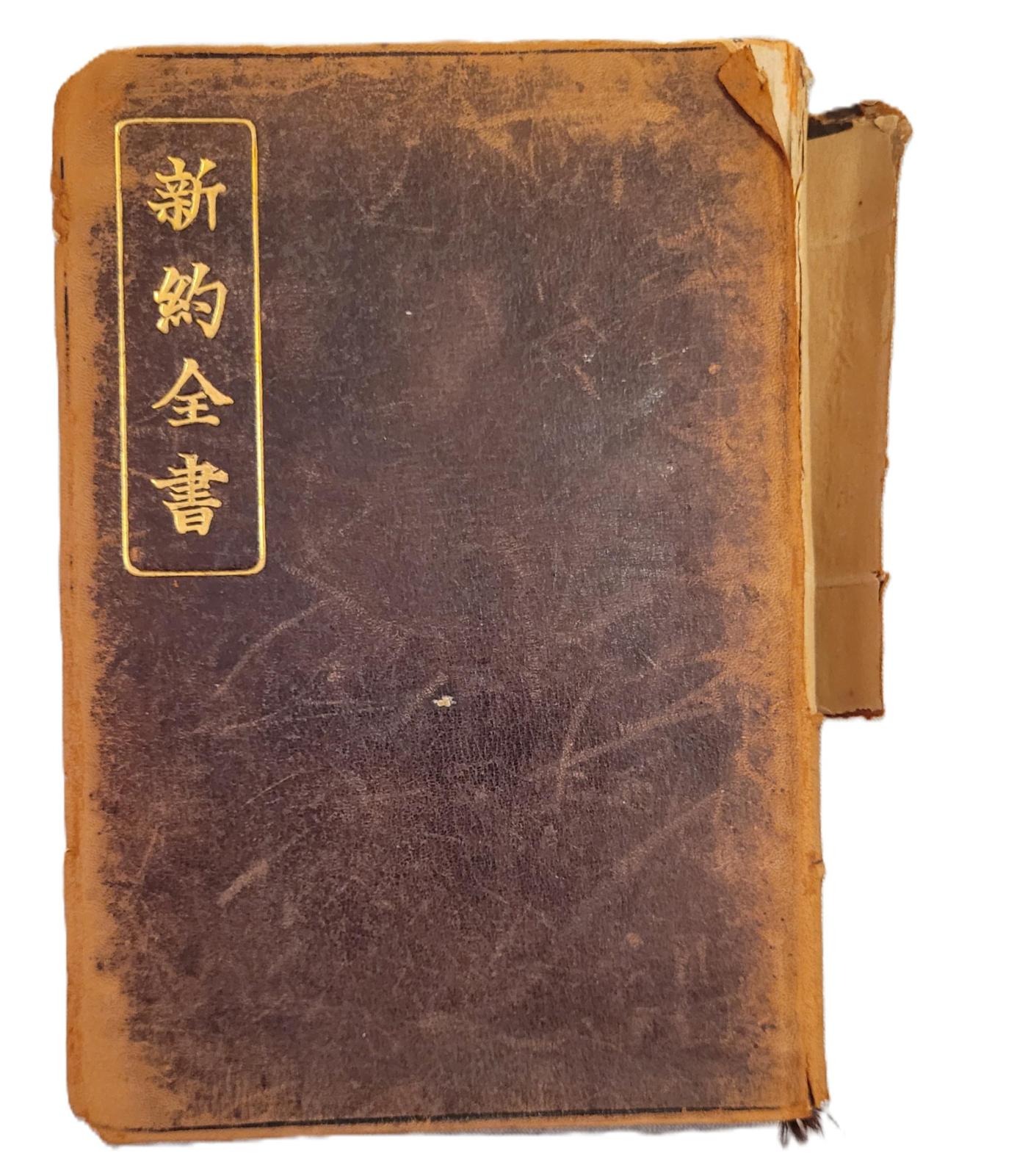
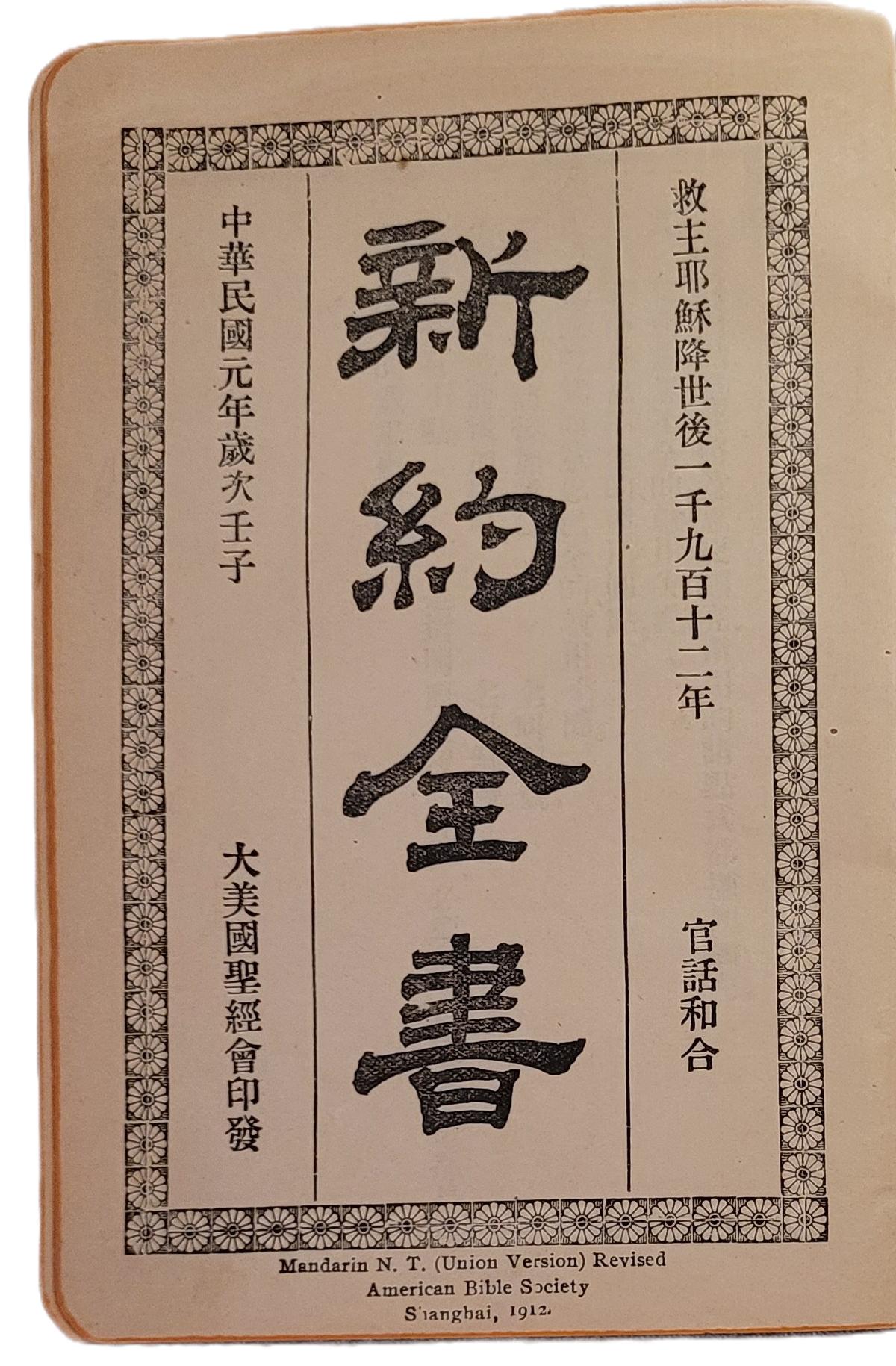
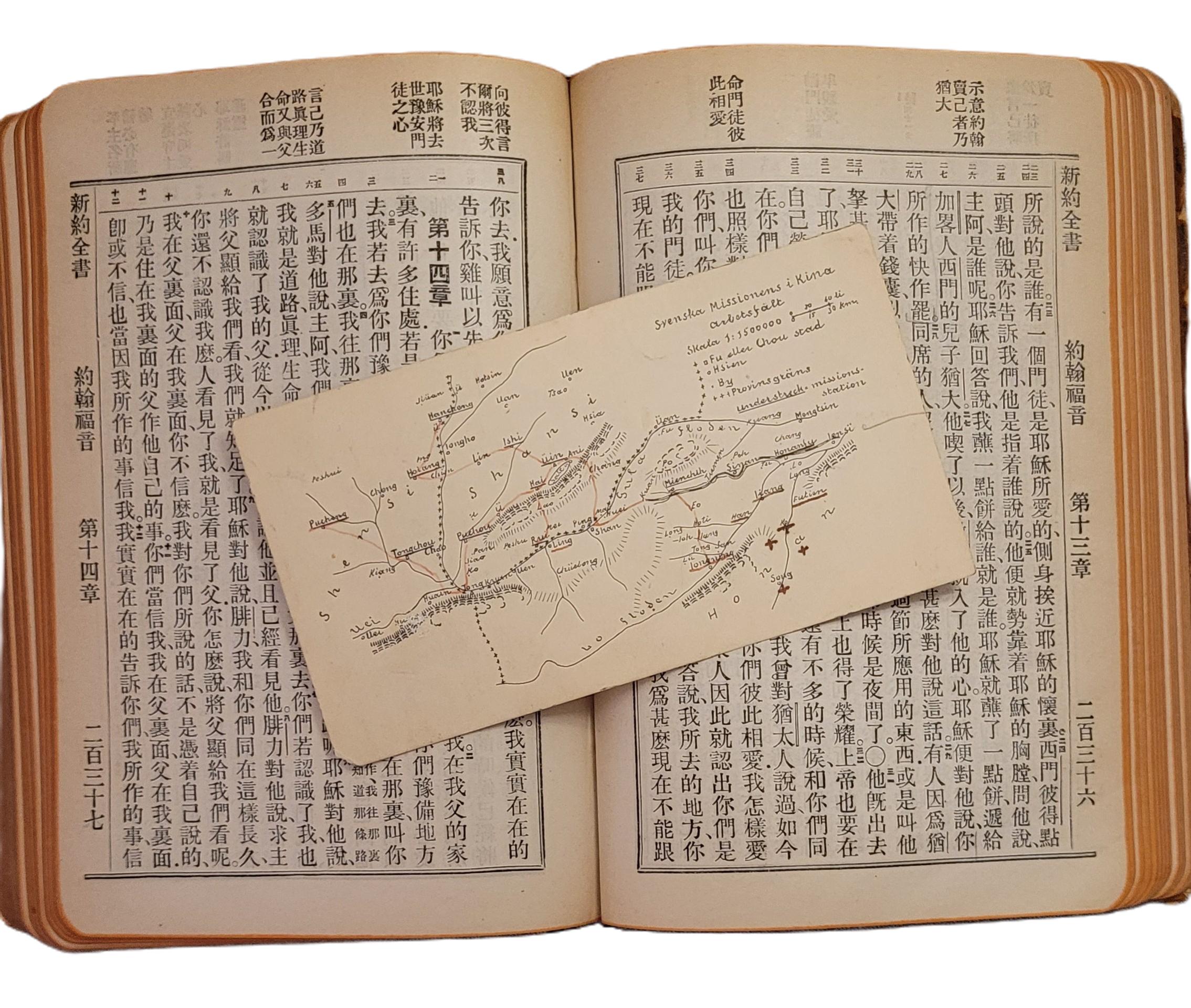
Looking through the box of books and documents that fellow researcher Karin Stålhammar Hansson sent me in December, I came across a carefully wrapped Bible in Chinese. On the title page is the name “Mina Stålhammar,” Karin’s grandmother. The cover is somewhat worn, but all the pages are intact, and a bookmark, depicting the mission stations of the Swedish Mission in China (SMK), was tucked about a third of the way into the book.
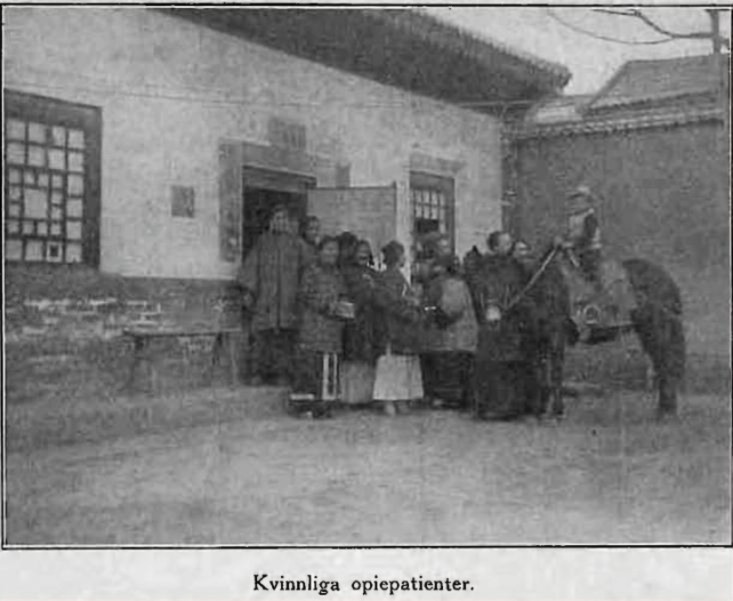
This made me reflect on how missionaries worked to spread their faith in China. I have read accounts of my great-grandparents holding tent sermons in the countryside, engaging local people at the mission station through prayer and church work, and combining opium-weaning efforts with evangelization, requiring patients to attend sermons and church gatherings as part of their treatment.
Bible women
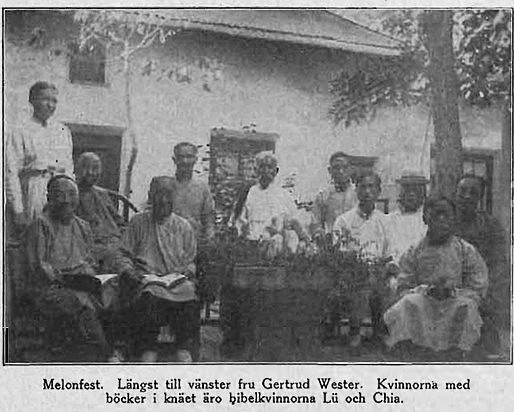
The missionaries naturally had to learn Chinese in order to communicate with the local population, but they were also greatly assisted by so-called Bible women. These were Chinese women who had studied the Bible – often in schools established by the missionaries – and who were able to speak to other women and children about Christian teachings without violating the cultural norms of the time. Even so, their work was not easy, as women and girls were rarely prioritized when it came to literacy and education in China before 1907 (starting in 1907, both girls and boys were required to go to school in China, but the SMK had started its first school already in 1892, with ten children).
Bible women played a crucial role because they could travel into rural areas, establish orphanages and schools, and spread the Bible in places where foreign missionaries were not always welcome. In the early years, many Bible women were wives or mothers of male evangelists or workers connected to missionary households. Even then, finding suitable Bible women was often difficult. Augusta Berg, a missionary with SMK, expressed her frustration on this matter in Sinims Land in 1896:
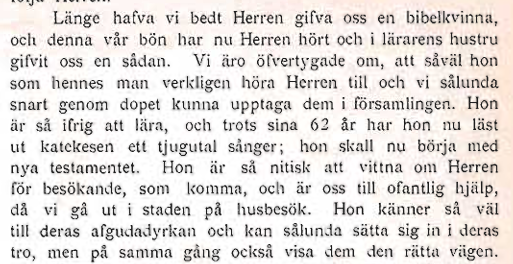
“For a long time, we have prayed to the Lord to send us a Bible woman. That prayer has now been answered, and we have found her in the teacher’s wife. We are convinced that both she and her husband truly belong to God, and through baptizing them we wish to receive them into our congregation.
She is deeply eager to learn, and although she is sixty-two years old, she has read the catechism twenty times. She is now beginning to study the New Testament. She is very thorough in bearing witness to the Lord to visitors, and she is of great help to us when we visit different homes in the town. She knows the people’s idolatrous practices well and understands their beliefs, yet at the same time she is able to show them the right path.”
No easy hire
There were certainly not many Bible women in the early years of the Swedish Mission in China. By the end of the nineteenth century, I can find only two Bible women mentioned in Sinim’s Land. In 1903, my great-grandfather Robert asks for prayers to help find a Bible woman for their station in Hancheng.
His prayer request asks for much – and I find this particularly revealing. It highlights the many layers of challenge the missionaries faced, challenges that are not always obvious when reading their articles, where difficulties were often described less directly.
Roberts request for prayers:
“That the Lord would grant us a full understanding of how great and responsible our position is, and give us grace to make use of every golden opportunity. That the Lord may send us the means to open village schools, for which He has given us several suitable teachers (one school would cost approximately 130 to 150 kronor per year). That the Lord may grant us yet another evangelist, and likewise a Bible woman.
That the Lord would preserve and strengthen our powers in the abundance of work, and soon send us new helpers from the homeland. That the Lord would soon grant us a house in the city of HoYang.
That the Lord may give us grace to be a true example to our congregation members and seekers.”
Already in the next issue of Sinim’s Land, part of Robert’s prayer appears to have been answered. We are given a page from his journal:
A page from R. Bergling’s diary
Han-ch’eng, September 8, 8 p.m.
“I rose before six and intended to hand over the leadership of the morning prayer to the evangelist, as there was so much that needed to be done during the day. The quarterly accounts for the work in H. were to be written out, as well as the accounts for the colporteurs. Mission statistics were to be filled in, and preparations made for an eight-day journey which I intended to set out on the following morning.
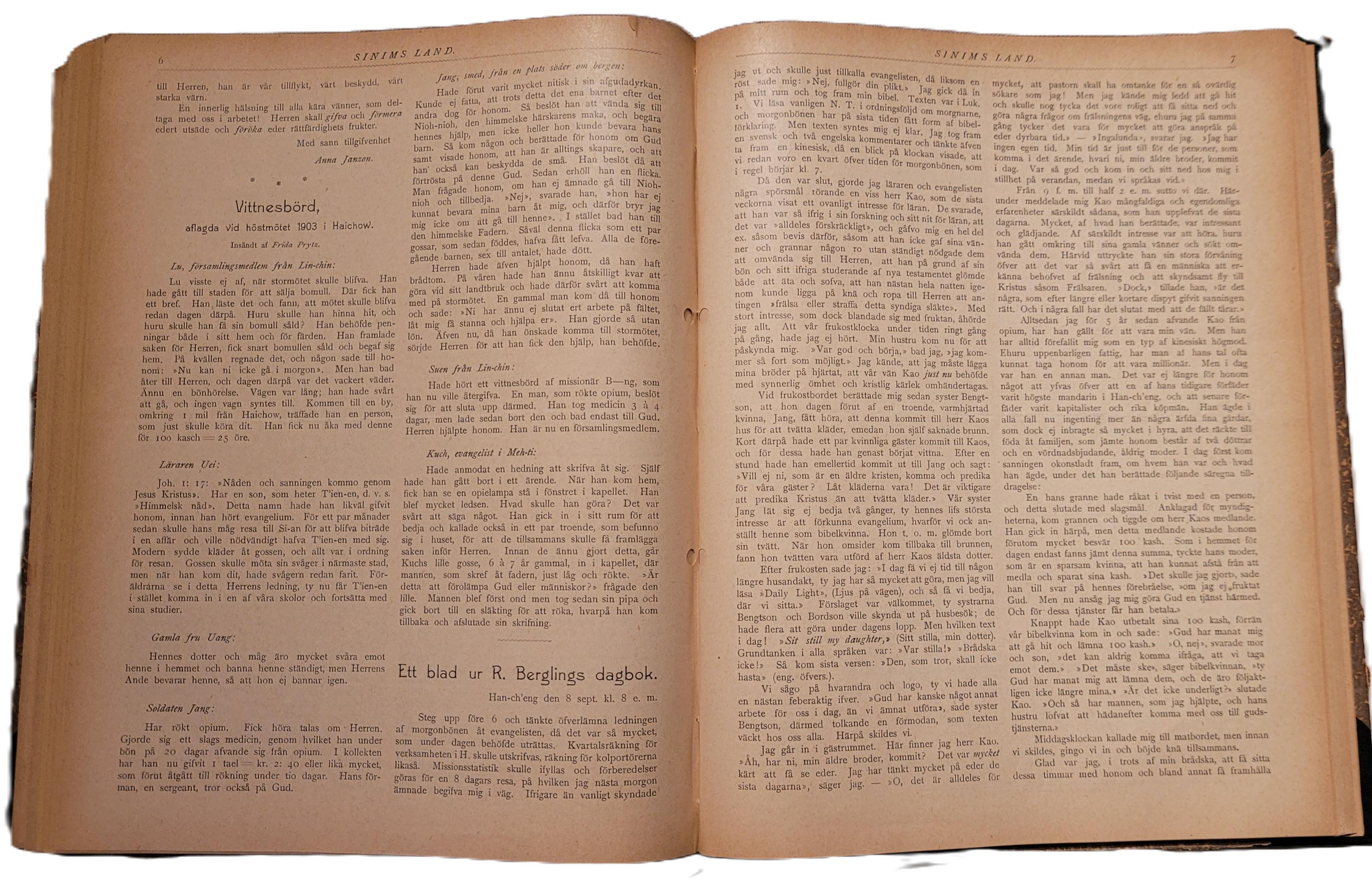
More hurried than usual, I went out and was just about to address the evangelist when, a voice spoke to me: “No, fulfil your duty.” I then went into my room and took out my Bible. The text was from Luke 1. We usually read the New Testament in sequence during our morning devotions, and in recent times the morning prayer has taken the form of a Bible exposition. But the text did not seem clear to me. I took out one Swedish and two English commentaries and was about to fetch a Chinese one as well, when a glance at the clock showed that we were already a quarter past the usual time for morning prayer, which normally begins at seven.
When the prayer was over, I asked the teacher and the evangelist a few questions about a certain Mr. Kao, who in recent weeks had shown an unusual interest in the doctrine. They replied that he was so fervent in his searching and so zealous for the faith that it was “quite alarming,” and they gave me several examples as proof: that he gave neither friends nor neighbours any peace, constantly urging them to convert to the Lord; that through his prayers and his eager study of the New Testament he forgot both to eat and to sleep; that he could spend almost the entire night on his knees, crying out to the Lord either to “save or punish this sinful generation.” I listened with great interest, though mixed with fear. That the breakfast bell had been ringing repeatedly in the meantime, I had not heard. My wife now came to hurry me along. “Please begin,” I asked, “I will come as soon as possible.” I felt that I must impress upon my brothers that our friend Kao at this moment needed to be cared for with particular tenderness and Christian love.
At the breakfast table, Sister Bengtson then told me that the day before she had heard from a believing, warm-hearted woman named Jang that she had gone to Mr. Kao’s house to wash clothes, since she herself had no well. Shortly thereafter, a couple of female guests had arrived at Kao’s house, and he had immediately begun to bear witness to them. After a while, however, he came out to Jang and said, “Will you, who are an older Christian, not come and preach to our guests?” “Leave the washing! It is more important to preach Christ than to wash clothes.” Our sister Jang did not need to be asked twice, for the greatest interest of her life is to proclaim the Gospel, which is also why we have employed her as a Bible woman. She even forgot her washing altogether. When she finally returned to the well, she found that the laundry had been done by Mr. Kao’s eldest daughter.
After breakfast I said, “Today we will not have time for a longer house devotion, as I have so much to do, but I would like to read Daily Light*, and then we will pray where we are sitting.” The proposal was welcomed, for Sisters Bengtson and Bordson wished to hurry out on house visits; they had several to make during the day.
But what a text for today! “Sit still, my daughter.” The central thought in all the languages was: Be still, do not hurry. Then came the final verse: “He who believes shall not make haste.” We looked at one another and smiled, for we were all filled with an almost feverish zeal. “Perhaps God has some other work for us today than what we had planned,” said Sister Bengtson, thus giving voice to the thought the text had awakened in all of us.”
Through Robert’s journal it is obvious that the missionaries worked with the Bible in Chinese as well – he writes that he wanted to “fetch a Chinese commentary” to the Bible text he was reading. Through the journal entry we also understand that he has employed Jang as Bible woman at the mission station. It seems, his work is demanding, but also going quite well.
I am thrilled to have found this text from Robert’s journal in Sinim’s Land, and I am very grateful that Karin sent me several compilations of Sinim’s Land that her grandfather had had bound into books. There is a special feeling in sifting through the pages of the real thing, as opposed to browsing scanned versions online.
Although the diary entry was likely edited, it still provides an interesting account of life at the mission station where my great grandparents were stationed. I am also certain that he had a Bible in Chinese, just like Mina Stålhammar.
Increasing interest
A decade later, the situation looks a bit better regarding the number of Bible women working with Robert and Dagny at the station in Hancheng. Robert writes about weaning the Chinese off opium in the 1913 issue of Sinims Land. Through this work, he has managed to increase the number of Bible women – and they are mainly former patients from the opium asylum. He writes:
“I cannot imagine any work in China that could bear greater or more immediate fruit. One can scarcely understand what our work would have been without this effort. Approximately half of our congregation members have come from our asylums, and half of the remaining portion have come from the homes of these opium patients. A review of this work shows that our only church elder, our three deacons, our three to four Bible women, two of our teachers, five of our evangelists, and ten of our local preachers have all been won for the Lord through our asylum work.“
I have not been able to find out how many Bible women were engaged by the Swedish Mission in China in total, but the mission had 19 stations, and most of them would have had at least some local women serving as Bible women. In 1912, the SMK issued a 25-year report of its work in China, stating that at that time they had 14 Bible women working in the mission field.
I really think it’s wonderful that the women who were formerly addicted to opium found something meaningful to occupy themselves with, which also helped them stay off the drug. The opium asylums were certainly one of the most concrete ways the missionaries were able to save lives. Other important measures included, of course, the schools, helping with food during periods of famine, treating illnesses, performing surgeries, and many other vital servicess that they offered in exchange for being able to talk about their beliefs and winning new members to their congregations.
*The Daily Light is a compilation of devotional scripture readings arranged by themes. It was first published in 1875, but is still in use.
 Thérèse Amnéus
All fascinating information, particularly about the Bible women. What would have been the difference between the role of an evangelist and that of a preacher in the context of the Chinese missions?
LikeLiked by 3 people
Hi Liz! Great question! The Chinese evangelists did not have to have the same formal education as the preachers. But I understand that it was somewhat fluid and that some acted as both. Also, the evangelists were mostly working outside of the mission stations – going out to the more rural areas.
LikeLiked by 2 people
That really is a treasure Thérèse. The information coming to you from direct sources. It shows with how little means de mission had to come by and how dearly help was needed. I think the anti-opium programm indeed was a great asset. I learned a lot again. And, if I may say so, that Bible in Chinese characters is a wonderful object in its own right.
LikeLiked by 2 people
Yes, they had very little to work with, and I am amazed that they kept on going for all those years. I agree with you – the Bible in Chinese is like an artwork in itself 😊
LikeLiked by 2 people
How interesting about the Bible women! And the opium rehabilitation work. I have two copies of “Daily Light” myself, only in English. The editions are too recent to have been owned by my grandparents, but there could be an older copy (how fun if it were in Swedish!) among all their books that I’ve “inherited”. 🥰
LikeLiked by 2 people
Hi Debra! Your comment made me curious about a Swedish translation of this book. Daily Light was first published in 1875. Searching for it I could only find one translation from 2009… This was also the edition our National Library has – which indicates that there are no other translations available. It seems it was a very popular and useful book for the missionaries. I think I might try to get hold of the English version 🙂 – they are still in use as I understand it! I hope you find your grandparents older copy, if they had one!
LikeLiked by 2 people
Yes, I’m sure you can still get them, probably on Amazon if nowhere else. I have a hardcover one printed in 1976 and I’m not sure about the other one, but it’s a paperback so it can’t be very old. Based on your research, I guess if I do find an older copy around here, it won’t be in Swedish after all.
LikeLiked by 2 people
No, I would not think so, but it’s lovely that you have your grandparents’ books in any case!
LikeLiked by 1 person
Interesting
LikeLiked by 1 person