– A Shared Swedish Missionary Legacy in China
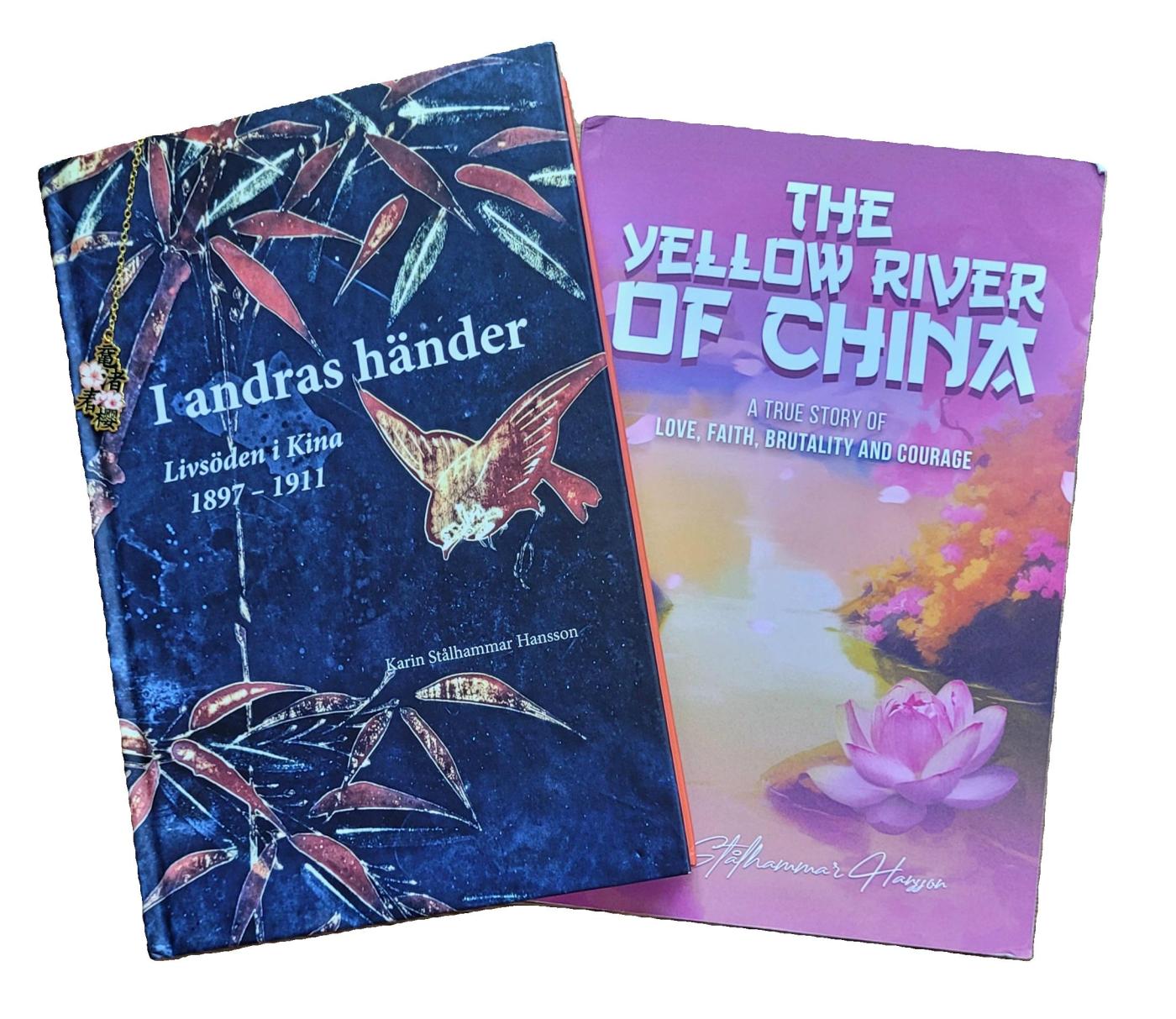
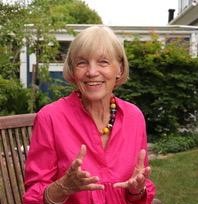
A few weeks ago, I received an email about my blog and research. It was from Karin Stålhammar Hansson, another descendant of missionaries in China. She wrote that she had read about my blog in a newsletter from the missionary society our ancestors had traveled to China with. Karin had written a book about her grandparents, the China missionaries Gustaf Adolf and Mina Stålhammar, and was delighted to discover my blog, where she could read more about the mission in China and my great grandparents – who worked alongside her grandparents during this transformative period in China. Since we share ancestral history, we can offer each other new insights and help shed further light on the events and the lives of our relatives from that time.
Karin wrote: “…I thought – here is a new connection and an opportunity to learn more. A great-grandchild of missionary Bergling, who was a missionary friend of my grandfather, Gustaf Adolf Stålhammar.
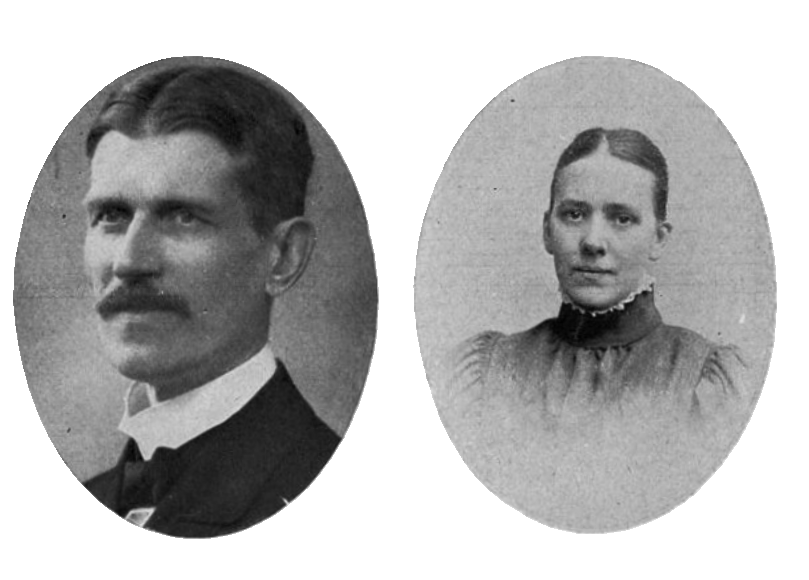
My grandfather Gustaf Adolf was a successful military officer who, to his family’s dismay, became a missionary. ‘How can you do something as foolish as becoming a missionary?’ his father asked. It became an extraordinary journey – a story of my family’s fate in a China on the brink of transformation. A journey through their challenging life in China, but also a love story. Much of the focus is on the women’s lives – my grandmother Mina and her friends. The strong women who were essential to success in Chinese society.”
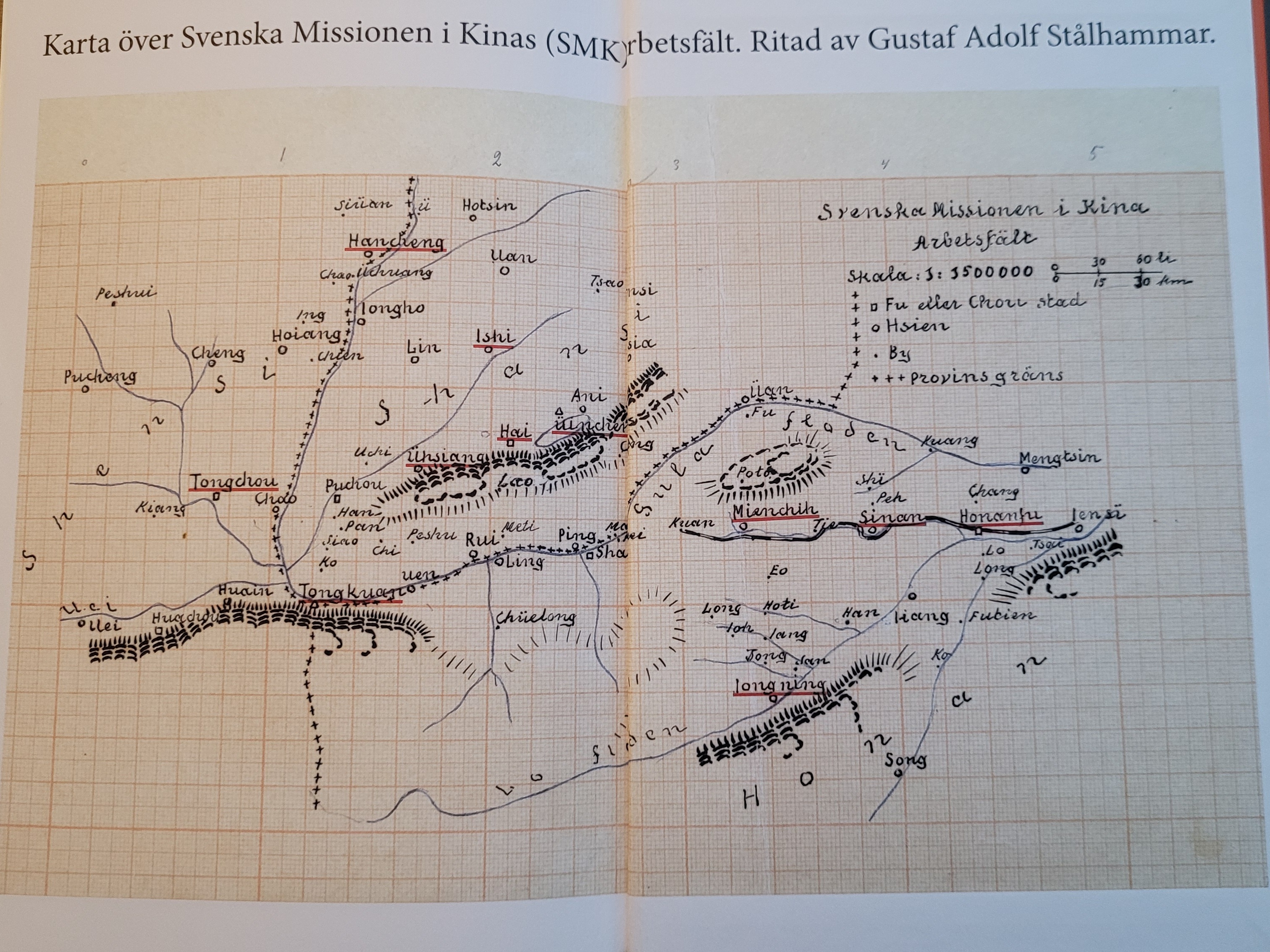
Naturally, I had to look up the Stålhammars right away – I had read about Gustaf Adolf before and knew that Robert and Dagny were acquainted with both him and Mina. They had worked at the same mission station in Hancheng.
I also noted that they had all attended the same annual conference in Yuncheng in 1914, a gathering that Nils and Olga were part of as well. This made me even more curious to read Karin’s book. Not long after our first exchange, she kindly sent me a copy.
The book was captivating and offered a new perspective on the mutual acquaintances of our ancestors – missionaries often mentioned in letters but never fully revealed. Karin’s book included personal accounts and letters between Mina and Gustaf Adolf, where they even expressed opinions about fellow missionaries – something quite rare in the letters I’ve read from my own relatives, which were typically written to the mission secretary in Sweden and kept a more formal tone.
This personal tone was refreshing, and the prominent role of the female missionaries stood out clearly in Karin’s book – a perspective that resonates with me, as I am researching my great-grandmothers and their courageous solo journeys from the Nordics to China.
After reading the book – which is as much a love story between the nurse Mina and the former military officer Gustaf Adolf as it is a record of their mission work in a country facing constant challenges – I knew I had to ask Karin a few questions.
Interview with Karin Stålhammar Hansson, author of the book “I andras händer” / “The Yellow River of China – a true story of love, faith and courage
Dear Karin, thank you for joining me on my blog to talk about your book ”The Yellow River of China – a true story of love, faith, brutality and courage”. It feels truly delightful to talk about your book, which has so many points of connection with my own family’s history – not least because they knew each other and had so many mutual colleagues and friends over there in China!
It struck me that both you and I were inspired and fascinated by our grandmothers. My grandmother used to tell me childhood stories from China when I was growing up.
I understand your family’s time in China wasn’t talked about during your childhood – what has it meant to you to make your own discoveries about that history?
– Discovering my family’s story on my own has greatly enriched my life. In fact, I believe it’s been more meaningful because I explored it myself. People choose what to share and those choices are shaped by what they themselves are willing or able to tell. One person’s version of reality may differ entirely from another’s, perhaps out of discretion or a sense of what’s appropriate to reveal.
As we grow older, we start asking deeper questions: Why did my life take this shape? Why did I choose this path?
Why didn’t my father talk about China, or his mother? My own mother spoke warmly of grandma Mina, though they only met briefly while we lived in Stockholm. Later we moved to a small village in Småland [Editor’s note: a province in southern Sweden], where I grew up in the 1940s. Grandma Mina died just weeks after I was born, during World War II. My father was away on military duty, and my mother ran the household while also working in his dental practice.
I began my search at a time in life when interest in family history often awakens, and that gave me great motivation. I learned things I had never known, and understanding my background has deepened my understanding of both my family and my upbringing.
In my grandparents apartment stood a beautiful Rococo-style display cabinet filled with keepsakes from China. Sometimes I was allowed to open it, and my grandma Edna would tell me about the items inside – like a tiny silk shoe for a bound foot, or a dollhouse-sized table set with miniature Chinese delicacies. In your book you mention how a small lacquer box from your grandmother sparked your curiosity, and then one day, you received a large number of personal letters and documents from a relative of yours, many of them unique and not to be found in for instance the National Archives.
How did you decide what to include in the book, especially regarding the love story between your grandparents?
– It all began with my grandmother Mina’s diary from the family’s return journey from China in 1912. That, and a small lacquer box with a bird on it, which once sat on her mahogany desk, and which I now have in my bedroom. Those objects made me wonder: what stories were hidden behind them?
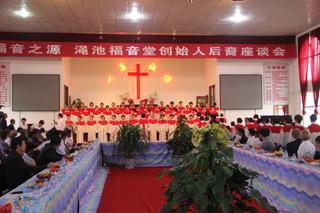
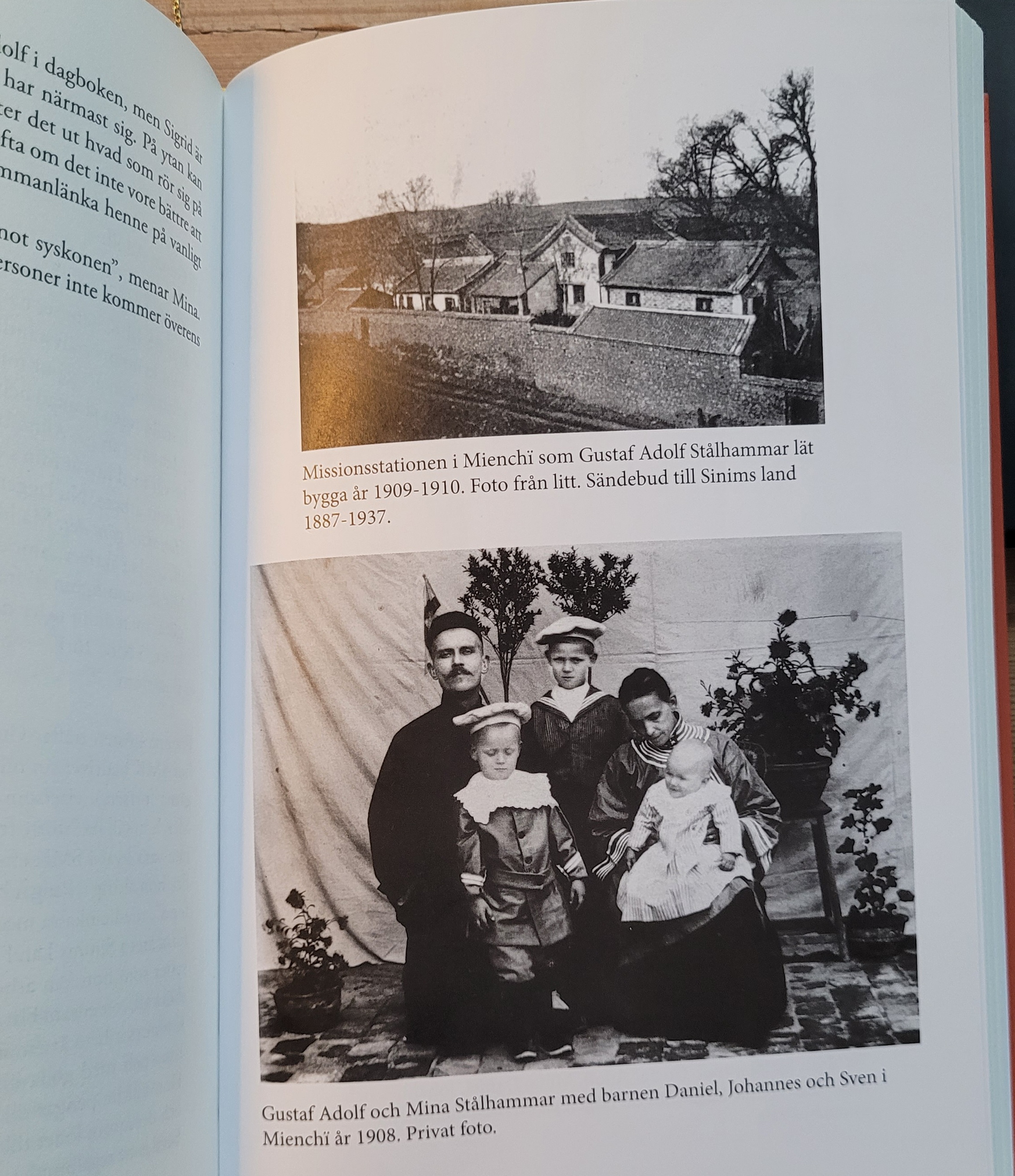
In 1997, I traveled to China with my daughter, retracing the Yangtze River route my grandmother had taken with her family. Unlike other tourists, we traveled like the Chinese on a crowded local boat. People were surprised to see two foreign women there – it was rare. In the town of Mienchi [Editor’s note: today “Mianchi”], we were told that Swedes had lived there a hundred years earlier. A boy named Sven was said to be buried by the river. To my surprise, I later found letters confirming that Sven, who was in fact my grandparents’ son, had died in China. That discovery was deeply emotional.
Shortly after, a relative gave me four boxes of letters, photos, and documents. They sat untouched for years while I was working full-time. But the question lingered: were the answers to my family’s past in those boxes?
Eventually, I began sorting through the material, helped by a Chinese man named Liu Hong whom I had met when he was invited to attend a meeting for the missionary society in Sweden. He translated my grandfather’s journals, filled with Chinese characters and biblical commentary. As we worked together, names and places became real people and communities. The puzzle pieces began to form a picture.
At first, I had planned to write about my grandfather – a Swedish officer who left everything behind to become a missionary. But I became more drawn to the everyday lives of the women, especially my grandmother. The womens’ letters were vivid, honest, and often spoke of daily struggles and small joys. I gradually came to understand that without the women, there would have been no mission. Women were the only ones who could visit other women in Chinese homes. I feel that the vital work of the women is not clearly reflected in Sinim’s Land. The men were credited with establishing mission stations, but without the women, the mission would never have taken the shape it did.
I’m especially thinking of one case where two female missionaries spent several years building up a station. In Sinim’s Land, it appears as though one of the male missionaries and his wife were responsible. Two very different portrayals of the same event.
Some letters contained many Bible references, which I often left out, depending on the reader. I imagined women would be more drawn to the love story, and men more to the historical context. Still, I kept biblical texts that related to their work or revealed something about who they were.
What in Mina’s and Gustaf Adolf’s love story affected you the most?
– Their honesty, courage, and strength, which came through clearly in their letters, both from Gustaf Adolf and Mina. They dared to act according to what they believed God had called them to do, even when others disagreed.
I was especially moved when I found a large brown binder carefully compiled by Gustaf Adolf’s father, containing all their engagement letters. In one letter, he wrote, “Perhaps one day your children and grandchildren will want to know why you went to China.” That shifted my focus. The love story between Mina and Gustaf Adolf, and the letters between Mina and her friends, became central.
In all this material, did you come across anything that surprised you more than expected?
– Yes, I did. I hesitated at first whether to include it, but it felt important. Life among the missionaries in this extremely poor part of China was far from easy. While Sinim’s Land hinted at tensions, they weren’t clearly expressed. I could compare how certain events were portrayed in the mission paper versus in personal letters. The letters gave a much more vivid and honest picture.
It became clear that missionaries had flaws too, and that the mission was shaped by a patriarchal structure brought from Sweden. But women like Mina and her female colleagues stood up for what they believed was right. They had been raised to trust their judgment and act justly, even when met with resistance from male colleagues. I got the sense that the female missionaries grew in confidence as they saw the impact of their work amongst the Chinese women and the communities. To me, it was improtant to include that the missionaries were not flawless.
You write that your grandparents’ lives came closer to you through your work on the book. I feel something similar – I’m getting to know my great-grandparents through their letters and different accounts about their life in China. How has this new relationship affected your own life?
– It has given me a deeper understanding of the generations before me, but also of those that will come after. Without this insight, I would have lived with many unanswered questions about my family. When those question marks are straightened out, a sense of acceptance comes, one that is much easier to live with. A quiet trust in life itself, and gratitude for so much. It helps me take one day at a time.
When you enter a project like this, you can get completely absorbed by the facts you uncover. Like finding a long-lost document or a picture showing something you’ve read about. It’s like a detective story where you slowly piece together what happened, when, where and how. Even though you “spend time” with your long lost relatives through their letters, I’ve found a strong need to talk to others about what I find. That’s one reason I started my blog. Through it, I also receive new insights from readers, which often leads me in directions I hadn’t considered.
You seem to have had strong support from your family and help with materials, how did that contribute to finishing your book?
– I received a lot of help from family and friends. Someone taught me how to scan and organize the letters, page by page. Another focused on the photos. Others read and reflected on the content. With close friends, I could talk more deeply about the people I was writing about. My husband gave me time. Writing requires solitude and discipline..
Once I focused on the people and their work, and used the diaries’ timeline as a guide, things became clearer. I also got help editing and cutting the text. That is hard but necessary. As readers, we know that not everything is equally interesting.
We’ve talked about the strength of the female missionaries. They were pioneers in many ways. Where do you think Mina got her strength from?
– I believe Mina’s deep conviction that God was guiding her, something she carried with her since childhood, gave her a clear sense of purpose. Her father also supported her decision to become a missionary, which I think was crucial. Life for women in Sweden at the time wasn’t easy. They were often trapped in poverty or restricted to what was considered appropriate: learning piano, studying languages, sewing, and so on.
My grandparents came to Sweden at the age of 14. Before that, they had attended the Swedish school in China and saw their parents once or twice a year. While it wasn’t much, it was more than the seven years that my grandfather’s older siblings had to endure between visits. Upon returning to Sweden, they stayed at the mission house in Duvbo and attended a nearby school. Their parents continued as missionaries, and both my grandmother’s father, Nils Styrelius, and my grandfather’s father, Robert Bergling, later died in China.
Your father returned to Sweden at the age of 10 and was boarded with other adults, while Gustav Adolf and Mina continued their missionary work in China. Do you have any sense of how the absence of the parents may have affected him and future generations in your family?
– Naturally, it affects a child not to grow up with their parents. How exactly, is harder to know. For some children, it becomes a trauma, while for others, they cope better.
My grandfather taught his children to write letters, ideally every day, and also to keep diaries. Although letters took time, sometimes up to three months to arrive, they would respond by referring to specific dates, creating a conversation between them that may have replaced face-to-face talks. Perhaps, at that time, it was even easier to write than to have personal conversations in some situations.
They were encouraged to write and to express themselves, even on difficult topics. My father, who found it easy, wrote many letters and diaries, including to me during my time abroad. But for children who struggled, I think the absence of parents was a handicap.
I also think it was harder for mothers to be separated from their children. I’ve gathered this from letters describing the children’s boarding experiences. Saying goodbye to a child, knowing you might never see them again, must have been heartbreaking for the mother.
Thank you, Karin!
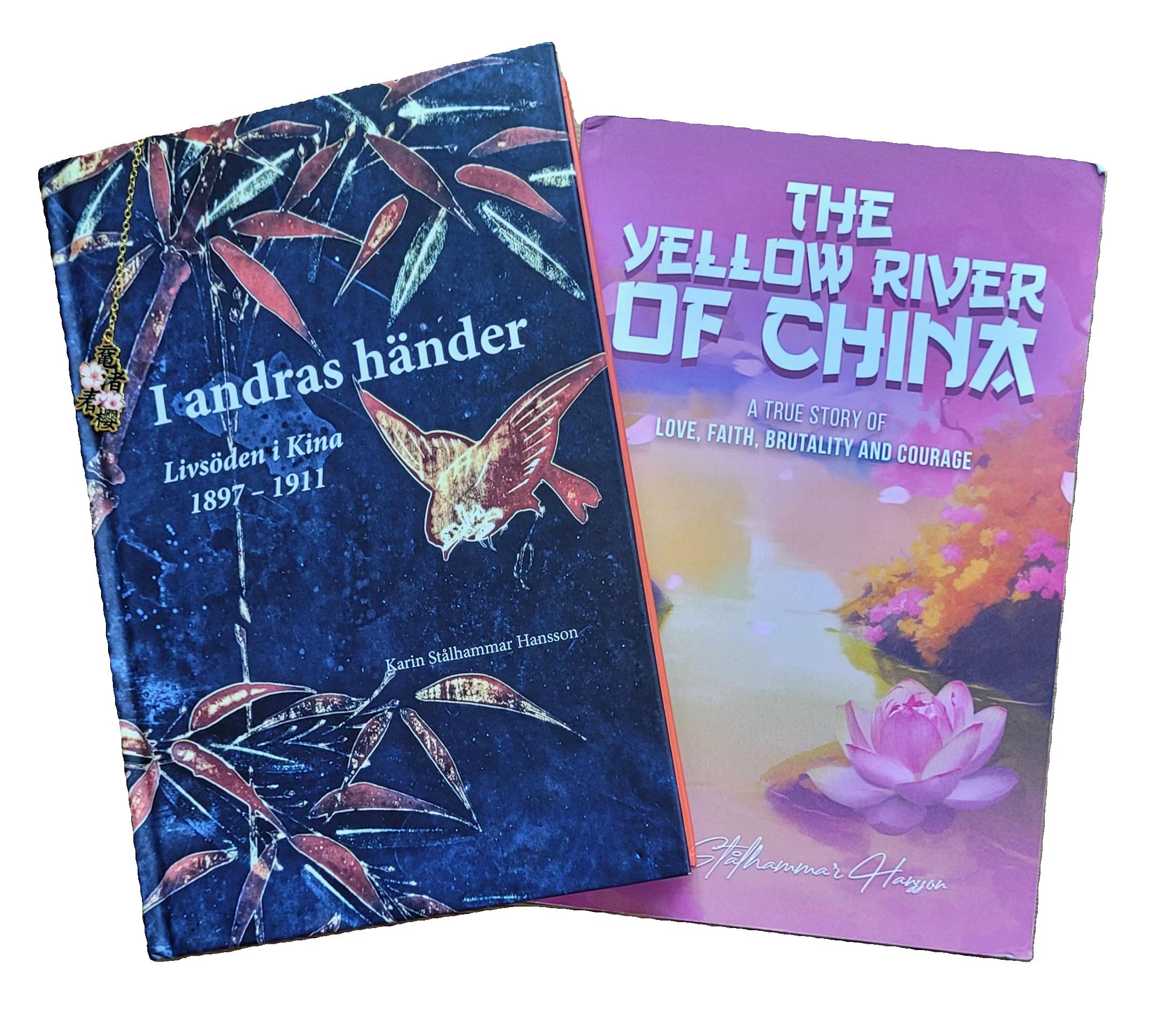
The book
I thoroughly enjoyed reading Karin’s book, which offers a compelling perspective on the mission in China – its challenges, its successes, and the deep sense of fellowship among the missionaries. It also illustrates how the missionaries managed to build something from nothing. They had to trust that resources would come; they received no salary and had no guaranteed funding to run the mission stations. Everything depended on faith – faith that mission supporters would provide what was needed, and that they themselves would be able to handle whatever challenges arose. Missionary stories are stories about human courage, perseverance and an unwavering determination – and such stories are indeed inspirational to take in.
Where to find Karin’s books in English and Swedish
The English translation of Karin’s book can be found here: Amazon.com: The Yellow River of China: A true story of love, faith, brutality and courage: 9798328434171: Hansson, Karin Stålhammar: Books
The Swedish original: I andras händer – livsöden i Kina 1897-1911 – Karin Stålhammar Hansson – Kartonnage (9789198369946) | Bokus
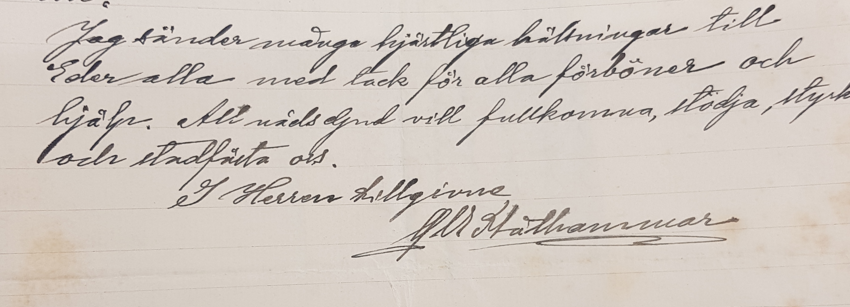
A letter from 1913
In my file with letters I found this one, dated the 23rd of May 1913. In it, Gustaf Adolf Stålhammar mentions a box he collected for my great grandfather Robert Bergling. Perhaps I will find more references to Gustaf Adolf in Robert’s letters as my research continues.

 Thérèse Amnéus
Well, that indeed is a special encounter with a fellow ancestrial reseacher of the mission in China, Thérèse. One would think this is such a niche it would be rather impossible to find someone else doing it. But no, and even a person being just as interested in the female point of view as you are. I read your interview with great interest. I can imagine that when you are going to compile your findings into a proper book (if you are not doing that already) Karin could be of some help with tips and tricks, if neccesary. But having had a conversation like this is mega cool in itself!
LikeLiked by 1 person
Hi Peter! Thank you for the cheer! Yes, it was wonderful to realise we had so much in common apart from the actual writing about our ancestors. When researching this history as a woman it is quite amazing what the female missionaries accomplished, and it is great that Karin and I share that fascination!
I have noticed that the interest in missionary history is growing, not least in China, where there is a great interest in understanding a history that has been lost there to a large extent, but that is as important as ever to understand how some communities developed, how poverty and analfabetism was fought and so on. But it is important to collect as many stories as possible now, from those that are still around to remember.m them. And to dig in the personal archives and make them available to others is a great task, and one that Karin executed beautifully in my opinion.
Thank you for reading the whole interview – quite a long post, this time 😅
LikeLiked by 1 person
Terrific post, Thérèse. I was struck by the fact that both you and Karin grew up without much knowledge of the missionary work of your ancestors. On the surface that seems odd. And yet, each generation of a family chooses to build a new life, and in doing so may prefer not to look back at the choices and accomplishments of previous generations. As a great-granddaughter and granddaughter of missionaries, you and Karin are far enough from them to examine their lives objectively, yet close enough to feel a connection, which makes your research more meaningful.
LikeLiked by 1 person
Thank you Brad! You put it so well! I suppose, for the next generation these old destinies won’t feel as interesting – and the family connection will be too distant perhaps. Though I must say I am quite interested in finding out more about my great great grandparents as well – I think it’s fascinating to imagine life back then, and I’m curious about their thoughts and endeavours. But that far back there is only so much one can find out. That will be a difference for our coming generations – with allt the personal data collected, the amount of information might even be insurmountable 😄
LikeLiked by 1 person
I can imagine you don’t want to read every bit of information in the magazines, Thérèse, but the adds and the pictures are a treasures in their own right. It must have been quite something to have put on one of the (rather expensive!) records and hear a bit crackling I can imagine Chinese vocabulary. And the organ! I had one of those for a brief time. Over here they are called Harmonium. I was rather good in getting the thing going by the pedals, but alas, I couldn’t play even one tune. 🙂 But the sight and the sound must have been astonishing for the Chinese who came to listen. And then then photographs, they are really something else. I wish I could time travel and have a peek around there in those times. The pics provide a glimpse. Wonderful.
LikeLiked by 1 person
I love the ads too! The Chinese Recorder differs from the Swedish missionary paper Sinims Land in that way – Sinims Land didn’t run any ads – they must have relied solely on donations for everything – from missionary upkeep to issuing the publication, perhaps not an easy feat either 🙂 How fun that you had an organ! I know, they are hard to play. I also had one I inherited from my father – he used to love to play it when I was young. Though, he never played religious music, only contemporary or rock 🙂 He was not the least bit religious in spite of, or perhaps because of his upbringing, but the organ was a beloved piece of musical furniture in my childhood home.
Just noting also that our small exchange here should probably best be read in connection to this article: https://thereseamneus.wordpress.com/2026/02/27/discoveries-from-the-book-gift-part-ii-recording-missionary-life/ (For those who wonder :)) Thanks so much for commenting, Peter!!
LikeLiked by 1 person