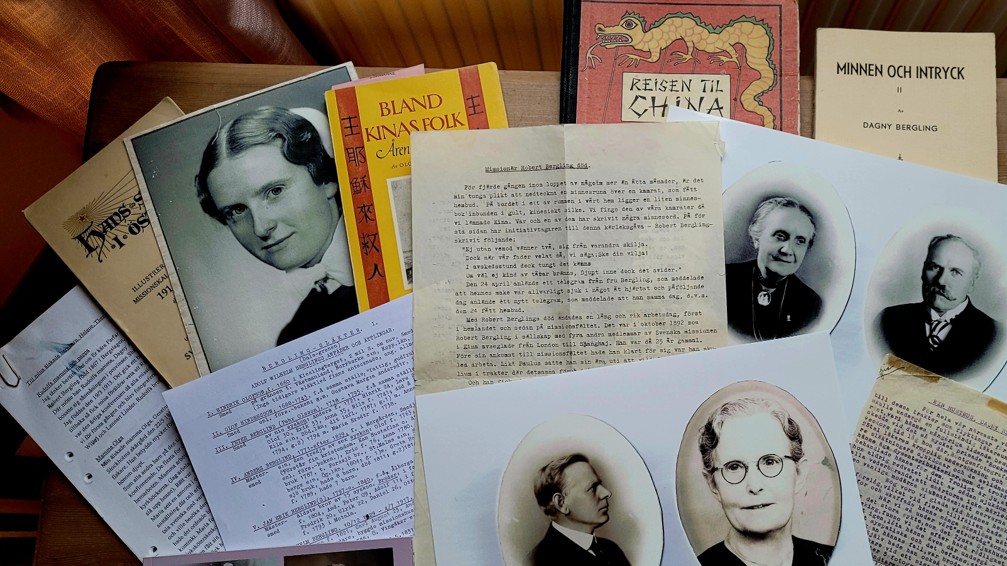
In May, I was invited to speak about my research into my family history in China by the Evangelical East Asia Mission (EÖM) the organization that used to be called the Swedish Mission in China, which is the very mission my ancestors were part of.
Today, the mission organization consists of many people who have a personal connection to the missionaries who worked in China during the late 1800s and early 1900s. They might be children or grandchildren of missionaries, or people who worked alongside them. What they all share is a deep passion for the mission’s work, which still continues today, though in a different form.
That is why it was especially meaningful for me to attend their annual meeting and talk about how I have gone about tracing my family history, the discoveries I have made, and especially the support I have received from other mission researchers both in Sweden and in China.
My lecture was essentially a reflection on how my research has developed over time and led to a series of articles, all rooted in childhood memories of my grandmother Edna telling me bedtime stories about her upbringing in China. Those early stories, combined with materials I’ve found through archival research and online sources, have formed the foundation of the articles now available on this blog – a collection that continues to grow as I uncover new information and make further discoveries. It has been an organic process, with information emerging from different time periods of the missionaries’ work in China, and even from the time before they left Sweden. Most of my great-grandfathers didn’t come from wealthy backgrounds, but rather from hardworking blacksmith or farming families (though Dagny’s Norwegian family was somewhat better off).
Looking at their lives now, I’d say that the mission was not only a calling of faith, but also a way to rise above their circumstances. It offered a chance to make a social leap and build a life that might not otherwise have been possible – even if that was probably not something they consciously considered as they set off to work in China, a country that at the time was marked by real hardship.
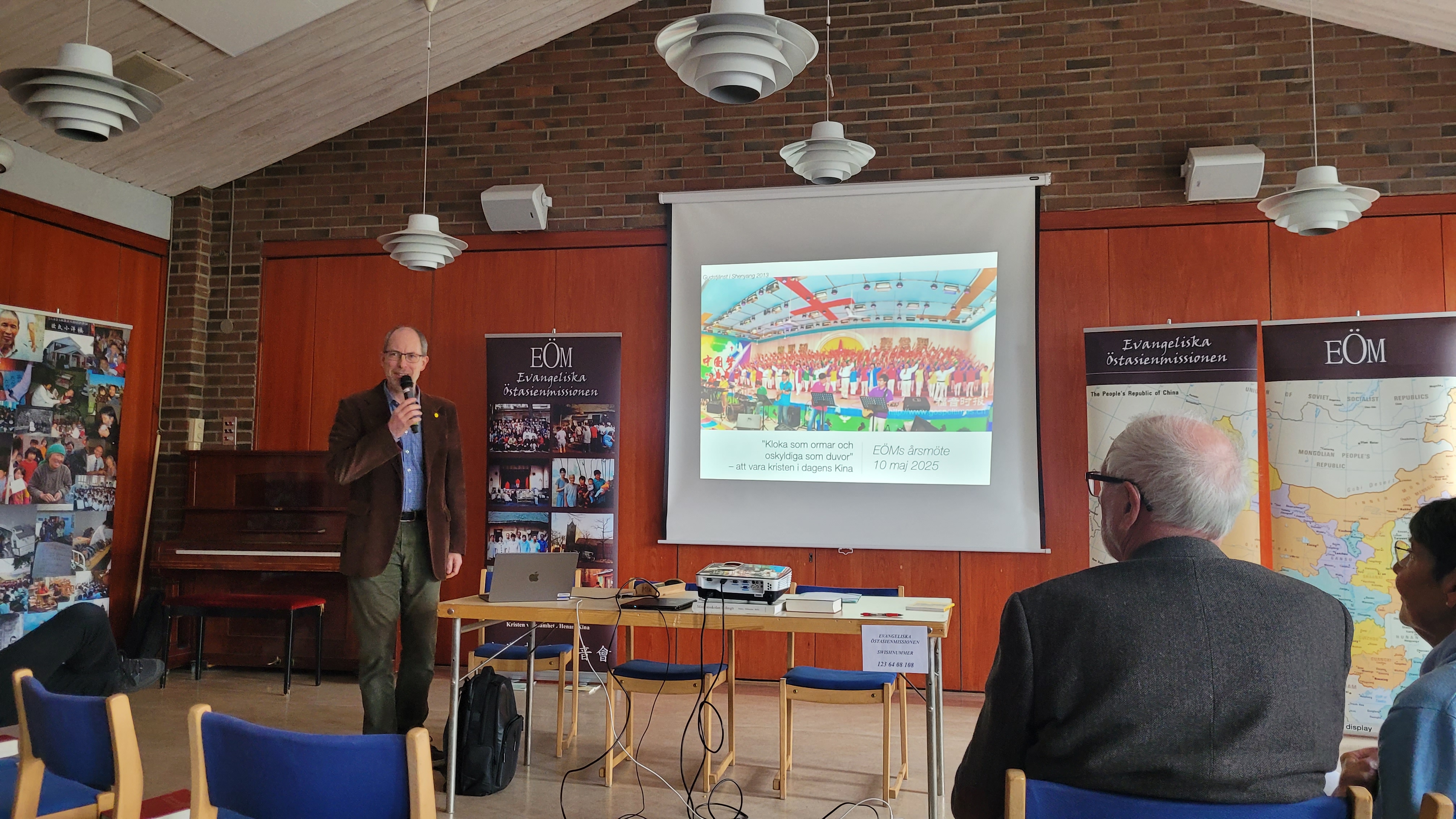
Fredrik Fällman from Gothenburg University during his lecture about Christianity in China.
Christianity in China today One interesting part of the annual meeting was Associate Professor in Sinology, Fredrik Fällman’s talk about what it’s like to be a Christian in China today. It was interesting to find out that while churches are technically allowed to exist, no one who isn’t a registered member is allowed to enter the church building. Outside the churches, you often see signs with various government directives encouraging people to read Xi Jinping’s decrees. Only inside the church fences is it permitted to display Bible verses or anything faith-related.
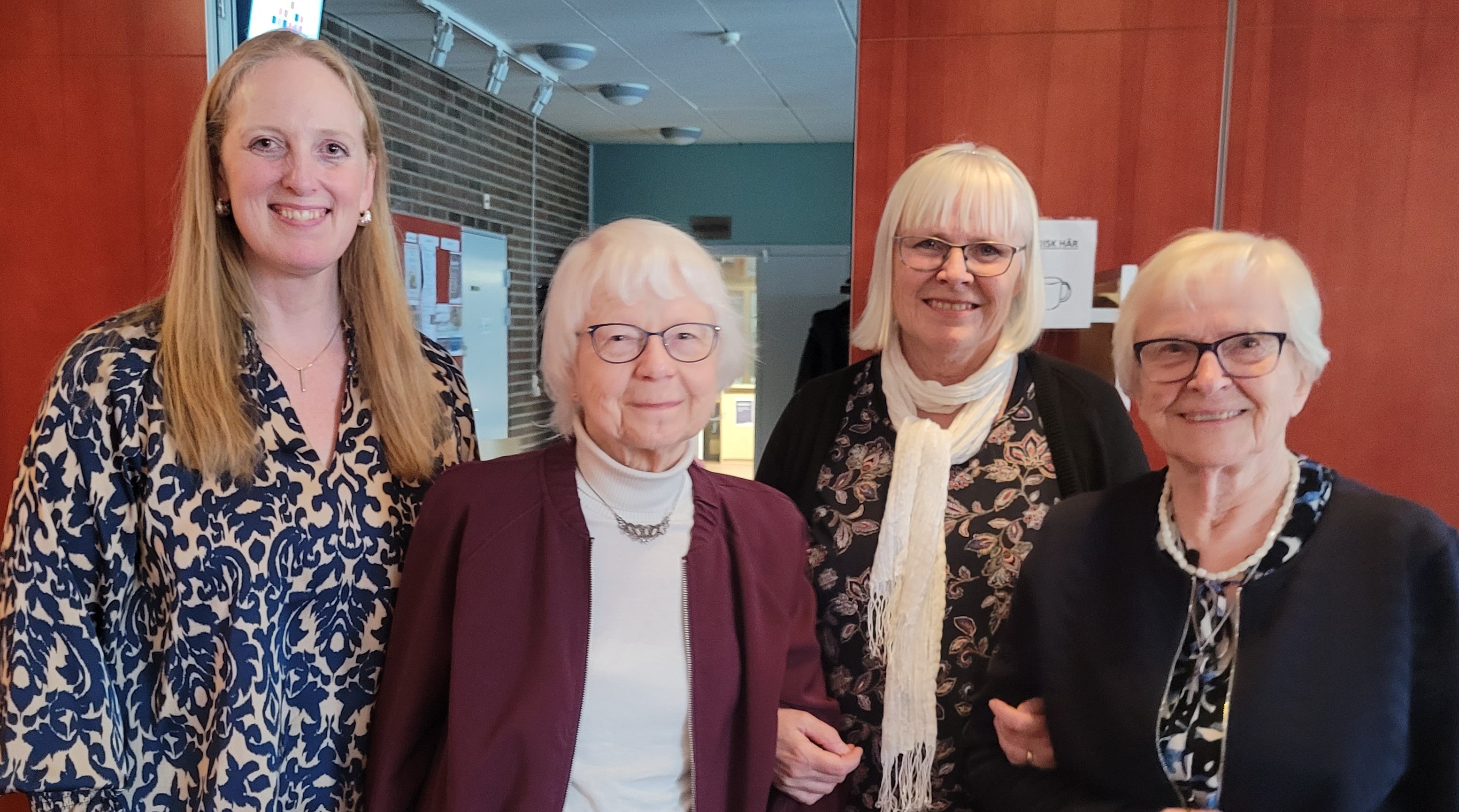
Stories about my relatives Another highlight for me was getting to meet members of the mission who actually knew my relatives in China when they were children. Especially lovely was meeting Gunvor and Anne-Marie, who were both born in China and who shared memories about Nils and Dagny, respectively.
Me, Elsie, Lisa (Gunvor’s daughter), and Gunvor at the EÖM annual meeting.
Gunvor, born in 1933, remembered sitting on my great-grandfather Nils’s lap as a child and described him as a very kind and cheerful man. Her impression of Olga, on the other hand, was that she came across as a bit more stern. I found that really interesting to hear!
Anne-Marie, born in 1939, shared a story about Dagny during a time of famine in China: Somehow, Dagny had gotten hold of a sack of flour. From this sack, she handed out flour to the local Chinese so they could bake bread – probably mixed with tree bark, which was common during times of scarcity. The famine was severe, and Dagny worried that the flour wouldn’t last long. But she made a decision not to look inside the sack to see how much was left. She just kept scooping out flour, day after day. According to Anne-Marie, the flour lasted for as long as it was needed – a kind of miracle, and a story that has since been passed down.
I haven’t personally found this story in any of Dagny’s writings, so I can’t verify it, but it was still a moving moment for me to meet someone who knew Dagny and could share a personal memory about her.
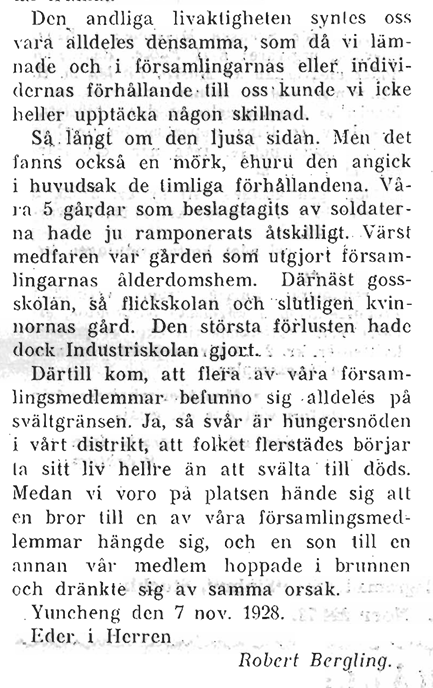
Looking through Sinim’s Land, I found this text by Robert about the famine in China that tells about another side of this catastrophe (1928-1930), that took an estimated 6 million lives:
“Our five mission compounds, which had been seized by soldiers, were all quite badly damaged. The worst off was the home for the elderly members of the congregation. After that came the boys’ school, then the girls’ school, and finally the women’s quarters. But the biggest loss was suffered by the Industrial School. On top of that, several members of our congregation were right on the brink of starvation. On top of that, several members of our congregation were right on the brink of starvation. Yes, the famine in our district is so severe that people in many places are starting to take their own lives rather than starve to death. While we were there, one of our church member’s brothers hanged himself, and the son of another member threw himself into a well and drowned — both for the same reason. Yuncheng, November 7, 1928 Yours in the Lord, Robert Bergling“
I’m truly grateful to EÖM for inviting me to speak at their annual meeting. The experience also gave me new inspiration for upcoming articles, that I hope to share on this blog in the future.
Congratulations on your well-deserved speaking engagement, Therese, and it was very interesting to read more of your family history — including that amazing sack-of-flour story!
That must have been a wonderful experience Thérèse. Meeting like minded people and being able to tell about your ongoing project. I can imagine it not only was interesting for your audience, but also for yourself, to write so to say a short history of your project. I think just that would make a very readable book in itself. The making of. Also having talked to people who remember your relatives from personal experience is great of course. The story of the inexhaustible sack of flower is remarkable. I need to read more about the position of religions in China. I was in Xian, where the decendants of muslim people live, still very visible in their facial features, and I understood their position isn’t all that easy. Reading about your quest I find very enjoyable and I hope to to read more of it in the future.
It was a great experience – such nice people and so much interest in missionary history – of course 😊. You are right – having to put together a lecture about my process finding out about my relatives made me collect my thoughts around it – that was quite nice and will be useful going forward.
Xian is a city where my relatives spent time as well – not least because there was a hospital there! I can imagine it is not easy for muslims anywhere in China at the moment – religion is very sensitive. I can imagine you took lots of photos – it would be vwry interesting to see (have you posted any on your blog?). 🙏
Dear Peter!
The photographs you have taken from China are truly marvellous! I love the mix between new and old, culture and scenery. The photographs with the old houses, where you see the modern city in the background are really striking, as well as the details you have captured. I will return to these links as I go along – they very much help my understanding of what it looked like in China back in the early 1900’s as well. Thank you for collecting the links for me here!
You are welcome Thérèse! I’m happy you enjoyed the pictures. China is a very interesting country with a lot to see and discover. The big cities are, well, big and mostly modern, but more inland there certainly are traces left of what was.
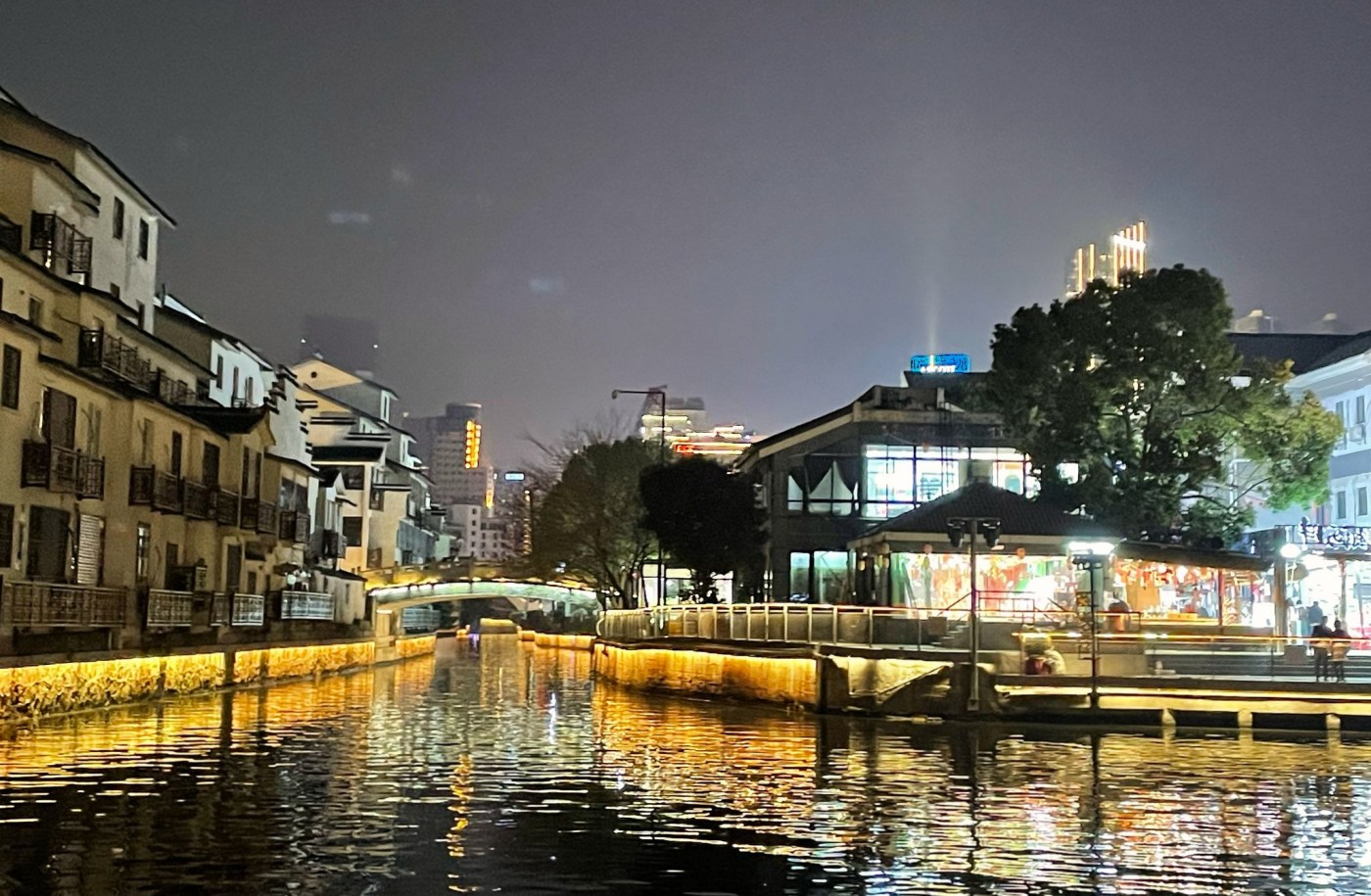
Yes, I thought it was very interesting to visit Wuxi outside of Shanghai this spring. Though a smaller city in China (7,5 million inhabitants!), it was modern, lots of highrises and heavily trafficked highways. Not much of the old China left at all. I would certainly love to travel further out into the country side.
Historically, When China was suffering from great famines, Sweden also experienced severe famines. At that time, many Swedes immigrated to the United States. There was a period when the population of the Swedes immigrating to the US was even larger than the population remaining in Sweden. However, even under such circumstances, the Swedish people were still very generous in donating money to China helping the Chinese people who were Thousands of miles away.and had no kinship with them. From 1880 seven to 1937 within these 50 years. Swedish Mission in China donated a total of 6 million Swedish Kronor to the Chinese people, thus assisting the Chinese people in their time of hardship. Many American and British missionaries did the same to the Chinese people. What a great kindness. What a glorious display of human nature, and what a remarkable grace of God it is!. This is something we Chinese must never forget.
Thank you Hong, for writing and adding this information! I know that a lot of Swedes emigrated to the US to find a better life from the mid 1800s to around 1914. In 1910 there were approx. 1,4 million Swedish immigrants and Swedish-American second generation immigrants in the US. In Sweden, the population at the time was 5,5 million. So, many of us have relatives in America still 😉 . And my great grandfather Nils was one of those emigrants, even though he later continued on to live in China instead. I did not know that the Swedish Mission donated so much money – that is a great feat, as the mission was possible solely through voluntary donations. Thank you so much for commenting, Hong!
 Thérèse Amnéus
Congratulations on your well-deserved speaking engagement, Therese, and it was very interesting to read more of your family history — including that amazing sack-of-flour story!
LikeLiked by 2 people
Thank you Dave! Yes, I enjoyed the sack-of-flour story very much as well!
LikeLiked by 1 person
I loved the sack-of-flour story, too.
LikeLiked by 2 people
Haha! Yes, that is a great story, I am so happy I got to hear it!
LikeLiked by 2 people
That must have been a wonderful experience Thérèse. Meeting like minded people and being able to tell about your ongoing project. I can imagine it not only was interesting for your audience, but also for yourself, to write so to say a short history of your project. I think just that would make a very readable book in itself. The making of. Also having talked to people who remember your relatives from personal experience is great of course. The story of the inexhaustible sack of flower is remarkable. I need to read more about the position of religions in China. I was in Xian, where the decendants of muslim people live, still very visible in their facial features, and I understood their position isn’t all that easy. Reading about your quest I find very enjoyable and I hope to to read more of it in the future.
LikeLiked by 1 person
It was a great experience – such nice people and so much interest in missionary history – of course 😊. You are right – having to put together a lecture about my process finding out about my relatives made me collect my thoughts around it – that was quite nice and will be useful going forward.
Xian is a city where my relatives spent time as well – not least because there was a hospital there! I can imagine it is not easy for muslims anywhere in China at the moment – religion is very sensitive. I can imagine you took lots of photos – it would be vwry interesting to see (have you posted any on your blog?). 🙏
LikeLike
Actually, I do have some pictures on my blog. Here are the links: https://petergreyphotography.wordpress.com/2018/10/24/beijing-1/ , https://petergreyphotography.wordpress.com/2018/11/11/beijing-2/ , https://petergreyphotography.wordpress.com/2018/12/02/china-heading-south/ , https://petergreyphotography.wordpress.com/2018/12/23/china-further-on-the-move/ , https://petergreyphotography.wordpress.com/2019/01/26/shanghai/ , https://petergreyphotography.wordpress.com/2019/02/17/hong-kong/ , https://petergreyphotography.wordpress.com/2019/03/11/hong-kong-2/
I really did take advantage of the trip, I now see, number of pictures wise. 🙂
LikeLiked by 1 person
Wow, so many wonderful photos! I will have to look closely at all your links! Thank you!! This will make my weekend 😊
LikeLiked by 1 person
You are welcome Thérèse!
LikeLiked by 1 person
Dear Peter!
The photographs you have taken from China are truly marvellous! I love the mix between new and old, culture and scenery. The photographs with the old houses, where you see the modern city in the background are really striking, as well as the details you have captured. I will return to these links as I go along – they very much help my understanding of what it looked like in China back in the early 1900’s as well. Thank you for collecting the links for me here!
LikeLiked by 1 person
You are welcome Thérèse! I’m happy you enjoyed the pictures. China is a very interesting country with a lot to see and discover. The big cities are, well, big and mostly modern, but more inland there certainly are traces left of what was.
LikeLiked by 1 person
Yes, I thought it was very interesting to visit Wuxi outside of Shanghai this spring. Though a smaller city in China (7,5 million inhabitants!), it was modern, lots of highrises and heavily trafficked highways. Not much of the old China left at all. I would certainly love to travel further out into the country side.
LikeLiked by 1 person
Congratulations, Therese! I’m so glad your visit was successful.
LikeLiked by 2 people
Thank you Liz! It was a lot of fun!
LikeLiked by 2 people
You’re welcome, Therese!
LikeLiked by 1 person
That is so absolutely cool and exciting!
LikeLiked by 1 person
Thank you, Debra! It was very nice to be given the opportunity to share some of my experiences from the last years of research! 😊
LikeLiked by 1 person
Thank you Thérèse for your wonderful blog!
Historically, When China was suffering from great famines, Sweden also experienced severe famines. At that time, many Swedes immigrated to the United States. There was a period when the population of the Swedes immigrating to the US was even larger than the population remaining in Sweden. However, even under such circumstances, the Swedish people were still very generous in donating money to China helping the Chinese people who were Thousands of miles away.and had no kinship with them. From 1880 seven to 1937 within these 50 years. Swedish Mission in China donated a total of 6 million Swedish Kronor to the Chinese people, thus assisting the Chinese people in their time of hardship. Many American and British missionaries did the same to the Chinese people. What a great kindness. What a glorious display of human nature, and what a remarkable grace of God it is!. This is something we Chinese must never forget.
LikeLiked by 1 person
Thank you Hong, for writing and adding this information! I know that a lot of Swedes emigrated to the US to find a better life from the mid 1800s to around 1914. In 1910 there were approx. 1,4 million Swedish immigrants and Swedish-American second generation immigrants in the US. In Sweden, the population at the time was 5,5 million. So, many of us have relatives in America still 😉 . And my great grandfather Nils was one of those emigrants, even though he later continued on to live in China instead. I did not know that the Swedish Mission donated so much money – that is a great feat, as the mission was possible solely through voluntary donations. Thank you so much for commenting, Hong!
LikeLike