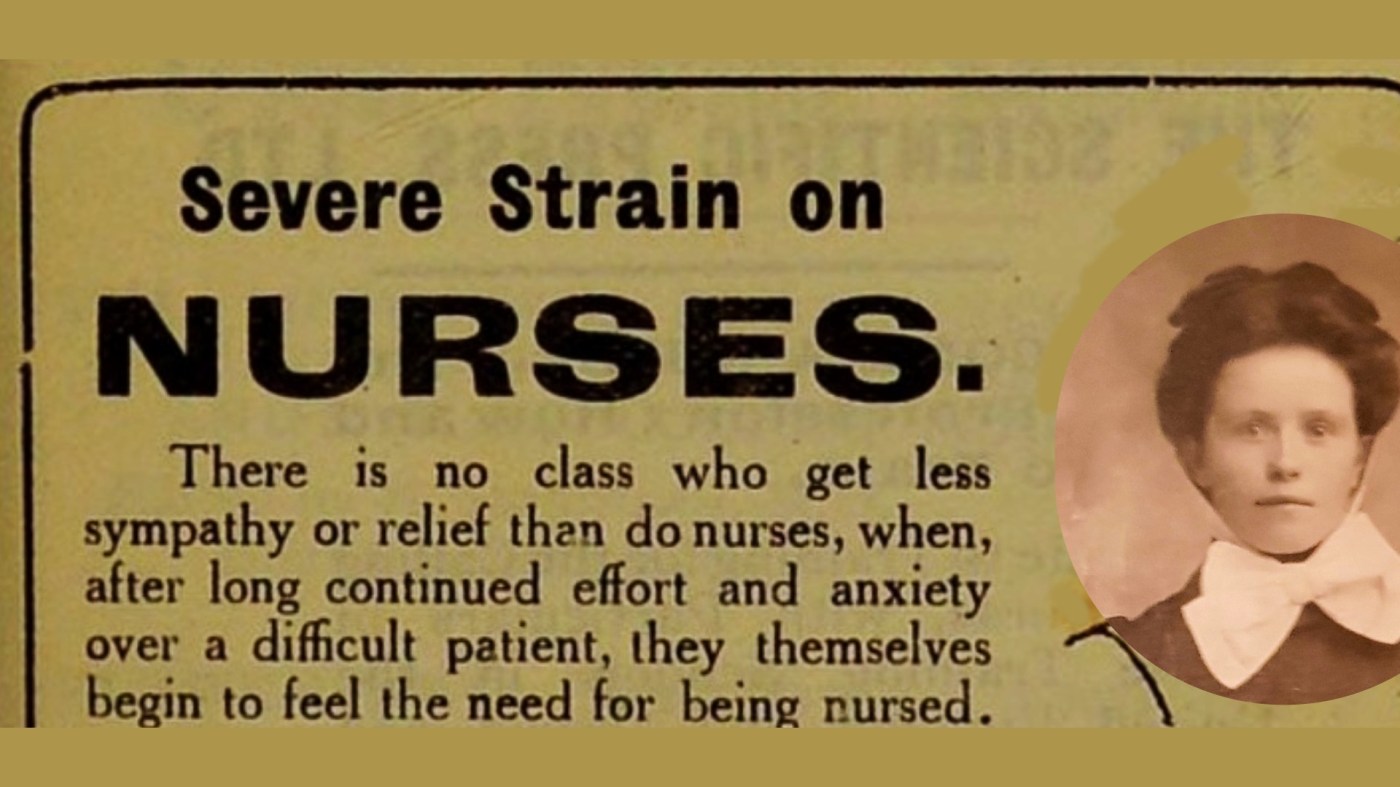
When my great-grandmother Olga started to train as a nurse in Glasgow in 1901, she combined practical work with formal classes at Govan Parochial Hospital. During “three years, three months and four days” she worked her way through her training and, apparently, quickly showed that she had a natural aptitude for nursing as she advanced in rank at the hospital. Though, seeing how she described her time at Govan Parochial Hospital down to the day, I feel it can be safe to say that she was also happy to leave, when she finally could to go back to Sweden and apply to become a missionary.
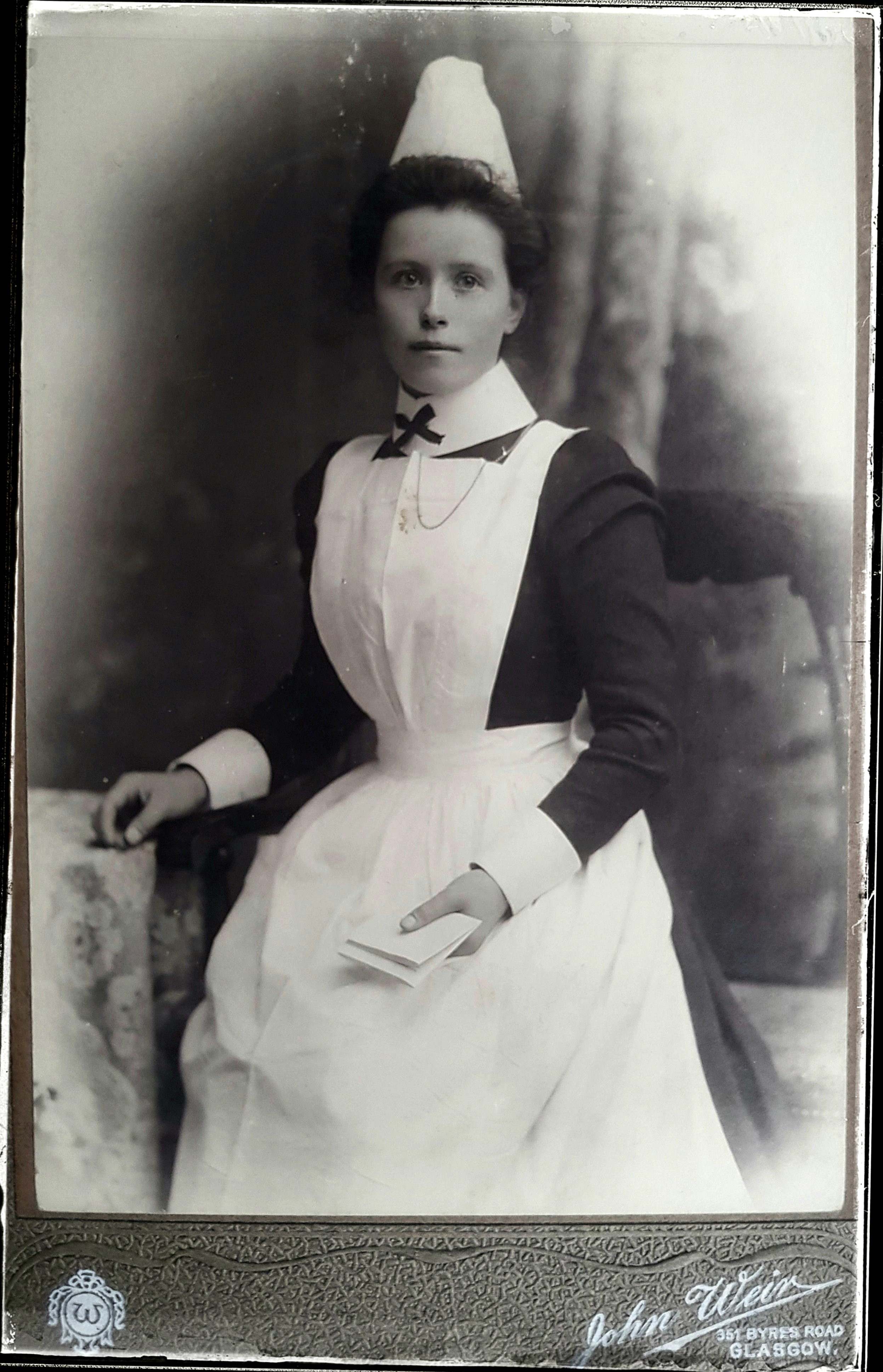
By the end of her training, she had become charge nurse of the children’s ward and was also responsible for a male surgical ward.
Those of you who have followed my posts here for some time, might remember that I went to Glasgow in 2024 and revisited some of the places, Olga must have frequented during her time there (read about it here).
I was very happy to find that part of the Govan Parochial Hospital still existed and was in use. This makes it so much easier for me to imagine Olga studying and working there as a nurse.
I think that it must have been quite difficult to learn nursing in English, having very little prior knowledge of the language. The English she knew was only from her stay at the cookery school in Glasgow, when she first arrived. She was not there for too long – about half a year – before it got unbearable for her and she found this possibility to learn more useful skills in order to become a missionary.
Charge nurse and children‘s ward during extreme infant mortality
As a charge nurse for a children’s ward in Glasgow during these years, she must have had to deal with many sad cases. As I was curious as to what she may have encountered I started researching the subject and – as always – came about such interesting information.

Apparantely, these years were some of the worst years in Scotland regarding infant mortality. In 1904, between 130 and 150 children died for every 1,000 live births in some parts of Scotland. In Glasgow, the figures varied enormously from district to district. In the worst-affected areas, as many as 217 infants died for every 1,000 live births. That is very sad – imagine more than one in five babies dying before their first birthday in some parts of the city… And many of these must have been brought to the hospital for the poor – Govan Parochial Hospital – where Olga worked. It’s difficult to imagine something more heartbreaking.
The reasons for the high infant mortality were many. Families often lived in overcrowded and unsanitary apartments or houses, where disease could spread easily. Poverty meant that mothers and children might not receive adequate nutrition and therefore the mothers could not breastfeed. Fresh food and milk were not always available and for poor people they would probably also have been too expensive.
A blessing or a curse?
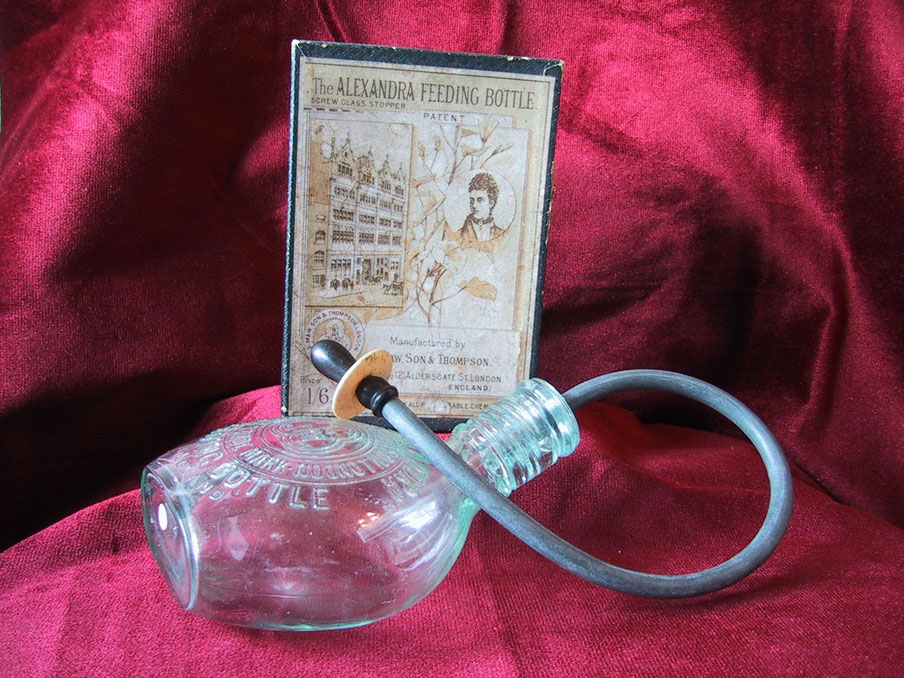
But one aspect in this research particularly surprised me – the feeding bottles. At the time, long-tube feeding bottles were widely used. They consisted of a glass bottle connected to a long rubber tube, with a teat at the end. They made it possible for mothers to leave their infants unattended during feeding, a way for the mothers to be able to work and get on with family chores.
Later, people started to call them “killer bottles”. They were not wrong. Lots of bacteria grew inside the rubber tubes, that were very hard to clean. The bottles became a source of contamination and contributed to serious gastrointestinal infections, of which many infants died.
Of course, people were not aware of this at the time, but the high mortality rates were counfounding and when researchers compared children who were breastfead with children who were not, they saw a pattern. It was also appartent that women, who were better off, could either breastfeed their children or have a wet nurse do it if they did not want to themselves. At the time it was not very fashionable to breastfeed.
Poor people did not even have the luxury of choice, as the women had to work as soon as possible after giving birth. For these women, a convenient solution was to get this kind of bottle. There were children to care for, meals to prepare, washing to do and a household to keep going under very difficult conditions. A bottle that allowed a baby to feed without the mother having to sit still and hold it throughout the entire feeding must have seemed very practical.The baby was still and was getting fed, while the mother could do her work, sometimes even outside of the home. Poor women often had an enormous amount of work to do.
More images of baby bottles used at the time can be found here: Un biberon à long tuyau (ou biberon à tube)
Unfortunately, the consequences could be devastating, and some of the children brought to the hospital were already beyond saving. It also seems to have been a recurring reality in nursing. As I looked through my great-grandmother’s nursing textbook by the author Honnor Morten, I found several advertisements addressing the problem in different ways.
Bringing mortality down
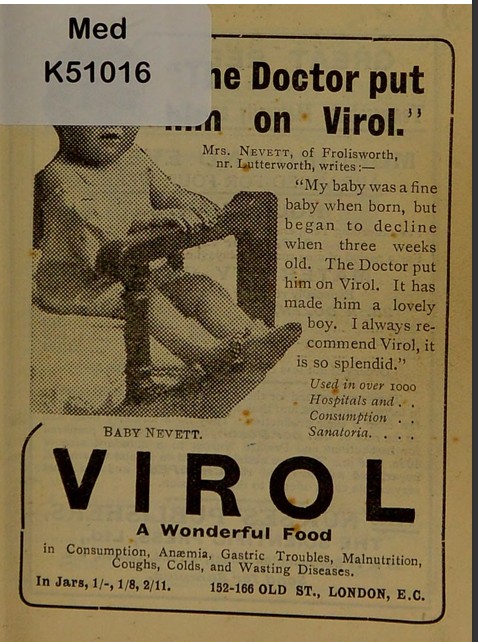
In an attempt to reduce infant mortality, Glasgow Corporation began introducing measures aimed at improving infant nutrition and hygiene. In 1903, the Health Committee decided to establish milk depots in the poorer parts of the city. The first Glasgow Corporation infant milk depot opened in 1904. This milk depot offered sterilized milk from cows (modified to make it more suitable for babies) for free or for a small charge. The ad below shows that some companies had understood the great need for infant formula.
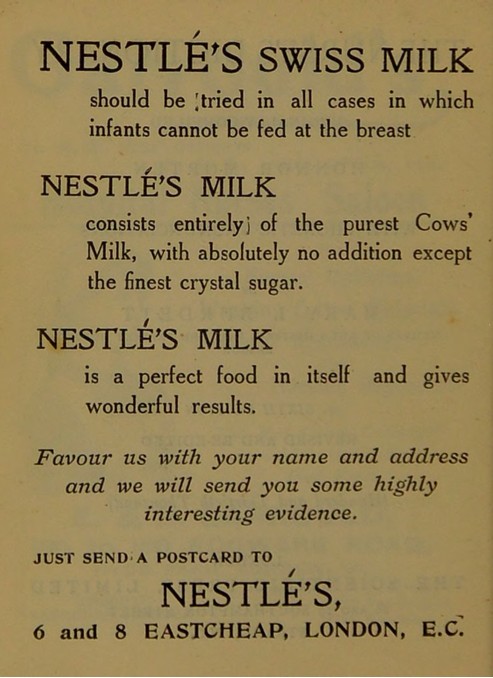
When I think of Olga on the children’s ward at Govan Parochial Hospital, I can only imagine how tiresome it must have been and I understand that she counted the days. At the same time, she must have learned a lot about hygiene, poverty and nutrition, that would be important to her in her work as a missionary in China. There, she would encounter proper famines and people living in despair that could not be compared to that in Glasgow, for sure.
The more I learn about Glasgow during these first years of the 20th Century, the more I realise what an extraordinary place Govan Parochial Hospital must have been for a young woman to begin her nursing career. Olga was working at a time when doctors, nurses and public-health officials were only beginning to understand how housing, poverty, nutrition, hygiene and infant feeding were all connected. She was there at a time when something as simple as a feeding bottle could mean the difference between nourishment and infection. And as a a young nurse, she was responsible for a childrens’ ward, caring for some of the most vulnerable children in Glasgow.
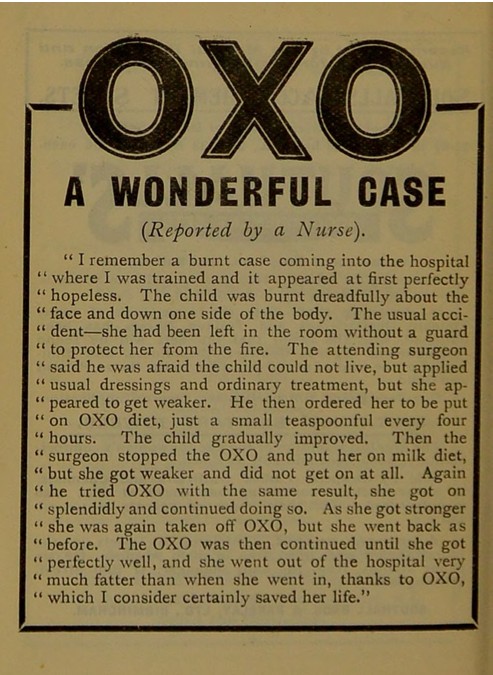
How to relax during stressful times
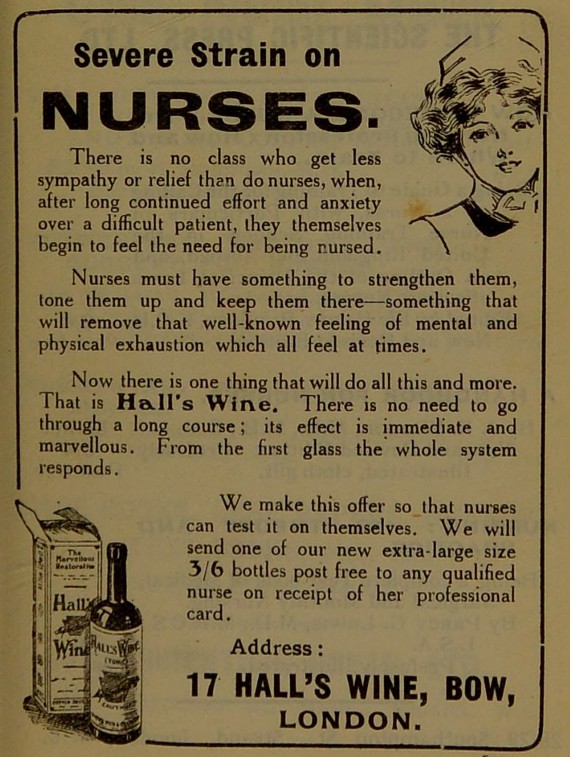
And lastly there was this very telling ad from the same nursing book:
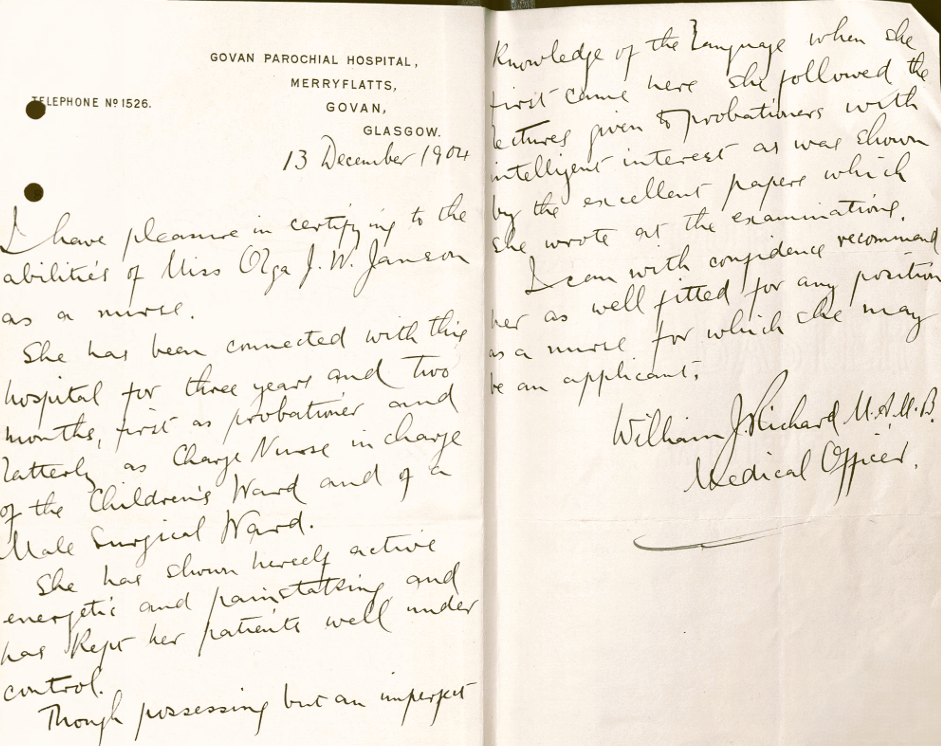
Olga got this letter of recommendation by the medical officer William Richard (if read correctly?), when she left the hospital. It says she was first on probation and then became a charge nurse in charge of the children’s ward and a male surgical ward. In the letter he writes that she was active and energetic and though possessing but an imperfect knowledge of the language when she first came, she followed the lectures and showed her intelligence through an excellent paper, that she wrote. (I wish I could get hold of that paper, that would be so interesting to read!)
Collage at the top: an advertisement for nurses, with Olga’s photograph placed over the previously sketched nurse.
Continue the story:
Before this: Retracing Olga’s Steps in Scotland – Thérèse Amnéus (follow Olga’s journey through Glasgow and discover how she prepared for her future as a missionary).
The People:
The Hero Behind the Scenes – Thérèse Amnéus (meet Li-Niang, the Chinese woman who helped care for Olga and Nils’s children and became an important part of their family’s life in China).
The Place:
What’s In A Place? – Thérèse Amnéus (discover the Chinese mission stations where Olga put her medical training to use, caring for women, children and other patients).
The Source:
Sinims Land – the Voice of the Mission – Thérèse Amnéus (explore the missionary journal that helps bring Olga’s world and the work of the Swedish Mission in China to life).
The Family:
Shui-yu In Focus – Thérèse Amnéus (discover photographs and memories from Olga and Nils’s family life in China, including the world in which their daughters grew up).
Next:
Travelling Home Through Warlord China – Thérèse Amnéus (follow Olga and Nils as they travel through a China torn by conflict in 1927, years after Olga began her journey towards missionary work in Glasgow).


This is such an interesting insight in health care in Scotland (and I suppose in England as well) at the beginning of the 20th century. Interesting and heartbreaking at the same time. Infant death was the main course of low life expectancy. And still is. If one survives its early childhood there is good change one is going to reach a healthy old age. Medical and sanitary knowlegde has increased dramatically in the past century and is still evolving. Olga must have had, as you write, a great learning school in Glasgow, not only in nursing but also in coping with misery and death. You did a great job searching Olga’s footsteps Thérèse!
LikeLiked by 1 person
Thank you for your kind words, and for reading, Peter! It is sad that there are so many countries still experiencing high infant mortality today, even though there is so much knowledge to prevent it. I am a bit curious as to how Olga handled her own children, when they were born in China. I think I remember reading somewhere that they employed Chinese wet nurses, but I am not sure – one would think she would have breastfead her children having experienced this period in Scotland. This will be another area for me to look into 🙂
LikeLiked by 1 person
What a remarkable young woman Olga was to learn nursing barely knowing the language and to be so good at it! I found the information about how the medical profession was trying to address the high infant mortality rate in the cities fascinating, albeit sobering.
LikeLiked by 2 people
Dear Liz, thank you for reading and I am happy you found it interesting! Olga keeps impressing me, the more I learn about her. She is a good example of a woman not letting circumstances hold her back, finding ways to realize her goals and having the patience to keep at it over time. There is certainly a lot to read and take in about the medical profession – and it is amazing how far we have come over such a short period of time – sometimes one fails to recognize the incredible advancements that have been made these last 100+ years.
LikeLiked by 1 person
You’re welcome, Therese! You are so right about the medical advancements. I can remember when AIDS was a sure death sentence, and now it can be controlled with antivirals so someone can lead a relatively normal life.
LikeLiked by 1 person
Yes, that is fantastic! And so much has been done to cure cancer and other tough conditions as well. I also hope the new generation of drugs against Alzheimers will prove effective – such a horrible disease.
LikeLiked by 1 person
I share you hope about a cure for Alzheimers. It’s such a cruel disease.
LikeLiked by 1 person
It is, I know a few who contracted it and the toll it takes on both them and their families 😔
LikeLiked by 1 person
What an interesting post, and once again I am so impressed by Olga and her fortitude and determination.
LikeLiked by 1 person
Thank you, Louise! So am I 😉
LikeLiked by 1 person
Wow, vad intressant. Verkligen ett imponerande arbete som beskrivs. Tänk att var så hängiven.
LikeLiked by 1 person
Ja, hon gav verkligen inte upp i första taget 😉 Men hon hade ju en mycket stark drivkraft i sin religion. Jag tänker också att det ju på ett sätt var hennes biljett bort från fattigdomen och trälandet som piga – och hon verkade ju ha läshuvud… tur för henne 😊
LikeLiked by 1 person
That was so fascinating! I’m glad Olga made it through the training and got a good recommendation too. In searching Michigan desth certificates in Ancestry, (looking for the elusive Frank) I am amazed at how many infant deaths there were in those times. A lot of them seemed to be from GI issues, and I had read about those feeding bottles before, but I never put two and two together until I read your post. That could have been the cause of a lot of those deaths! It’s so sad what they had to go through for lack of knowledge about things we take for granted today.
LikeLiked by 1 person
Thank you, Debra! Interesting that you also noticed the infant deaths – so sad that such a major part of those could have been avoided. It seems for a long time they treated the symptoms rather than the cause – which is sadly most often the case before really finding out what it is all about. I can only marvel at those dedicated researchers who found out why the infants were dying. Science is truly a life saver!
LikeLiked by 1 person