I have written about the political unrest in China before, and how my great-grandparents often encountered different warlords, bandits and military forces during their time in China. In 1927, the situation was very serious, especially for foreigners. Olga and Nils thus decided to listen to the advice from the mission and start the journey back to Sweden. But first, they had to risk their lives, travelling through several Chinese provinces to reach the coast and the ship that would take them back to Sweden.
The conflict was not new. In 1926, the family of four (Olga, Nils and their two daughters, Edna – my grandmother – and Linnéa) had already changed their summer holiday plans due to armed conflict in northern China, when Nationalist forces and regional warlords clashed. Read about it here: Stranded In School Over Summer – Thérèse Amnéus. They had just returned home from spending the summer with their children at the Swedish School on the mountain of Kikungshan, when their Chinese colleagues at the mission station urged them to leave the area again.
This turned out to be the beginning of the end of their stay in China this time as all missionaries were called back to their home countries to avoid being killed. The Swedish School on Kikungshan now closed permanently and the staff brought the children with them to Shanghai so that they could meet with their parents and leave the country.
Goodbye China In the mission paper Sinims Land, I found an article by Nils and Olga recounting their journey from the mission station in Tungkwan to Nanking, and then to Shanghai, where they planned to meet their daughters.
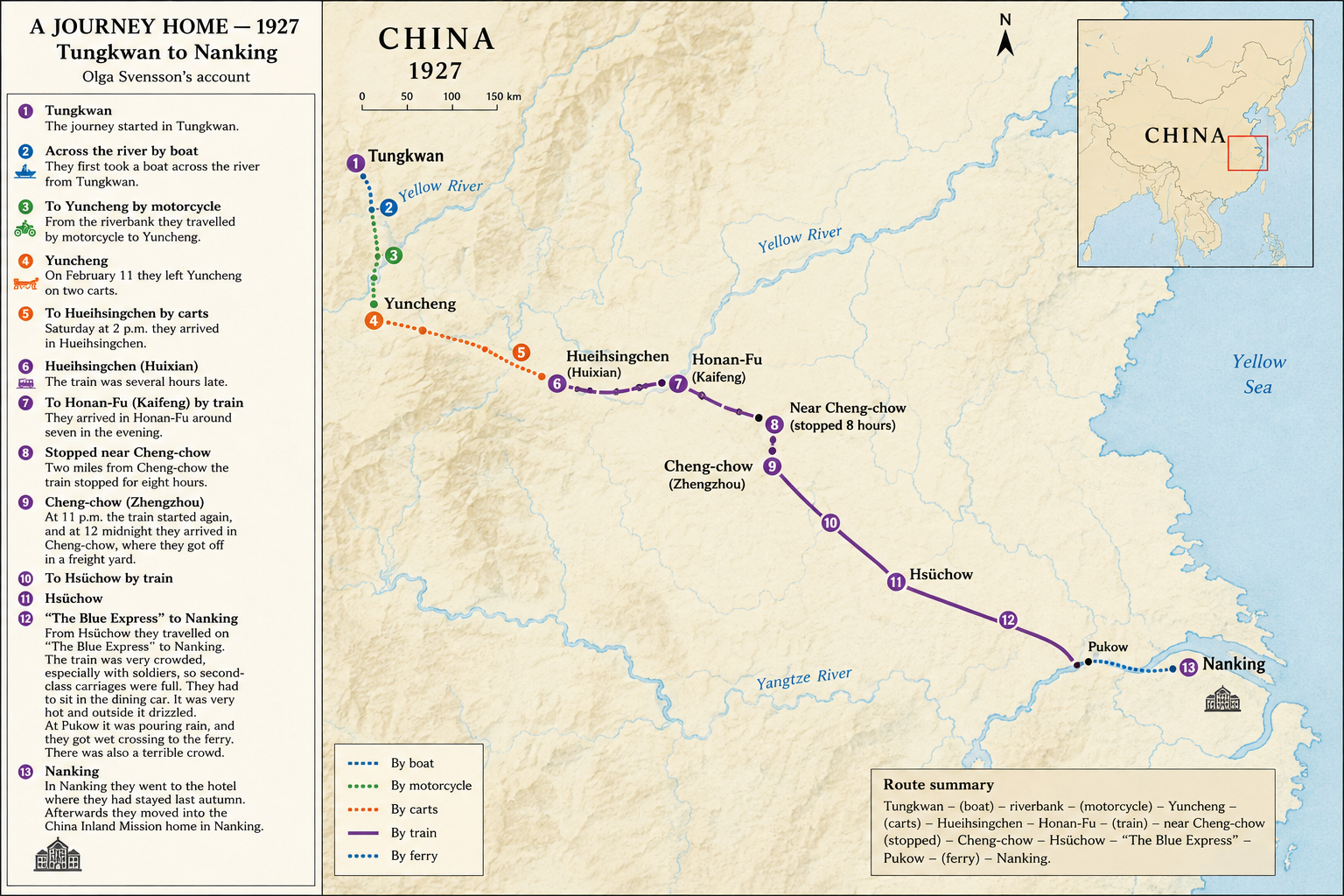
I wanted to track Nils and Olga’s journey through China, going by their own description. Thus, I asked AI to make a map showing the places they mention and how the trip was laid out. This makes it easier to follow their account below. I think it was Olga who wrote the article for the mission paper, so I will treat it as her text, but I am sure Nils was involved, as it is not her writing style all the way.
A map of Nils’ and Olga’s journey through China in 1927, AI.
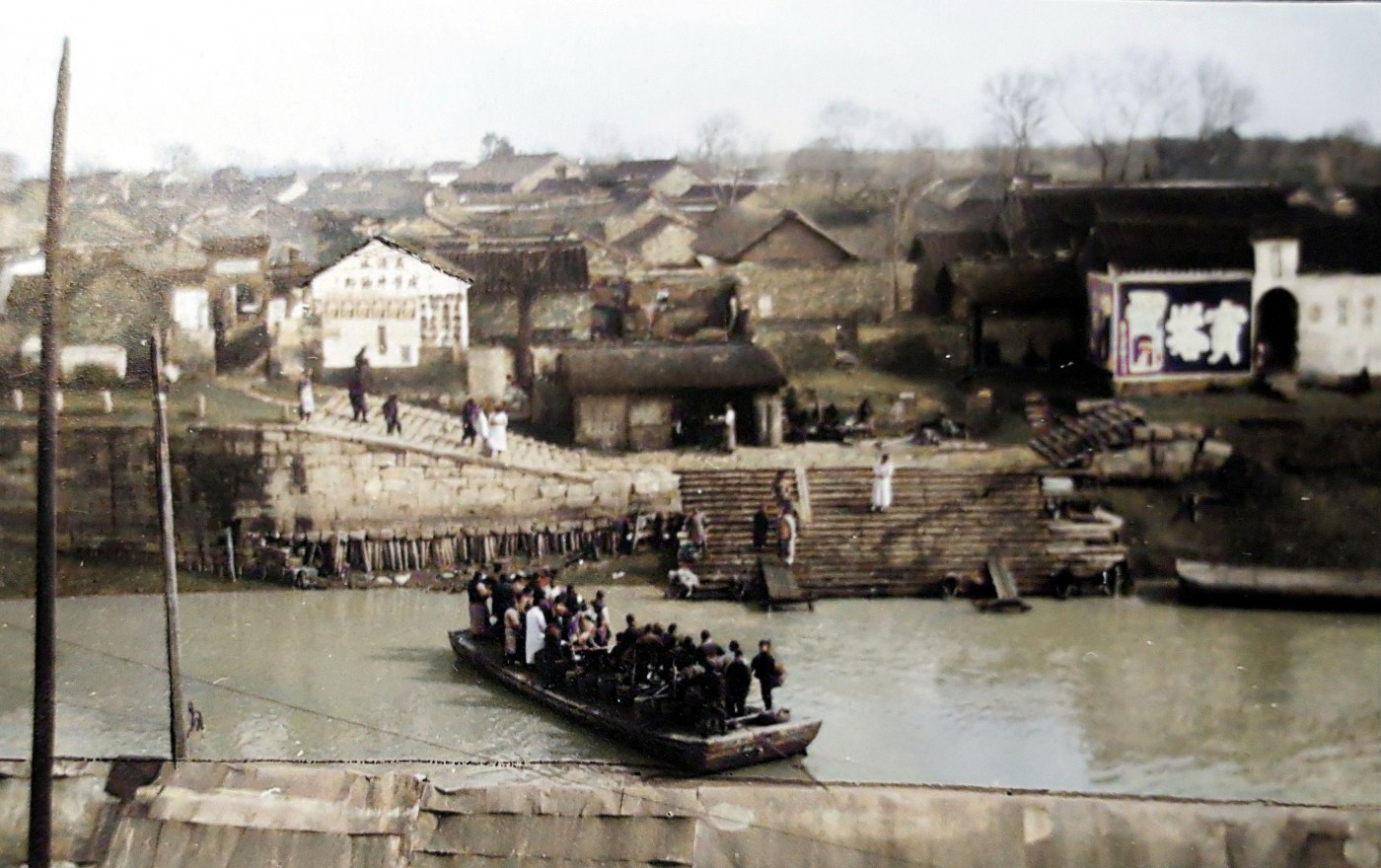
The article in Sinims Land is called “Farewell to China” and starts with Nils and Olga saying goodbye to their dear Chinese brothers and sisters in Tungkwan. When their boat pulled out from the shore, their friends stood on the banks, singing Christian songs.
Olga writes about their departure: “It was touching to see the love and affection the Chinese friends showed us in many different ways. Before leaving, we were invited to several farewell dinners – five days in a row. We also had to decline many invitations as we did not have enough time. Our departure date had to be set earlier because of the unrest. We decided to benefit from travelling during the first days of the Chinese New Year, as one could hope for more of a standstill in the war, seeing that they wanted it to be a little festive around New Year’s in China, even if there was fighting going on. Now we are on the ninth day of the new year. We hope to leave from here to Yuncheng tomorrow.
I am so sad that I did not have film in my camera, so I could not take a photograph of our dear friends; the sisters and the brothers, where they stood in a long row on the bank, waving goodbye. The morning was so clear and still, and the snow glowed beautifully on the heights and the city wall. For a long, long time, the elder Yang and several others stood on the shore, waving to us, yes, all the time until we reached the other bank and they could no longer see our boat. We saw them slowly return towards the city. Tears of goodbye had been shed these days, by us and the ones we left. It is wondrous how one grows attached to these people, especially those who are our brothers and sisters in faith.”
The last days in Tungkwan In her text, Olga recounts her thoughts about the last days at the mission station: “Our last days in Tungkwan were a bit tense. The magistrate and one of the general’s advisors came a week before we left and took over our living quarters for General Feng Yu-Hsiang, who was expected to arrive in Tungkwan. We had to be ready to move out of our rooms — even our bedroom — since the general would supposedly arrive the very next day. They did promise, though, to let us know for certain once Feng left Sianfu, so we wouldn’t have to move out too soon. We were right in the middle of packing at the time, and secretly hoped he’d hold off for a few more days — though we were also curious to see him in person, given all the different rumors about him. As it turned out, he never arrived while we were still there, so the other missionaries would have to meet him instead. Over the station’s main entrance was written: General Feng Yu-Hsiang’s Traveling Residence.”
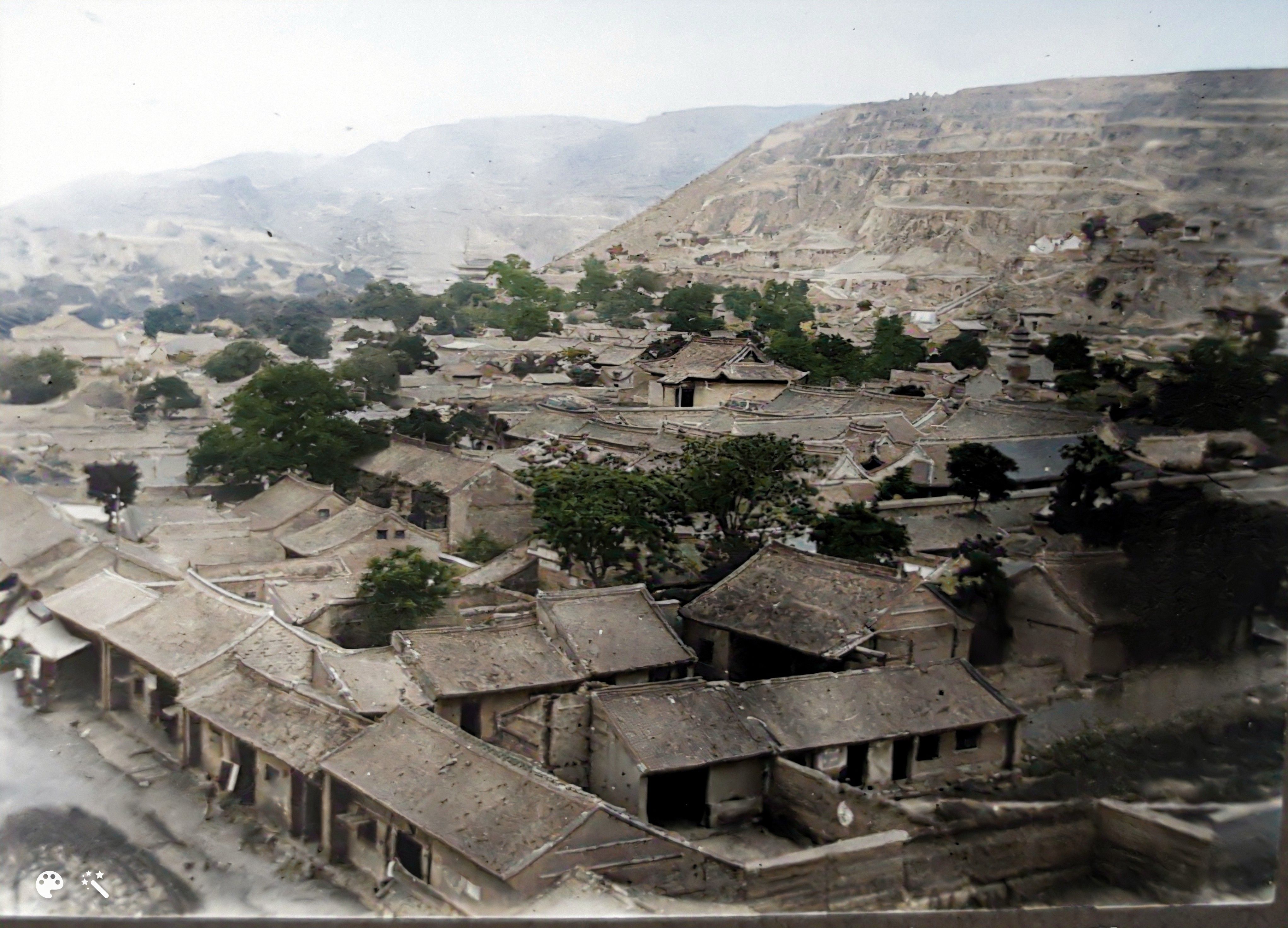
The village of Tungkwan, where Nils and Olga worked at the mission station. (Colorized).
I looked up General “Feng Yu-Hsiang”, and it was interesting to read that he was nicknamed the Christian general, as he had converted to Christianity in 1914. He was based in Shaanxi, where my great-grandparents worked, so they would have heard a lot about him through the years. Read about him here: Feng Yuxiang – Wikipedia.
Travelling by all means Having crossed the water, Olga and Nils had to go by motorcycle from the riverbank to Yuncheng. The roads were in bad shape, but they managed, even though they had to push the bike in front of them along some stretches of the road. At least they did not have to manage their luggage as well – instead, it followed behind.
On February 11, they left Yuncheng, this time on two carts. The weather was good and everything went well, even though the slopes were difficult due to the previous heavy snowfall. The day after, they arrived in Hueihsingchen, and that was the end of travelling in a Chinese cart for this period in China.
Olga writes that she received a telegram the night before, saying that the Swedish School was now in Hankow, on its way to Shanghai. That must have been reassuring for her and Nils, seeing that Edna and Linnéa were still quite young – only 14 and 11 years old.
Trains in China.People climbing on top of the wagons.
Not there yet But they still had some distance to cover to reach Nanking and, from there, Shanghai. In Hueihsingchen, they sat at the train station and froze, as it was impossible to fit inside because of all the people who wanted to get out of the region.
“But a foreign engineer eventually helped us get into a small room they used as an office. The soldiers who had prevented us from going inside could no longer stop us, as we had help from the engineer”, Olga writes.
“We left on Monday and managed to get a decent spot in a baggage car. The train ran behind schedule, though, stopping for hours at several stations. About twelve miles from Chengchow, we sat stuck on the train for eight hours. It was a calm, moonlit night, so we weren’t too cold, huddled together in a corner of the car among our belongings. Soldiers lay stretched out on the floor around us, and the car was completely dark except for the beautiful moonlight. It was interesting to overhear the soldiers discussing Wu Pei-fu — plenty of harsh words were said about him.”
Wu Pei-Fuwas another Chinese warlord and leader of the Zhili military clique. His nickname was the “Jade Marshal”, and he was known for being ruthless and strategic. During the Northern Expedition, he was challenged by the National Revolutionary Army under Chiang Kai-shek, who wanted to defeat the major warlords and bring China under a unified Nationalist government.
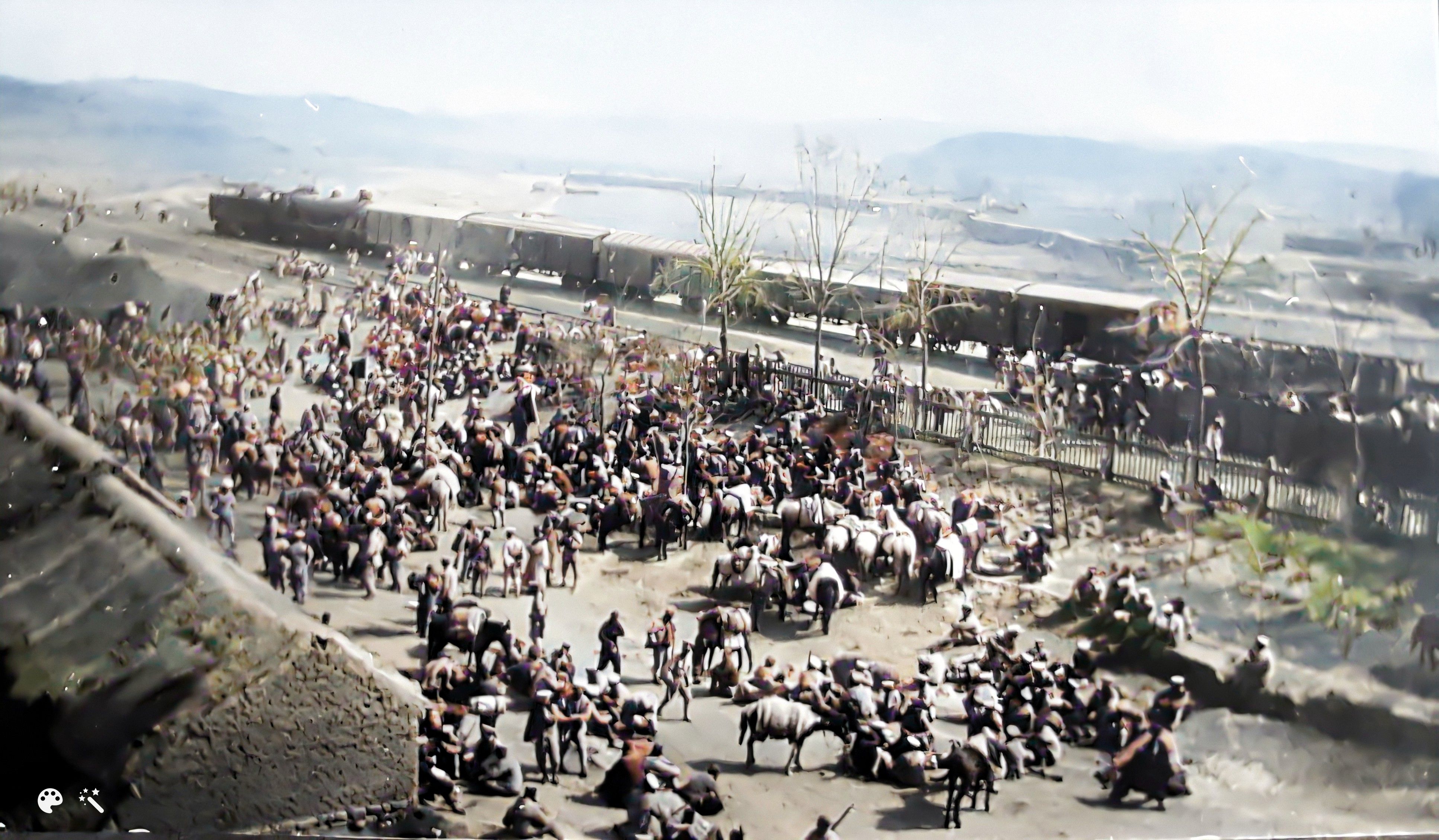
Troops getting ready to board an incoming train. (Colorized)
Missionaries, soldiers and crowded trains As there were many warlords and their alliances changed constantly, it was a very uncertain time. Armies were moving around the country, and there were many rumours of fighting going on. The people travelling by train were thus travelling through a country where military control could change from one place to another.
Olga writes: “At eleven that night the train finally started moving again, and by midnight we arrived in Chengchow, where we got off in a coal yard. The station was packed with military trains. The next morning we boarded again after a couple of hours’ sleep at an inn. We checked our luggage through to Hsuchowfu. There we ran into Lindbeck, Lindell, and Miss H. Person from Honanfu — they had been stuck in Chengchow for three days waiting for a train. We joined up with them and had a pleasant time together. In Kaifeng, Dr. and Mrs. Gibson boarded with their three children, so our group grew even bigger. Many missionaries were at the station in Kaifeng, among them Dr. and Mrs. Guinness, who were talking about staying on in Honan. Mr. Joyce also got on in Chengchow and got off in Kaifeng — he’d been out in the province trying to get missionaries to safety, since war and trouble were expected in Honan. We also passed several troop trains. In Hsuchow, an armored train manned by Russians stood ready to depart, and we saw two more between Hsuchow and Nanking.”
Reading Olga’s account, I can imagine how chilling it must have been passing all the military forces and encountering so many missionaries who were fleeing China, just like themselves. Perhaps they were wondering if they would be able to reach Shanghai and meet with their daughters.
Many of the names she mentions are new to me – they were with other missions and are not frequently mentioned in any of her other texts. But it shows that the missionary community in China was quite large and that they respected and enjoyed each others’ company, though not always sharing the exact same views on Christianity perhaps. And regardless, they were all in the same boat – or on the same train – in this situation.
The travelling conditions were certainly not the greatest, and they did not know how long they would be on the train, as it could stop at any time.
“The train was packed with travelers, and we sat crammed in for an exhausting night — thirty-six hours between Chengchow and Hsuchow. From Hsuchow we took ‘The Blue Express’ to Nanking. The train was crowded, full of soldiers among others, so all the second-class carriages were completely full. We ended up sitting in the dining car for the whole trip, which was stiflingly hot — we were sweating. Outside it was drizzling and miserable, and by the time we reached Pukow it was pouring, so we got soaked crossing over on the ferry. It was also terribly crowded there.”
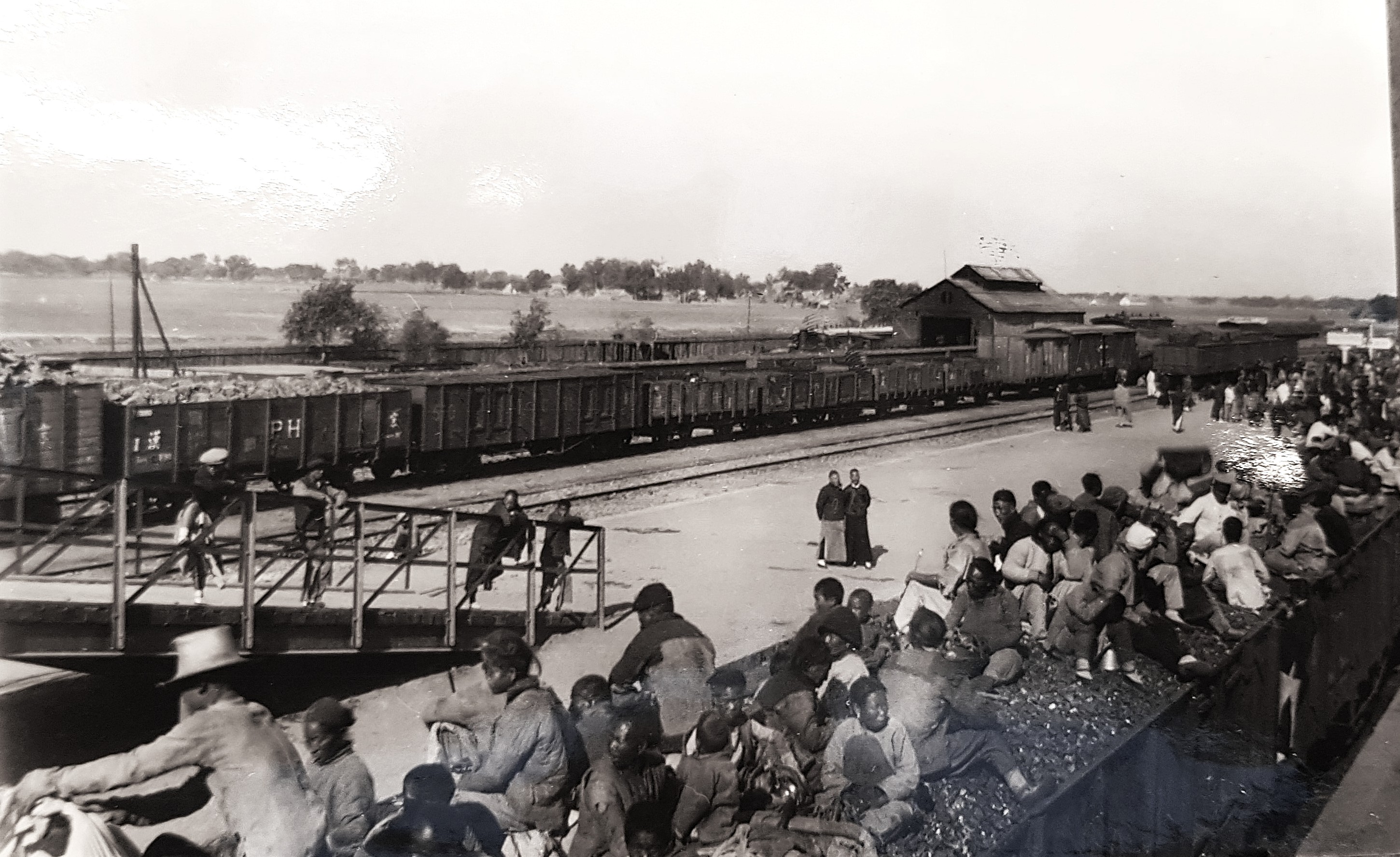
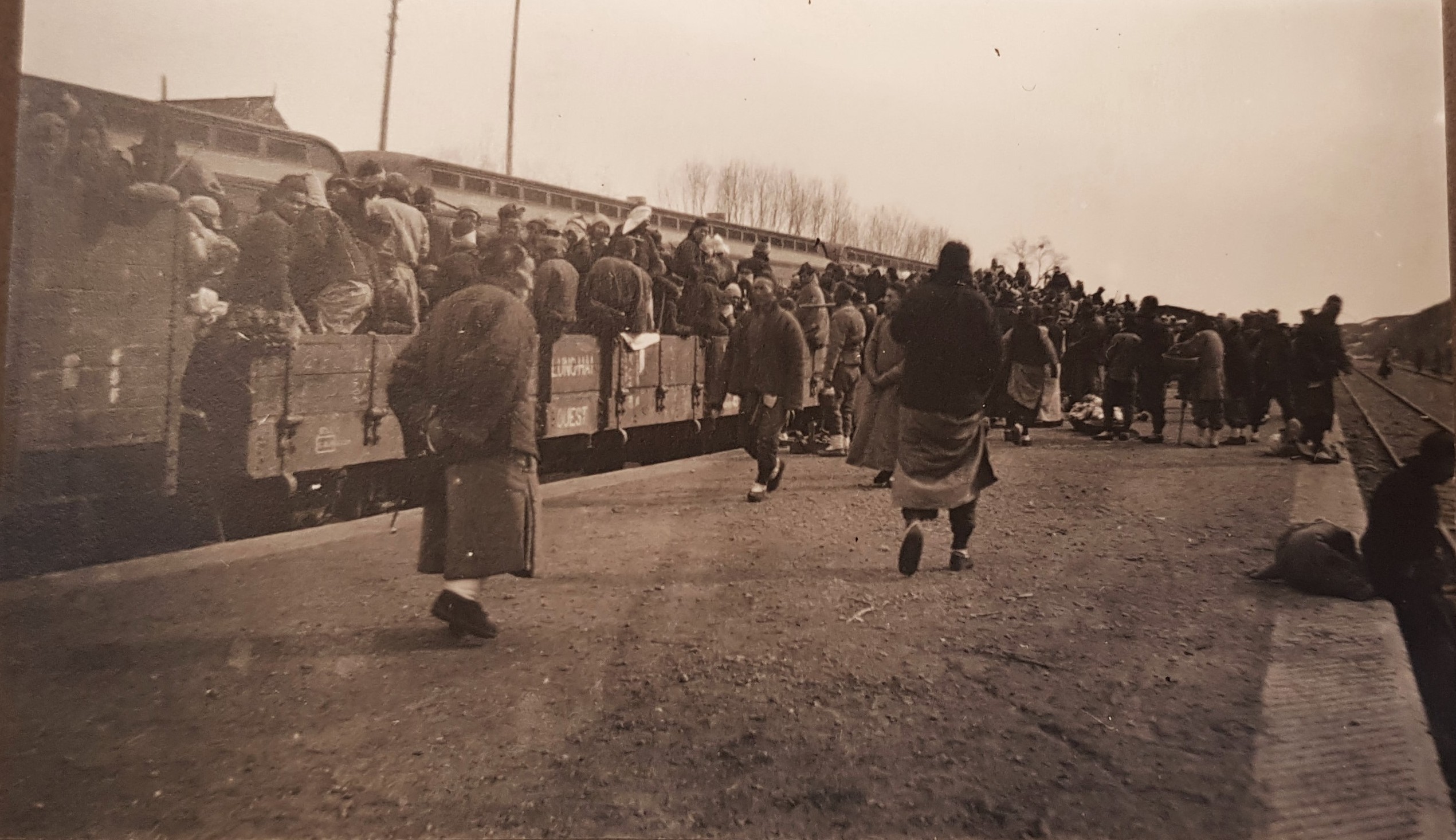
I have not managed to find a photograph of the Blue Express, but this is a photo from a Chinese railway station.
For some reason, they weren’t able to get their checked baggage across that evening. It took a long time and a lot of hassle before everything arrived the next day.
“In Nanking, we stayed at the same hotel where we had stayed the previous autumn. In Chinkiang, fifteen young women from the language school in Yangchow boarded, escorted by Mr. Olson. Mr. Glanville came along to the train to help them on board. In his eagerness and hurry to take their things and put them up on the luggage racks in the compartment, he nearly knocked the head off a military officer – a senior one, by the look of him, with a friendly, good-natured face. One of the larger suitcases slipped before Mr. G. had properly gotten it onto the rack, and it landed square on the man’s head before falling to the floor. He took it all in good humour, simply telling Mr. G.: Don’t be in such a hurry, don’t be in such a hurry!
Both Mr. G. and Mr. Olson had also managed to knock over their own glasses of tea on their respective tables, in the rush of grabbing luggage through the window.”
Olga must have been quite amused, but also a bit frightened as she watched these two men hurrying up loading the luggage, knocking down glasses and potentially provoking the military. Seeing that the situation was so tense, it is nice to read about a good-humoured military, who did not take it so seriously getting knocked over…
Finally in Shanghai “Last night we hardly slept properly, since we still didn’t have our bedding. Because we’re heading home soon, in a couple of days we’ll move over to the actual China Inland Mission home, which they try to keep as free as possible for those returning home. Right now we’re staying in one of the rented houses, with Mr. and Mrs. Tull running the household. Our boat leaves on the 13th, and we’re very glad about that.
February 25th. We’re now staying at the big mission home, and it’s completely full here. The Engbäck family arrived on Monday, and we’re relieved they made it here safely. Vivan* isn’t feeling quite well. Our helpers Paulus Li and Chang from Honanfu left for home on February 23rd – we hope they get home safely too.
Warm regards from N. and O. Svensson”
Sketch by AI, a bit weird, but possible to follow 🙂
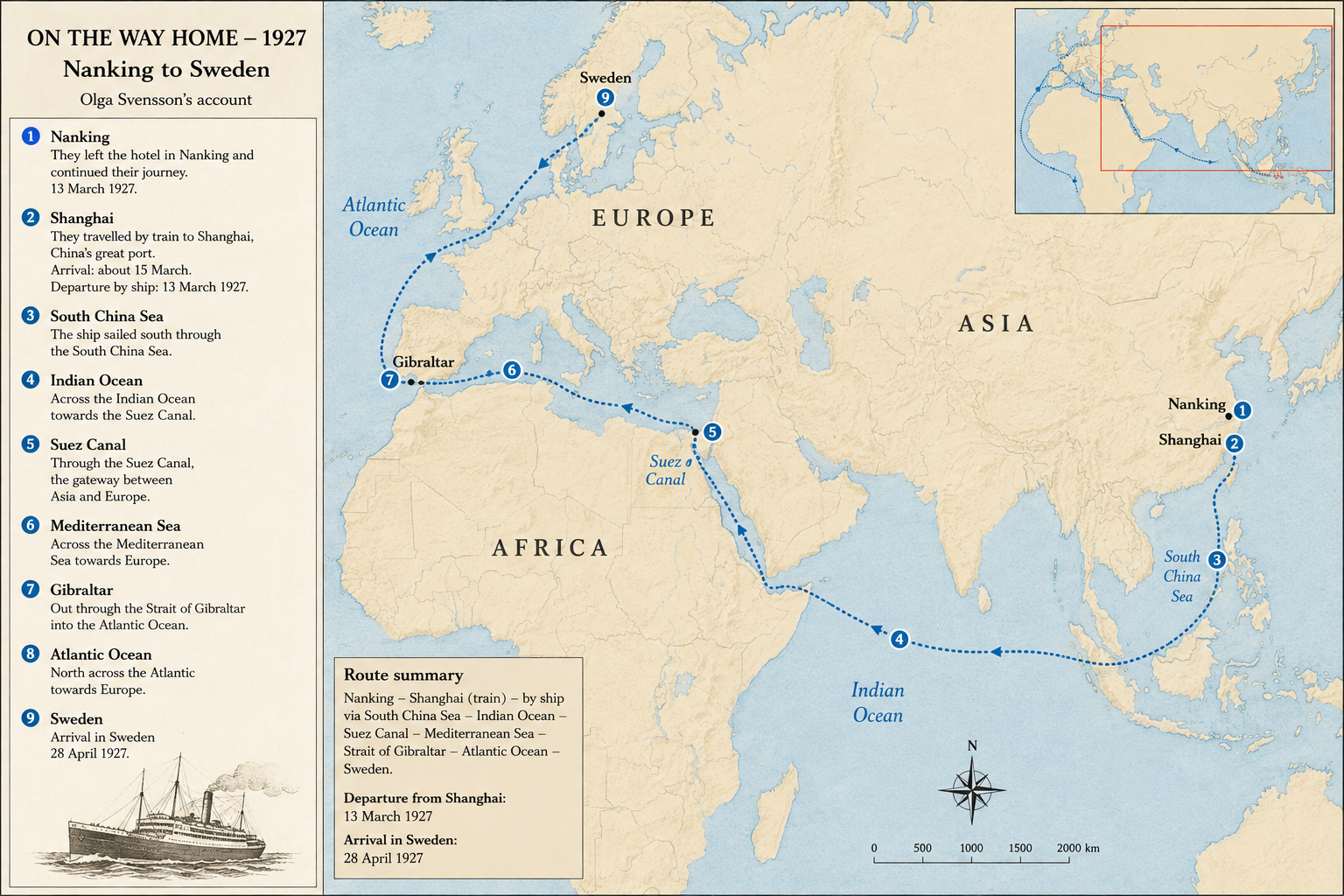
An interesting fact is that Olga, Nils, Edna and Linnéa left Shanghai only nine days before the city fell to Nationalist forces on 22 March 1927, and Nanking was occupied shortly afterwards. They got out just in time. Sinims Land happily reports that they then arrived in Sweden on 28 April 1927, safe and sound. I know they went via the Suez canal and also asked AI to sketch out that possible route.
Nils and Olga feared that this might be their last time in China, and that they would never again be able to return to their beloved friends and mission stations. But that fear did not become reality. Just two years later, Nils and Olga returned. For Edna and Linnéa, however, it was indeed the last time they would see China, as they were to remain in Sweden to attend school. Neither of them would go on to become missionaries as adults.
That’s amazing you have the resources to trace your great-grandparents’ route out of China. The trip sounds absolutely harrowing. Just the thought of so many people fleeing a region in fear.
Wat a trip that must have been. I can imagine the angst, the fear, the uncertainty. It wa snot the ordinary people they had to fear but the warlords, wich is a far to martial adn noble word for gangs on the loose. It’s touching how is described the Chinese people of the mission waving them goodbye. And brave the were to head back only 2 years later. The mission must haven been in their blood. Great post Thérèse!
I agree – warlords sounds like something from a fairytale or the Lord of the Rings…
I think they really formed close bonds with the Chinese in the small villages and towns where they lived. They got to know and understand each other, and became a family of sorts.
You are spot on about the mission in their blood! It seems it was even more important to them, than their children. Somehow, I think they did not even consider having a choice – they followed their calling, and made the necessary sacrifices.
Thank you so much for commenting, Peter!
So fascinating! I got behind in my blog reading so I just now sat down to read this. I can’t imagine how scary that must have been. There was a Miss Ebba Person (although not H. Person) in the missionary photo album my grandma had, and it said she was in Honanfu, Honan. I discovered that she had come back to the US in 1927. Could they have come in contact with Swedish missionaries from other countries on their way out of China? 🤔
It could well be that they came in contact, met along the way or travelled on the same trains/boats. My understanding is that foreigners who met in China certainly greeted each other and exchanged information, no matter what mission they belonged to, and all the more so if they were the same nationality of course – the chance they would have friends in common back home was of course also a possibility. Many Swedes who had emigrated to America and later come to China would be interested in connecting with the Swedish missionaries to China as well. My great grandfather Nils was such a ”double emigrant”…
It is, indeed! And just the fact that our stories are now connected, with your Swedish ancestry, is in itself quite amazing 🙂 It’s a great thing that the past generations keep on giving. I love that thought and hope that it will be the case for my future relatives as well – that I somehow contributed to their understanding of where they came from :).


That’s amazing you have the resources to trace your great-grandparents’ route out of China. The trip sounds absolutely harrowing. Just the thought of so many people fleeing a region in fear.
LikeLiked by 1 person
I agree, it must have been been extremely stressful..i can only imagine how they must have felt…
LikeLiked by 1 person
Wat a trip that must have been. I can imagine the angst, the fear, the uncertainty. It wa snot the ordinary people they had to fear but the warlords, wich is a far to martial adn noble word for gangs on the loose. It’s touching how is described the Chinese people of the mission waving them goodbye. And brave the were to head back only 2 years later. The mission must haven been in their blood. Great post Thérèse!
LikeLiked by 1 person
I agree – warlords sounds like something from a fairytale or the Lord of the Rings…
I think they really formed close bonds with the Chinese in the small villages and towns where they lived. They got to know and understand each other, and became a family of sorts.
You are spot on about the mission in their blood! It seems it was even more important to them, than their children. Somehow, I think they did not even consider having a choice – they followed their calling, and made the necessary sacrifices.
Thank you so much for commenting, Peter!
LikeLiked by 1 person
So fascinating! I got behind in my blog reading so I just now sat down to read this. I can’t imagine how scary that must have been. There was a Miss Ebba Person (although not H. Person) in the missionary photo album my grandma had, and it said she was in Honanfu, Honan. I discovered that she had come back to the US in 1927. Could they have come in contact with Swedish missionaries from other countries on their way out of China? 🤔
LikeLiked by 1 person
It could well be that they came in contact, met along the way or travelled on the same trains/boats. My understanding is that foreigners who met in China certainly greeted each other and exchanged information, no matter what mission they belonged to, and all the more so if they were the same nationality of course – the chance they would have friends in common back home was of course also a possibility. Many Swedes who had emigrated to America and later come to China would be interested in connecting with the Swedish missionaries to China as well. My great grandfather Nils was such a ”double emigrant”…
LikeLiked by 1 person
It’s fun to think about how people’s stories can intersect like that and that we can figure it out a century later! 😀
LikeLiked by 1 person
It is, indeed! And just the fact that our stories are now connected, with your Swedish ancestry, is in itself quite amazing 🙂 It’s a great thing that the past generations keep on giving. I love that thought and hope that it will be the case for my future relatives as well – that I somehow contributed to their understanding of where they came from :).
LikeLiked by 1 person
Yes!! I agree! 😀
LikeLiked by 1 person